
Rhinebeck: The Village That Plans Together
By Anne Pyburn Craig | Photos by David McIntyre | Summer 2025 | Community Spotlight
After a three-year process that included 15 public meetings and involved about 1,000 people, the Village of Rhinebeck passed a new comprehensive plan in September of 2024, replacing one that had been developed in 1993. In April of this year, the village learned they’d been awarded the distinction of Best Comprehensive Plan by the New York Planning Federation at its annual meeting. The awards committee cited “an outstanding commitment to smart growth, sustainability, and civic engagement” and an “exemplary” level of community engagement, leading to “the foundation for a sustainable and prosperous future.”
Now the real work begins. “We’re working on the implementation,” says Village Trustee Lydia Slaby, “and revising our zoning, so there will be a lot more conversation to come. One of the things we identified was that we lack a solid mix of housing options. We have nothing in-between starter apartments and large single-family homes; we have lots of older folks alone in large single-family homes that aren’t ideal for their needs, but they don’t have anywhere to move within the community and don’t want to leave. So with the comp plan and zoning, we’re looking to allow and support people who want to create suitable housing for those residents.”
Adding housing in a densely packed, 1.5-square mile space is a challenge, but Slaby says fresh thinking leads to fresh possibilities. “We have an old schoolhouse in the village center that, until a year ago, could only have been torn down and replaced with two units. So we’ve reworked the code to allow that particular building to be redeveloped as 10 units, one income-restricted and five of them ADA-compliant. It’s beginning.”
Even in 1993, affordability was identified as a potential issue, but the zoning at the time was exclusionary by nature, requiring large lot sizes and banning multi-family housing. “So for the last 25 years, we’ve been dealing with zoning that’s made housing in the village difficult,” says Slaby. “With the comp plan and new zoning, we’re trying to make sure we don’t make that mistake again.”
The goal, Slaby says, is “to bring the village back to its roots and away from the suburban-style development that was happening in the mid-20th century. We want a diverse, eclectic business community and a healthy mix of housing. Getting to this point took four years of conversations and a lot of respectful disagreements among neighbors; a big part of the job is making sure we don’t listen only to the loudest voices in the room.”
The Rhinebeck Scene
“When we opened, we were the only jewelry store in town, and now there are four,” says Bruce Lubman, who opened Hummingbird Jewelers with his wife Peggy in 1978. “And we’re thriving. When we first got here, there were two restaurants. I remember long lines just to get a cheeseburger when the kids were small; now, we have tons of international cuisine and there are no bad choices.”
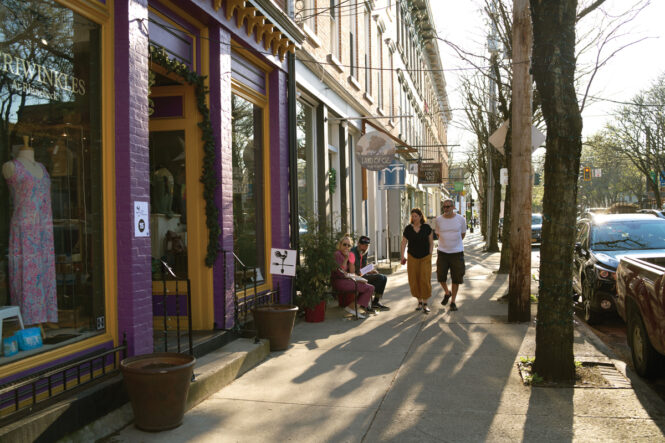
Shops along East Market Street in downtown Rhinebeck.
When Lubman arrived, hay wagons were a common sight in the village on a Saturday; now, he says, Teslas and Maseratis prevail. “This was the first place of concentrated wealth in the Colonial era,” he says, “and it always had an upper-echelon community and a blue-collar community, well-integrated and mutually respectful. We first came to Dutchess County as caretakers on a farm, worked our way into craft sales, and saved up $5,000 to open our store, which seems incredible now. But we were members of a collective, so by collaborating with talented people, we were able to fill our first store with beautiful things.”
Lubman, an environmental lawyer before he became a jeweler, remembers the pitched battles that stopped proposals like the one that would have placed a mall and 1,500 condos along Route 9, and fended off corporate chains that wanted a piece of the Rhinebeck action. “So just about everything here is independent, and it shows,” he says.
The Rhinebeck Real Estate Market
Rachel Hyman-Rouse, founder and principal broker at Rouse + Co., says things are still tight and lively. “We don’t have enough inventory,” she says, “and of course, more buyers than sellers will support higher prices. Unlike during Covid or some other disaster, things that are overpriced tend to sit until the price is cut, but properties that meet the market’s demands and are priced right still move very quickly. A lot of sales happen off-market, where a realtor learns that something is becoming available and already has just the right buyer who’s been waiting.”
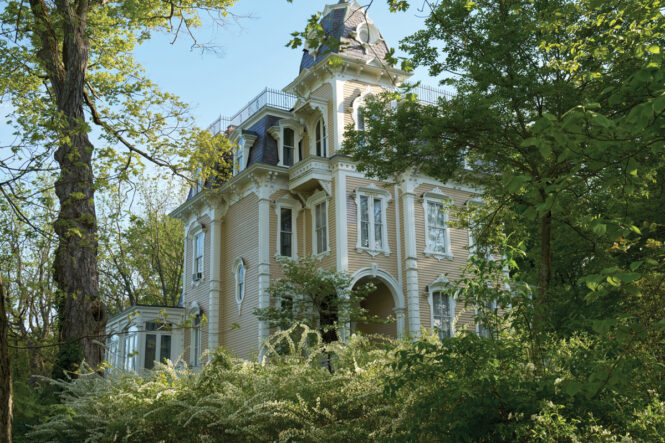
A stunning Victorian in Rhinebeck.
The Hudson Valley, she says, is still “having a moment,” as evidenced by projects like the proposed One&Only property adjacent to the Culinary Institute of America in nearby Hyde Park. “They’re planning 40 or 50 ‘branded residences’ that will cost over $4,000,000 for two bedrooms,” she says, “and I don’t see the luxury market stopping anytime soon. Decent houses in the village are around a million, with higher-end stuff costing three to five; it may not be 20 showings and 10 offers in two days anymore, but five showings and two offers still means a sale.”
People looking for something that’s relatively affordable, she says, may need to focus on compromise. “Look at everything in your price range, to get a feel for the market. People don’t want split-level ranches or houses on busier streets as much as they want the pristinely restored Colonial or the sleek modern in a secluded spot, but you still get a foothold in Rhinebeck.”
At press time, there was a three-bedroom 1805 home in the Village Historic District listed at $283,500; despite being in serious need of TLC, the sellers had multiple offers and had set a deadline for highest and best. A move-in-ready two-bedroom farmhouse 10 minutes outside the village was listed for $495,000, and a three-bedroom ranch in the village was listed at $524,900. Most homes under $600,000 were “pending.”
For $1,175,000, one could consider a three-bedroom on nearly 10 acres 10 minutes from village limits, with saltwater pool, passive solar and “vista views.”