
A Perch in the Pines: Modern Design Meets Wooded Serenity in Andes
By Joan Vos MacDonald | Photos by Ben Rahn/A-Frame Studio | Spring 2025 | Design Feature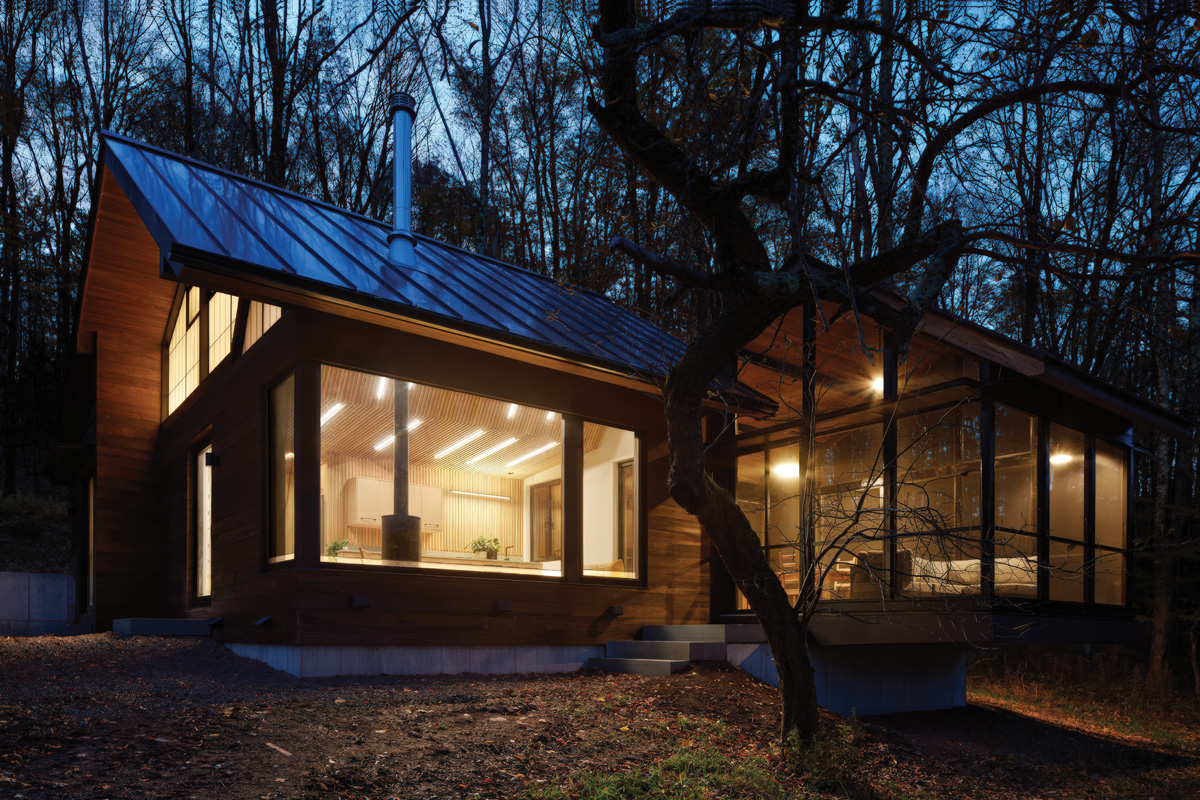
It began with a simple wish: a screened-in porch surrounded by trees, a place to retreat and take in the meadow views. But, like the trees around it, the project took root and grew. For architect Lynn Gaffney, AIA, and her long-time clients, the screened porch became the seed of a larger vision—a cabin that blurs the lines between structure and nature, utility and beauty.
“It started as more of an escape,” says Gaffney. “The idea was to have some privacy out in the woods and a different view of the meadows from this particular spot. A screened-in porch was the first piece we talked about. But then the project grew—as happens with a lot of projects.”
Gaffney, based in Brooklyn, was no stranger to this property in the Delaware County town of Andes. She had previously designed the clients’ four-bedroom home nearby. This new endeavor—the fourth project she’s undertaken for the couple—was planned as a serene woodland retreat. When the pandemic struck, the priorities shifted. With the family confined to the main house, both owners needed quiet workspaces. The simple porch evolved into a multifaceted cabin with an expansive kitchen, guest bedroom, and private areas for remote work, all while maintaining the retreat’s central mission: a perch in the woods to enjoy the natural beauty of the property.
A Porch That Takes Flight
The design centers on the glass-enclosed porch, cantilevered dramatically to create the feeling of floating among the trees. “It’s all about being in the woods and engaging with that meadow view,” Gaffney explains. “When you’re on the cantilevered porch, it feels like a perch. You’re elevated and surrounded by the trees. It was a structural challenge and could have easily been value-engineered out, but the clients and contractor were committed to the idea. Because of that, you can experience the site in such a unique way.”
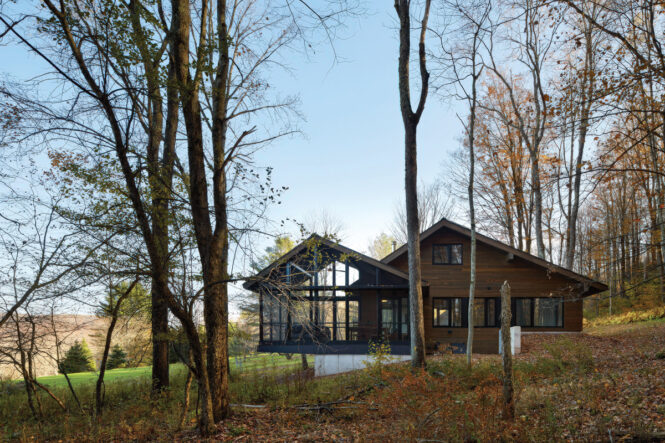
Lynn Gaffney Architect
This “perch” is more than a stunning visual feature. It exemplifies the thoughtfulness that runs through the entire project, from the choice of materials to its integration with the land.
Sustainability Rooted in Design
Sustainability was a cornerstone of the design. Gaffney carefully sited the cabin to minimize the impact on the forest, preserving as many trees as possible. “We didn’t want to disrupt the woods unnecessarily,” she says. Locally sourced and reclaimed materials further reduced the project’s environmental footprint.
The cabin’s envelope is highly efficient, with triple-pane Passive House windows that help regulate indoor temperatures year-round. While the project didn’t pursue Passive House certification, Gaffney incorporated many of its principles. “The windows were a significant upgrade,” she says. “Triple-pane glass is not standard, but it made a big difference in terms of energy efficiency.”
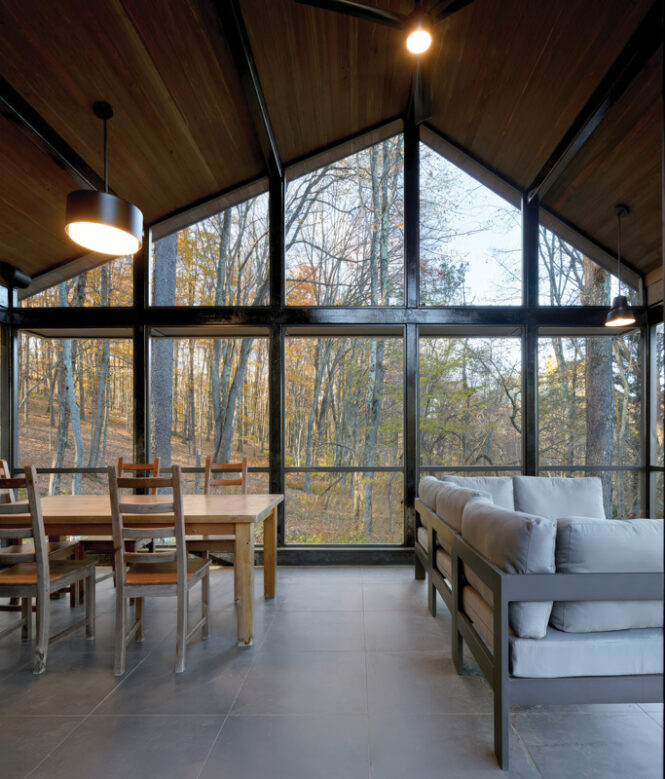
The site was carefully selected so that as few trees as possible needed to be cut down, thus reinforcing the retreat’s central mission: a perch in the woods to enjoy the natural beauty of the property.
On the cabin’s south-facing front, Gaffney installed a grid of translucent polychrome panes framed in black. The material, known as Kalwall, is often used in industrial buildings but serves a dual purpose here: bringing in ambient light while maintaining privacy. “It was important to let light in from the south without creating exposure in that direction,” Gaffney explains.
The framing of these panes, along with the porch doors and windows, evokes the aesthetic of traditional Japanese homes, where shoji screens are framed in dark wood. This design element gives the cabin a modern yet inviting presence, particularly at dusk when light glows softly from within.
Bringing the Outside In
Inside, the cabin’s material palette mirrors the natural surroundings. White oak was used extensively, cladding the sloped ceiling and custom kitchen cabinetry. “We wanted to keep everything very natural,” Gaffney says. “The oak brings warmth, and all the metal elements—like the windows and light fixtures—are black, to keep a low sheen.”
Gaffney worked closely with local artisans, including Al Mohr, who also built the cabinetry for the main house. The kitchen design reflects the clients’ collaborative approach, balancing rustic charm with modern functionality.
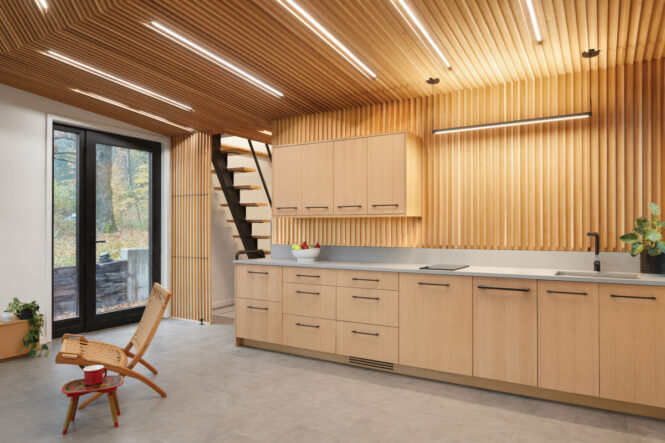
White oak was used extensively in the kitchen, both to cover the sloped ceiling and on the custom cabinetry.
Throughout the cabin, the interplay between indoor and outdoor elements is seamless. In the main living area, a wood-burning Stuv stove anchors the space. Its sleek, sculptural form echoes the bare branches of a tree visible through the windows. The stove’s drum can be manually rotated, allowing the homeowners to enjoy the fire and the view from different angles.
“That tree was really significant to the design,” Gaffney notes. “We worked hard to save it, along with many others. Its presence helped ground the space and guided our choice of materials and colors.”
A Loft with a Starry Glow
Above the main level, the cabin features an upper-level loft tucked beneath its prominent metal roof. Originally conceived as an open mezzanine, the loft was enclosed during the pandemic to create a private workspace. Gaffney transformed this necessity into a sculptural feature, designing slatted wood panels that extend from the loft to the back hallway.
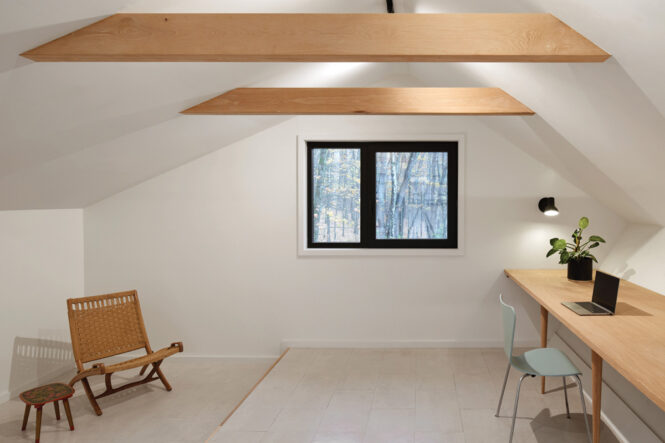
The cabin provides a quiet sunny workspace, which the homeowners used for remote work.
LED lights are integrated into the slats, creating a constellation-like effect. “We wanted the lighting to feel intentionally random,” Gaffney explains. “It’s surprisingly hard to make randomness look natural. We planned it carefully to ensure it felt organic while meeting the space’s functional needs.”
The loft’s design reflects the same thoughtful integration as the rest of the cabin. The slats connect the vertical space visually, while the lighting adds a whimsical touch. “I call it the underbelly of the loft,” Gaffney says. “It’s one of those elements that gives the cabin its own personality.”
Collaboration in the Catskills
The cabin’s success is a testament to the collaborative spirit of the project. Gaffney worked closely with the homeowners, contractors, and local craftspeople to bring the vision to life. Travis Balcomb of Andes-based TAB Construction played a key role, particularly in executing the cantilevered porch and the intricate loft design.
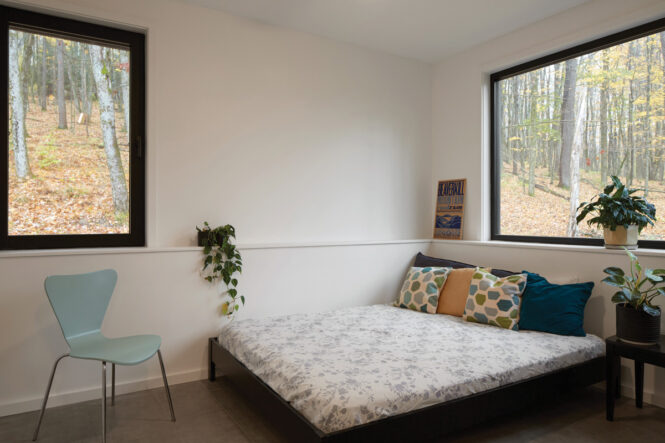
The addition of a guest bedroom allowed the homeowners to provide a private space for guests.
“Being on-site is one of my favorite parts of the process,” Gaffney says. “Even in the freezing cold, we were out there figuring out exactly where the cabin should sit. It was a lot of fun and a lot of collaboration.”
Gaffney’s background in both urban and rural projects—from Brooklyn townhouses to a nonprofit in Los Angeles—shaped her approach to the cabin. She brought a keen understanding of the site’s natural beauty and the clients’ needs, creating a retreat that feels both grounded and elevated.
A Woodland Escape
The cabin is more than a structure; it’s an experience. Whether perched on the cantilevered porch, warmed by the wood-burning stove, or bathed in the soft light of the loft’s starry glow, the cabin invites its occupants to slow down and connect with the surrounding forest.
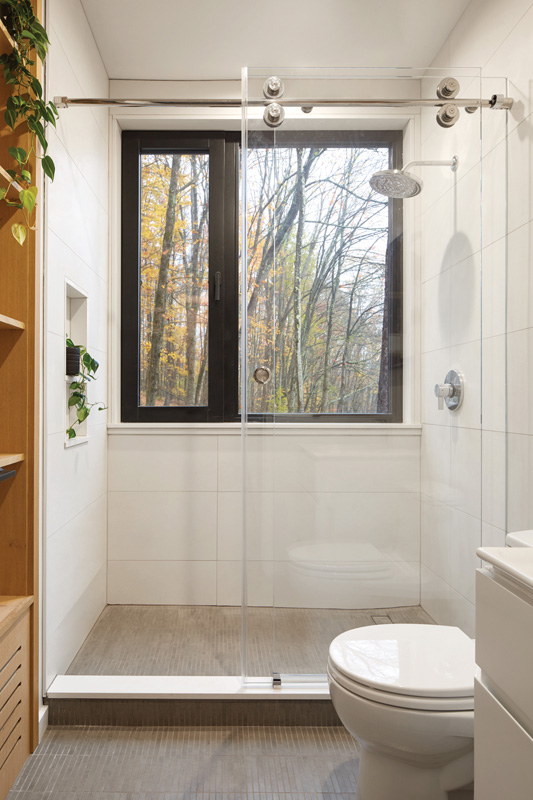
Every room in the cabin, including the bright modern bathroom, has views of the natural scenery outside.
For Gaffney, it’s a project that embodies the best of what architecture can offer: a thoughtful response to its environment, a reflection of the people who inhabit it, and a celebration of the beauty of nature.
As the light filters through the trees and the seasons change, the cabin stands as a testament to the harmony that can exist between human design and the natural world.