
So Hot Right Now: Why Heat Pumps Are the Future
By Barbara Todd | Winter 2025 | Clean Power Guide
As energy prices rise and the climate shifts, many homeowners are rethinking how they heat and cool their homes. Heat pumps have emerged as one of the most efficient, comfortable, and future-proof solutions. Maximizing their benefits depends on matching the technology to your home and lifestyle.
Why Heat Pumps Make Sense
A heat pump doesn’t create heat the way a furnace or boiler does—it moves heat. In winter, it extracts warmth from the air or ground and brings it indoors. In summer, it pulls heat out of your home to cool it.
Because it moves energy instead of burning fuel, it can deliver two to four units of heat for every unit of electricity consumed.
Compared with oil or gas furnaces, this means lower operating costs and a smaller carbon footprint. Even without federal tax credits, heat pumps make good financial sense in New York, where state incentives remain strong and the long-term economics of gas and oil are grim. Delivered fuels continue to rise in cost due to delivery and infrastructure expenses, while electricity generation gets cleaner and cheaper each year for the utilities.
The Right Fit: Matching System to Home
Heating and cooling systems are like clothing—your home needs the right size and fit for your comfort. What matters most is matching the system to the home’s heat-loss rate and the occupants’ comfort preferences.
Proper insulation and air sealing should come first, followed by a heat-load assessment. These assessments model how quickly each room gains or loses heat, guiding the selection of air-source, ground-source, or air-to-water systems for even, efficient comfort.
Unfortunately, most US heating systems are sized and installed by rule of thumb rather than careful calculation, resulting in rooms that are too hot or too cold and furnaces that waste fuel by cycling on and off. Heat pumps perform best when tailored to the home, running steadily and efficiently.
Types of Heat Pumps
Air-Source Heat Pumps
- Transfer heat between indoor and outdoor air.
- Can operate efficiently even in subzero temperatures.
Ductless Mini-Splits
- The most common type of air-source heat pump.
- Compact, wall/ceiling/floor-mounted indoor units with an outdoor compressor.
- No ducts required; ideal for older homes, additions, or individual rooms.
- Zoned comfort and high efficiency via inverter technology.
- Require external drainage access.
Ground-Source (Geothermal) Heat Pumps
- Use underground loops to exchange heat with the earth.
- Efficient but more expensive to install due to drilling/trenching.
Air-to-Water Heat Pumps
- Provide low-temp hot water for hydronic radiators or radiant floors.
- Common in Europe; emerging in the US.
Packaged Window/Through-the-Wall Heat Pumps
- Two-way heating/cooling for a single space.
- Affordable and easy to install and swap out for apartment use.
- New York City Housing Authority is deploying thousands for apartments.
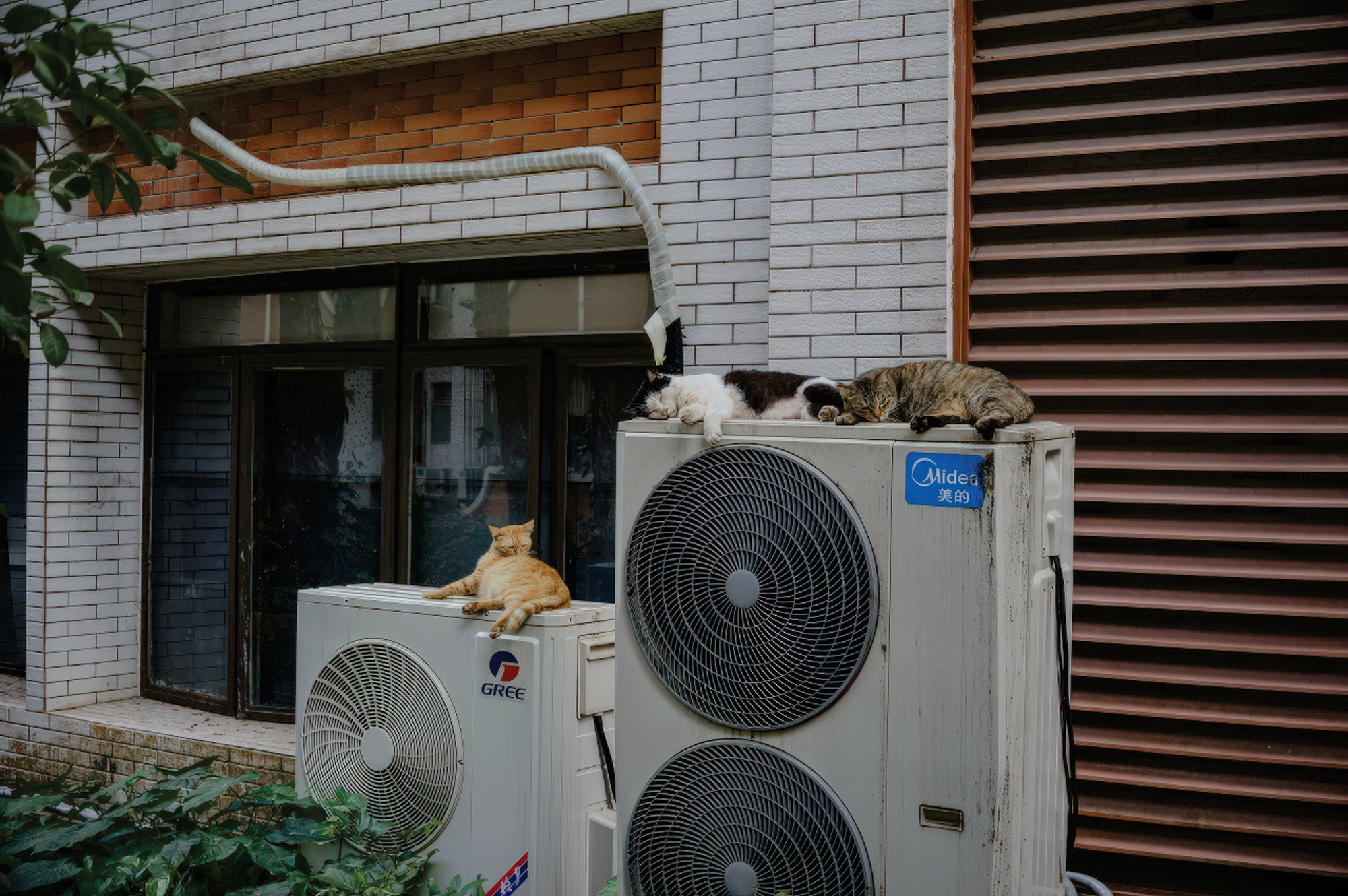
Cats know comfort: perched atop a heat pump that heats, cools, and runs more efficiently than fossil fuels—no combustion required. Photo: Shawn Rain/Unsplash
Maintenance & Warranty Essentials
Heat pumps are remarkably reliable when properly maintained—but nearly all manufacturer warranties require regular care and documentation. Neglecting basic maintenance can void coverage for major components like compressors and coils. Proper maintenance is essential to protect your warranty and system longevity. Most installers offer service plans.
Air-source & mini-splits:
- Clean or replace indoor filters every one to three months (more often in dusty conditions).
- Keep the outdoor unit clear of leaves, snow, and debris to prevent airflow blockages or icing.
- Schedule annual professional service to check refrigerant levels, coil condition, electrical connections, and defrost operation.
- Ensure professional installation and keep records. Most warranties require installation by a licensed contractor and annual service documentation.
- Use genuine parts and maintain logs or invoices—lack of proof can void coverage.
Ground-source systems:
- Annual professional maintenance is required for refrigerant, pumps, and controls.
- Loop system checks fluid level; pressure and flow rate must be verified yearly to prevent damage from leaks or poor circulation.
- Water chemistry (glycol mix and pH) must stay within manufacturer limits to avoid corrosion.
- Document loop installation and commissioning by a certified installer—improper loops are a common cause of voided warranties.
Warranty Tips
- Get the warranty in writing before installation.
- Ensure it starts at installation, not manufacture date.
- Target 10 years for major components (compressor, heat exchanger, reversing valve).
- Standard components (fans, pumps, accessories) for two to five years.
- Ground loops may have much longer warranties (pipe warranties up to 50 years).
- Aim for two to three years or more for labor coverage.
- Review exclusions carefully.
- Understand and follow maintenance requirements.
Refrigerant Considerations
Refrigerants are some of the most powerful greenhouse gases known and have a huge impact. Here are a couple of tips on handling them responsibly:
Before charging refrigerant into a new system, contractors are supposed to test the refrigerant circuit by pressurizing it with nitrogen and confirming that the pressure doesn’t decline over time. If the pressure declines, there’s a leak that needs to be fixed before moving forward. If the pressure stays high, it’s a sign the system is ready to be turned on.
The refrigerant circuit is not normally opened during regular maintenance, unless signs indicate something is wrong with the heat pump. If your contractor has to open the refrigerant circuit, ask them in advance to provide you with a written record of how much refrigerant was taken out and/or how much was put in. They are required by law to do this.
Common Issues and How to Avoid Them
Shreyas Sudhakar, founder of heat pump installation company Vayu and author of Heatpumped.org, explains that most homeowner complaints stem from a lack of understanding of how differently heat pumps operate compared with furnaces.
Air doesn’t feel hot
Heat pumps deliver moderate-temperature air, which warms the room over time and creates comfortable, even warmth.
Poor humidity control
Oversized systems cycle on and off so they don’t dehumidify efficiently. The installer should perform load sizing calculations based on performance, reviewing your previous utility bills to size your heat pump system—not using rules of thumb or matching the size of your current system.
Excessive supplemental heat
Electric resistance heat should only be a backup during very cold weather; well-insulated homes can be served with only cold climate heat pumps and no backup system. Proper thermostat settings and climate-appropriate system selection prevent unnecessary auxiliary heat usage.
The Real Value: Affordable Luxury
Heat pumps are more than energy-efficient devices—they transform home comfort. Proper sizing, professional installation, regular maintenance, and attention to warranties unlock their full potential: effortless comfort, predictable costs that easily compete with fossil fueled heating and cooling, and minimal environmental impact.
While the politics of the moment have had us fretting about reduced tax incentives, heat pumps remain a financially competitive choice and an investment in lifetime value for your property. “A well-designed system that makes people comfortable is the available luxury that most people are not familiar with,” says Tom Kacandes, a senior consultant with Vermont Energy Investment Corporation. “Heat pumps can give us the truly luxurious experience of not spending a lot of money to be truly comfortable. That’s the real prize—freedom from getting whacked with an oil delivery bill. Because the humidity is controlled and filtration reduces dust, every hour of every day, that’s your experience of luxury,” he says.
Barbara Todd is Program Coordinator at Sustainable Hudson Valley and has a background in software quality assurance, management and the arts.