
Janson Scuro’s Cross-Disciplinary Approach to Designing Homes
Presented by Janson Scuro | Fall 2025 | Architects Guide | Design Feature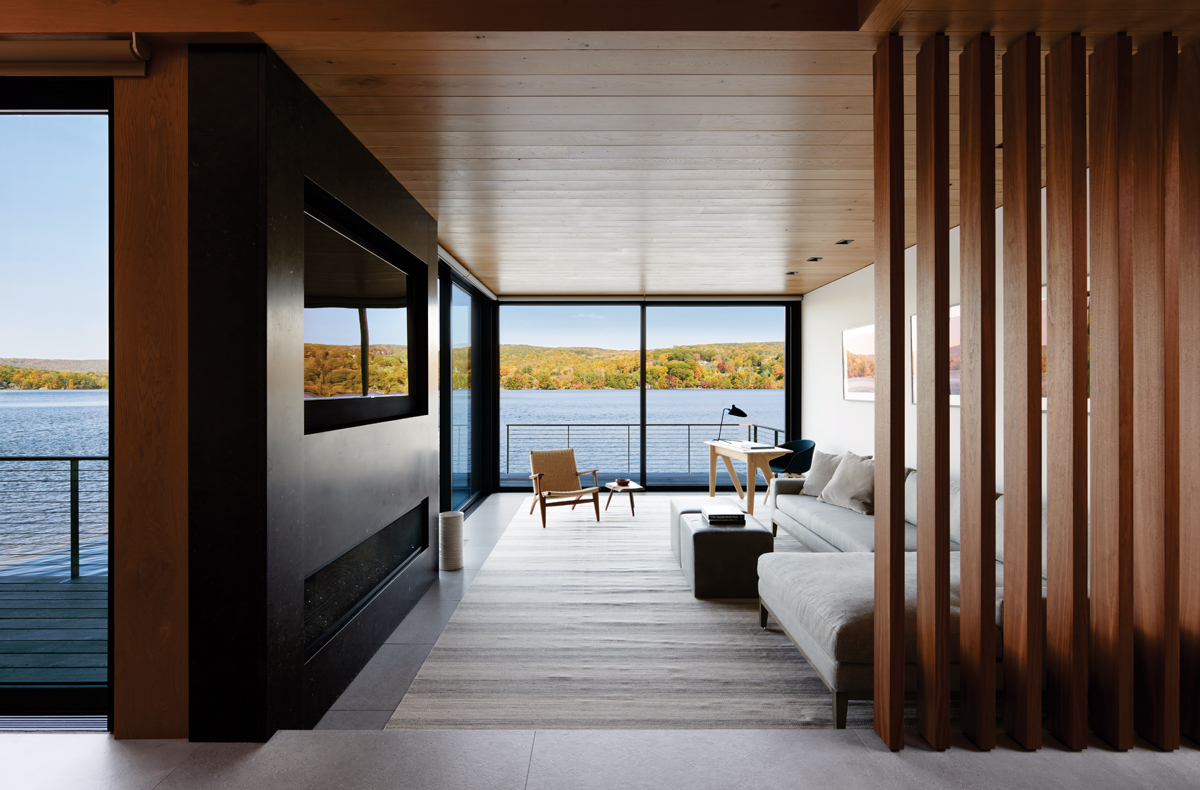
Whether confronting the challenges of historic preservation or creating modern spaces, the architects at Janson Scuro like to blur lines. “Pushing through design limitations is a good description of what we do every day at our firm,” explains cofounder Mark Janson. The boundaries they play with are the lines between past and present; an interior space and its setting; and even the disciplines of architecture, interior design, and landscape design.
Janson and partner Matthew Jasion share a vision for uniting architecture and interior design under one roof, and have built a studio grounded in strong foundational principles and a deep respect for the context of a site. The partners met in New York after attending Parsons School of Design and Rhode Island School of Design, respectively, and launching their careers under architectural luminaries—Janson with Steven Holl and Jasion with Aldo Rossi.
Connecting the firm’s varied projects across retail, residential, and hospitality is a commitment to cross-pollination. “It’s natural for us to take inspiration from our different projects and objectives,” says Janson. That ethos has naturally extended into the Hudson Valley, where Janson began renovating homes of his own shortly after founding the firm, and where both partners now maintain residences. “We’re influenced by 20th-century art and the variety of micro-climates along the Hudson River,” says Janson. “Our philosophy is, no matter what your budget is, you can create something beautiful with good proportions and good use of daylight, so that’s where we start.”
Floating Possibilities
The redesign of a dilapidated boathouse and crumbling dock perched on a lake in Litchfield County, Connecticut, might have paralyzed lesser architects. “It was an unsalvageable boathouse that was falling into the water,” explains Janson. “But, because of the strict zoning rules protecting the lake, we had to stay within the original footprint. It was kind of like putting together a puzzle.”
To realize the owners’ dream of using that footprint to enhance the experience of the main house on the hill above, the partners envisioned a 995-square-foot, light-washed glass and concrete entertainment pavilion that floats above the lake like a modernist meditation on light and space.
They designed the lakehouse as two volumes placed at a perpendicular angle to maximize the experience of the waterside setting and diffuse its abundant natural light throughout. “The main objective was to capture as much of the sky and views as possible,” says Janson. The northern orientation also meant they could maximize windows and glass doors without worrying about the interior overheating. By utilizing steel frame construction, they could push the expanses of glass even further to give it a sense of weightlessness, as if hovering over the water.
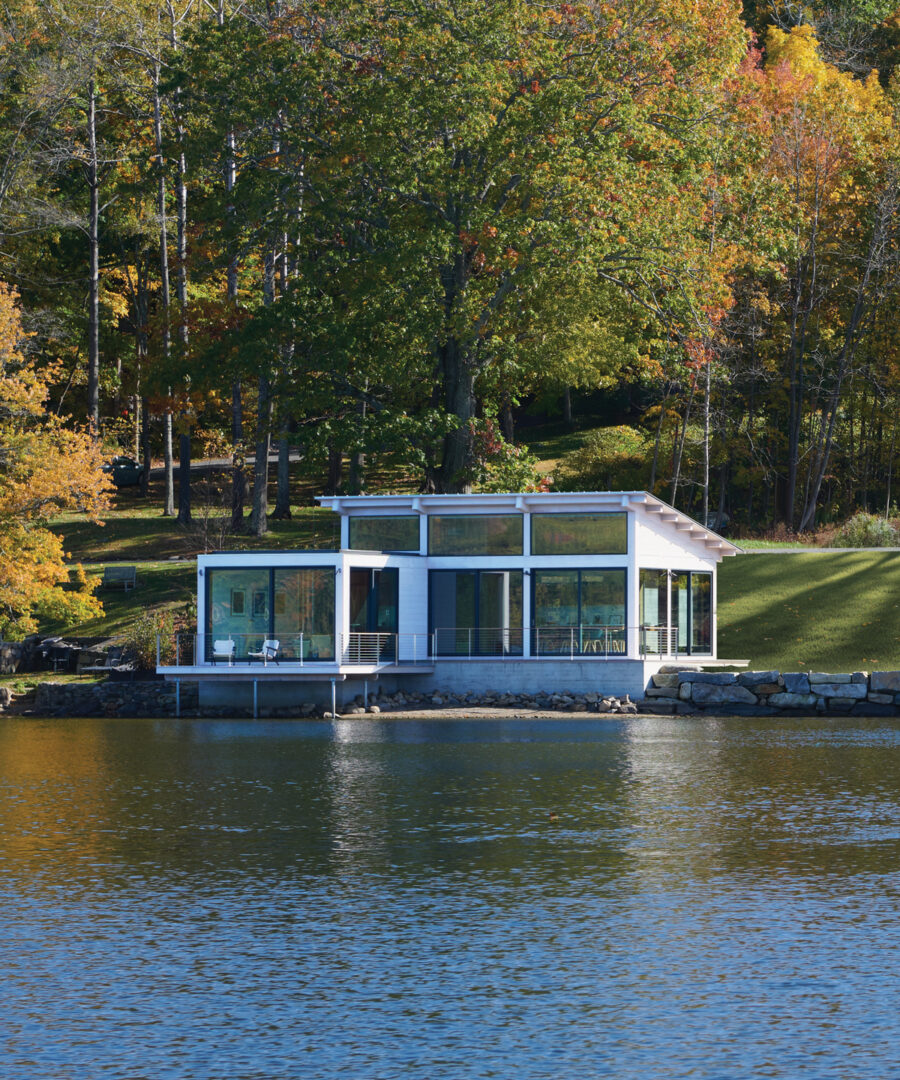
For the redesign of a boathouse and dock on a lake in Litchfield County, Janson Scuro envisioned an entertainment pavilion that floats above the lake like a modernist meditation on light and space. The pavilion’s angled ceiling creates a dramatic cathedral-like openness in the dining area, and a lower wood-paneled ceiling creates a warm and intimate space for lounging by the fire in the living area. Photo by Daniel Salemi
After reinforcing existing concrete retaining walls and pouring a new foundation, the duo designed a waterside dining pavilion to replace the boathouse’s former storage space. By deliberately raising and angling the room’s ceiling toward the lake, they created a dramatic cathedral-like openness while maintaining a sense of intimacy for entertaining. Strategically placed floating pendant lights do triple duty, providing direct illumination to an island countertop, indirect lighting for the ceiling, and a spotlight for the dining area.
Next, they captured the space from the two former boat slips to create a combined living room/lounge area that feels as though it floats above the water. Surrounding the pavilion, a bluestone terrace extends the entertaining space outdoors. Massive nine-by-eight-foot Marvin glass doors disappear when opened, further dissolving the boundaries between the pavilion and the lake.
A natural palette of white oak and American walnut tie the lakehouse’s interior spaces together. Large-scale porcelain tiling transitions easily from indoor entertaining to lakeside lounging. The exterior’s stained cedar siding and zinc standing-seam metal roofing blend into the water and shoreline, creating a calm visual presence that melds with the lake, reflecting both a durability and elegance that will age gracefully in the environment.
Reenvisioning Spaces
Janson Scuro’s theory of basics—that is, starting with proportions and light—works to transform existing spaces just as well. “The techniques can create something that seems old,” says Janson. “But sometimes they can be used to create a counterpoint to the original design.” For instance, they had been working with a Rhinebeck-based client for five years before she came across a stylistically mismatched villa along the Hudson River. “She wanted a river view and had spent years searching for the right property,” explains Janson. “This one checked all the boxes and was high on a hill with a view of the Catskills.”
The home, however, was a hodgepodge of architectural elements combining Tuscan stucco with Scandinavian details and Japanese influences. The mix resulted in visual chaos that detracted from the spectacular setting. “We could never figure out how to describe it,” says Janson. “But I suggested she buy it because of the view. I knew that we’d figure out the design.”
The structure had significant problems beyond its eclectic styling. “The original house had a very awkward entry that was on the wrong side of the house, and without a clear path from arrival,” Janson says. “There was no entry sequence. The home was naturally oriented to the western view of the river, but there was also an overlooked but lovely lawn to the south and a wooded view to the east which added beautiful morning light.” Fake interior beams, excessive ornamental overhangs, and an oversized screen porch added to the visual clutter.
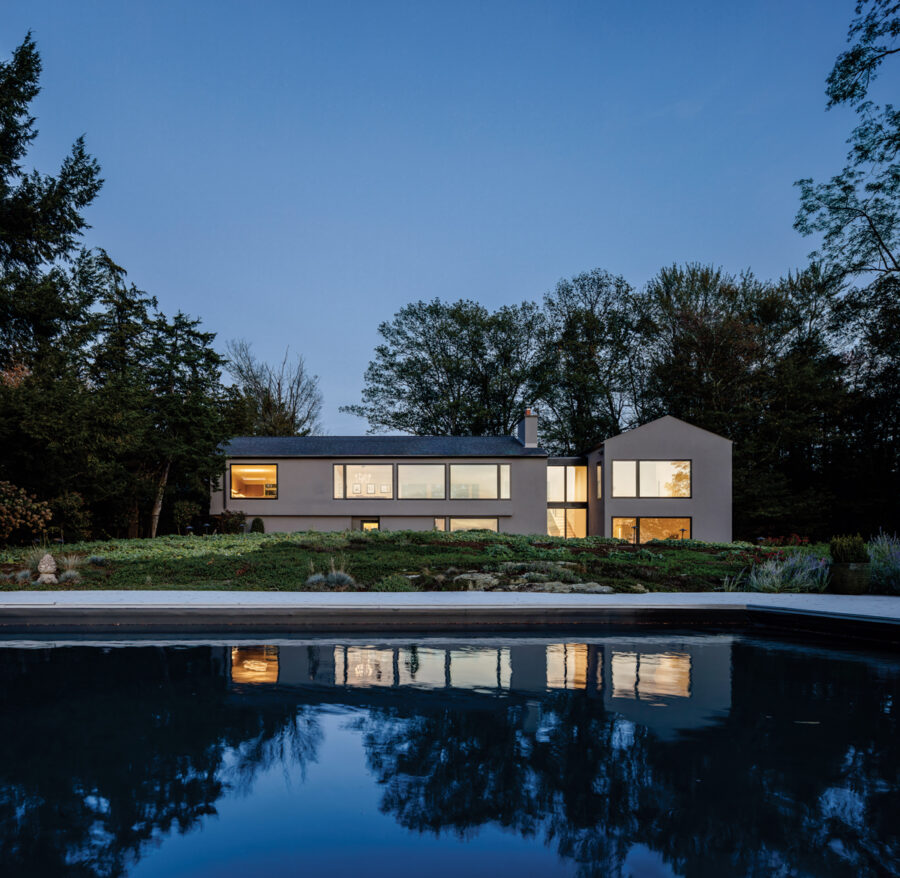
For the renovation of an architecturally eclectic home in Rhinebeck, the firm added a new wing and divided the home into distinct public and private spaces, connected with a dramatic glass entry hall.
Photo by Paul Warchol
The firm’s solution was bold, yet respectful toward the original design and geographic viewpoint. They decided to preserve the existing structure while adding a new wing, connecting old and new with a dramatic glass entry hall. “The genesis of the entire design was the new wing,” he says. “It created the opportunity to balance the proportions of the original structure.” The new design also clearly divided the home into distinct public and private wings.
After stripping away the superfluous details and streamlining the original 2,740-square-foot structure, the team converted the first floor into a den space for gathering. Then, they filled the perimeter of the expansive second floor main living area with nearly floor-to-ceiling Anderson windows. The 1,900-square-foot addition was designed for privacy, including a primary bedroom suite on the second floor and an additional office and guest room at ground level.
The glass entry hall works visually to connect the two wings of the house while celebrating the home’s spectacular river view. “It also created the entry that the existing home was lacking,” says Janson. “A new circular drive integral to activating the entry was critical. The new entry appears naturally and the glass wall clearly identifies it as your destination,” he explains. Once inside, a second glass wall facing the river is visible, immediately drawing the gaze to the western views beyond. “As you ascend to the second level where the living spaces are, the river and mountains come fully into view.”
Restoration with Intention
Not all projects require reinvention. When Janson approached the renovation of a 1950s Mid-Century Modern house he purchased in Stanfordville, his goal was respectful restoration. Built by an engineer, the 2,000-square-foot post-and-beam structure was already well proportioned when Janson moved in. The floor-to-ceiling Mid-Century windows filled the home with light while blurring the line between the open-concept, cedar plank interiors and the surrounding six-acre meadow. “The original designer sighted the house beautifully with southerly views over the meadow,” Janson says. “But many elements needed to be updated or replaced.”
“The major windows that create the effect were already there,” he continues. “It was a hundred smaller decisions that brought the house into conformance with its original potential.” Those decisions included opening up walls to create better flow and replacing an awkward and over-scaled fireplace with a modern wood-burning stove. He also replaced the floors with parquet and cork floor tiles and sourced era-appropriate windows throughout. “With restoration, there are so many things to do that are not things you see in the end,” he says.
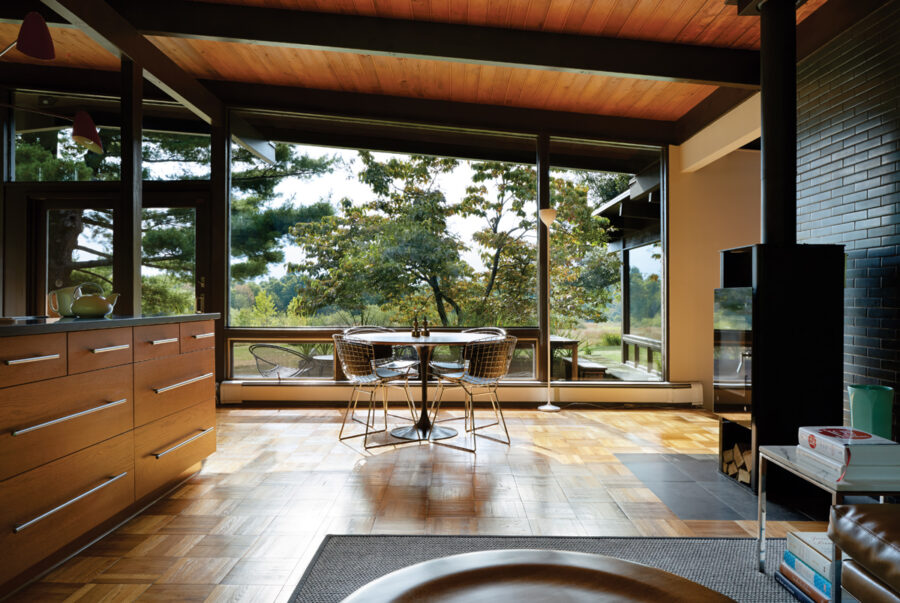
Janson Scuro’s renovation of a 1950s Mid-Century Modern home in Stanfordville prioritized the restoration of era-appropriate details while updating its floor plan and landscape for increased enjoyment. Photo by Mikiko Kikuyama.
As with any residential property the firm works on in the region, curating the experience of its landscape is always central to the final effect. For the Stanfordville home, they reconstructed an existing barn, put in a pool, and redesigned the landscape to allow for its enjoyment. They created new grass walking paths in the meadow, pruned hundreds of trees, and added hundreds more to add to the property’s secluded feel and provide privacy and shade for the new pool.
Whether working within the constraints of a historic footprint or celebrating contemporary design, the architects at Janson Scuro bring the same commitment to fundamentals—proportion, light, and flow—to homes defined by a sense of place, be they in the Hudson Valley, Berkshires, or beyond. Their interconnected approach to design creates architecture that feels both innovative yet rooted. In Janson Scuro’s world, the best solutions come from constraints, where limitations can be transformed into the very elements that make a space sing.