
Among Stone & Sky: White Oak Farm Offers Homage to the Landscape
By Joan Vos MacDonald | Photos by Michael Biondo | Winter 2025 | Design Feature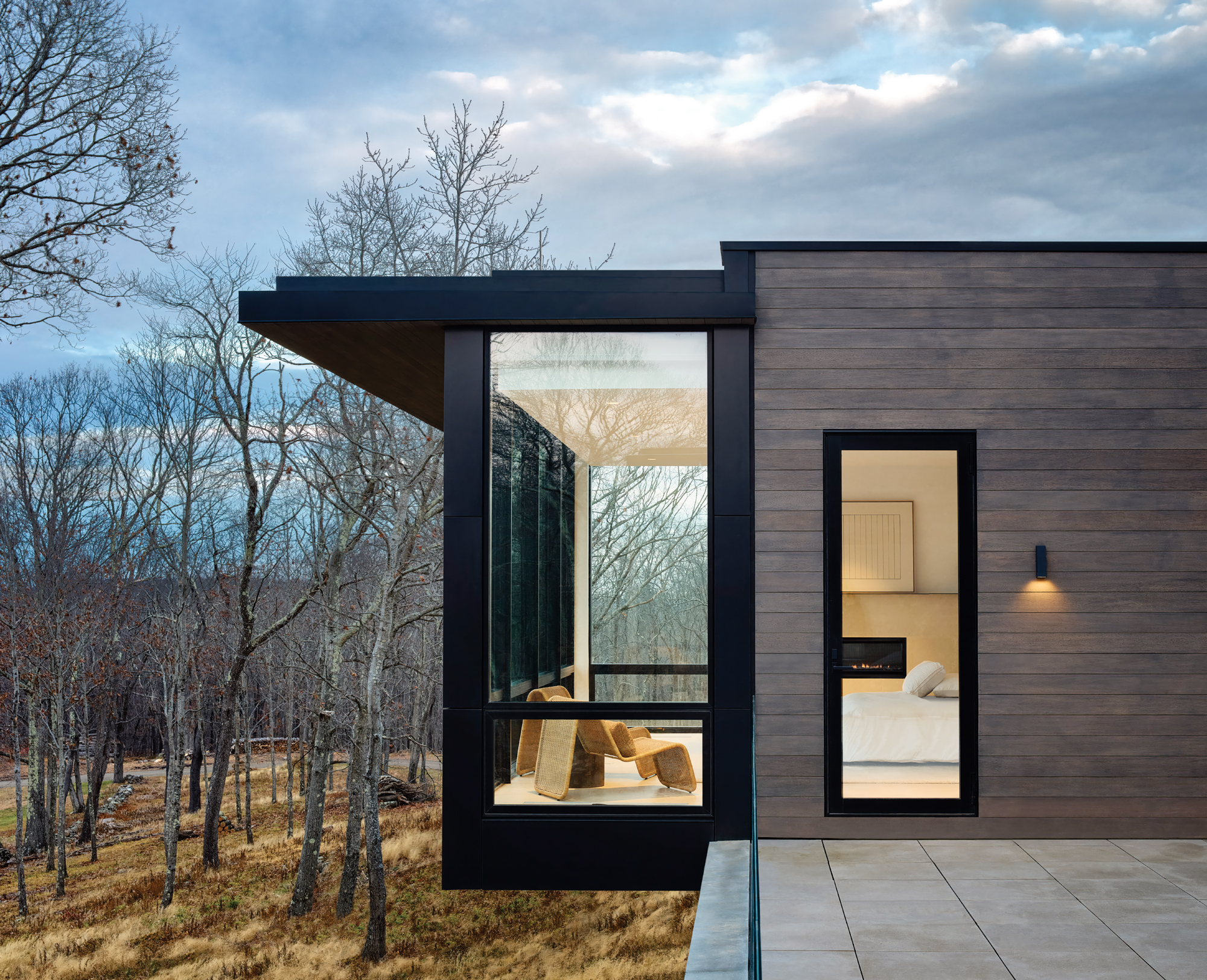
Michael Biondo
Toward evening, the hilltop at White Oak Farm turns to silhouette, and the house seems to light from within, a lantern tucked among stone walls and wind-brushed grasses. The living pavilion doesn’t so much stand on the land outside Pawling as hover in quiet deference to it—glass planes catching the fading sky, warm wood gleaming like embered bark. Inside, branches lace the view in every direction, as if the forest leaned close to look back. “The intention was not to necessarily inspire awe,” says architect Amanda Martocchio. “Except perhaps reverence for the landscape.”
Although there’s glass on both sides of the living pavilion, one side faces a geometrically precise lawn, the only mowed grass on the property. The other side faces a natural habitat with native grasses, woods, and a meadow.
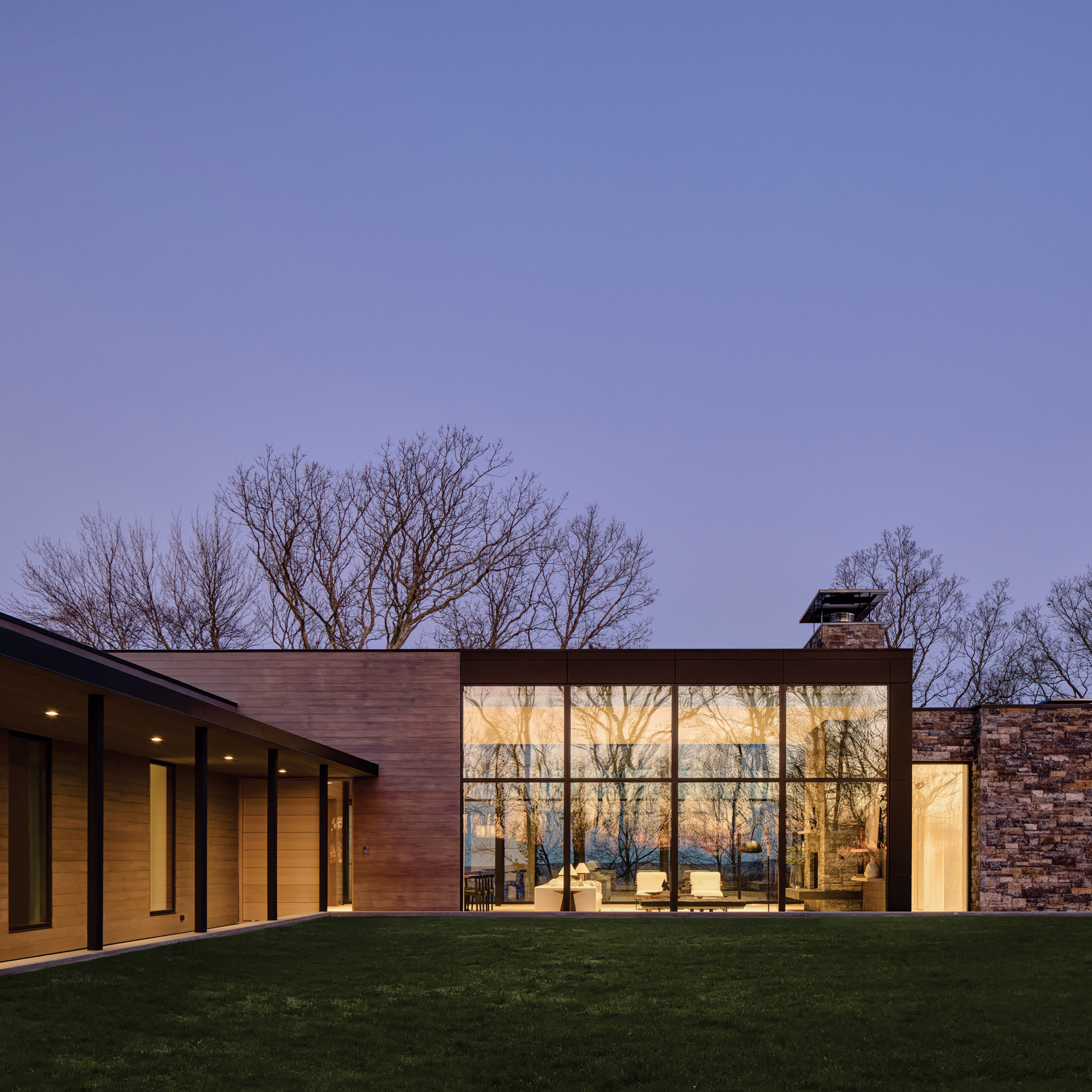
One side of the glass-walled living pavilion faces the property’s only mowed lawn while the other side faces a natural vista of trees and grasses.
“So you get this sense that you’re in nature with one kind of constructed nature on the one side and on the other side, something completely natural,” says Martocchio, whose firm specializes in creating architecture that responds to and harmonizes with its surroundings.
The farm’s rustic views were very important to her client, as the location evoked childhood memories and of the unhampered freedom to roam and enjoy the same hills. “Anytime a client comes to you with a story, it’s really nice as a generator of design ideas, and this is such a beautiful piece of property,” says Martocchio. “When the homeowner was a little boy, he lived not far away. He and his brother would go into the woods and play around. It was not a fully utilized farm and had a lot of woods. There was a lot of playtime, forts, and stone climbing in the woods.”
When the property landed on the market the new homeowner rushed to buy it. “That was a real motivator for me, finding out what he loved about the property,” says Martocchio. “Also, he has always been an equestrian and a horse lover. This property, which was 200 acres, had paddocks and old barns that were derelict. They hadn’t been used for many years. Part of his mission was to conserve the woods and the habitats, but also to introduce a new operation for boarding thoroughbred horses. So, it was not only an aesthetic appreciation, but a functional use that they could impart in this beautiful piece of property.”
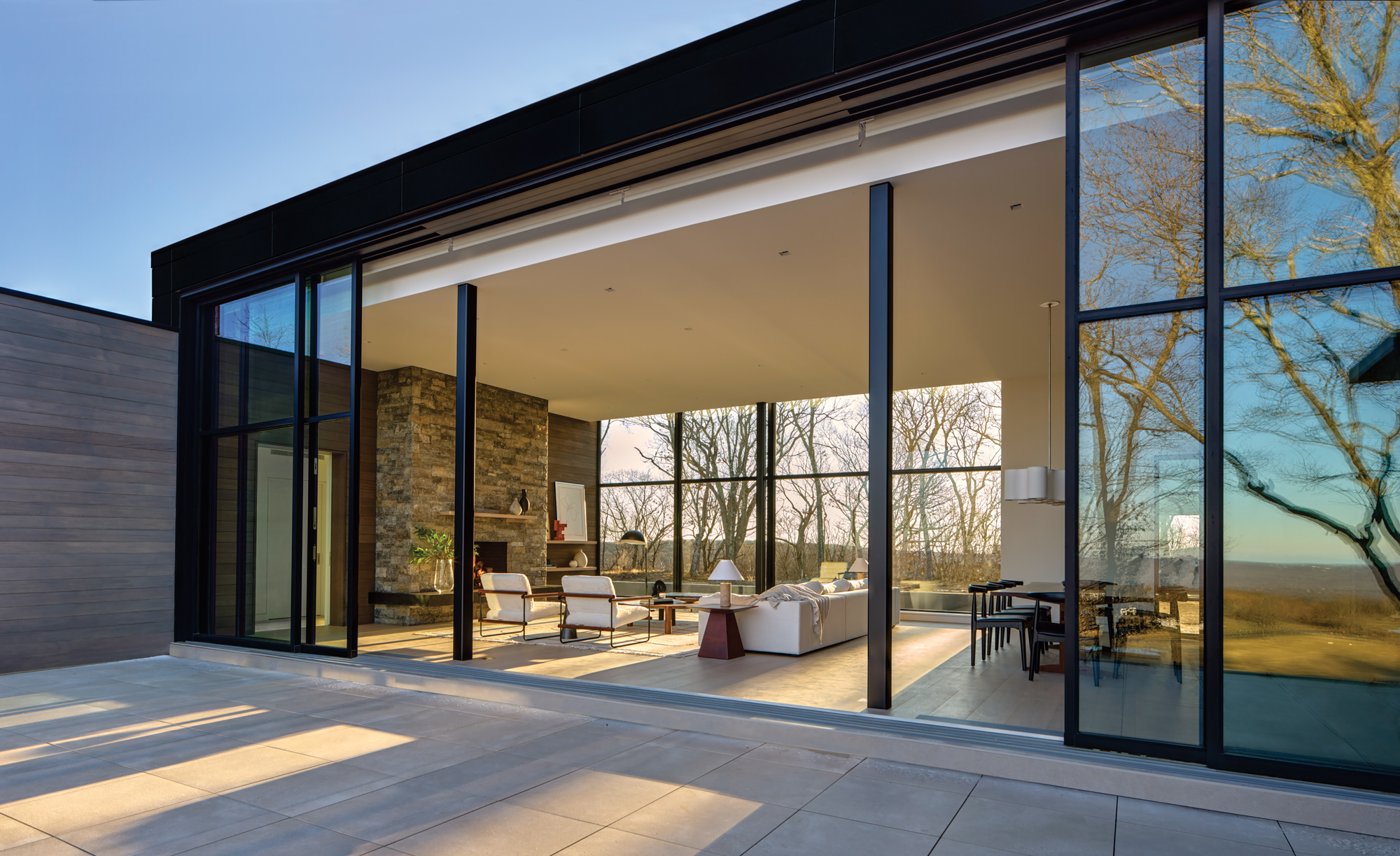
Floor-to-ceiling glass dissolves the boundary between interior and landscape in the living pavilion at White Oak Farm.
The paddocks are visible from the cantilevered primary bedroom, which floats over the rolling hills. “It is like making a tree house,” says Martocchio of her decision to cantilever the room. “It comes back to the owner climbing trees and loving trees so much. By cantilevering that primary bedroom, we kept it in the trees.”
Martocchio’s office in New Canaan, Connecticut, is not far from Philip Johnson’s iconic modernist Glass House, which she has long admired for the way the glass wraps around it. White Oak Farm is a study in wood and stone contrasted with large expanses of glass. “In contrast to the solid stone walls, the bedroom feels very light and floating above the sloping site,” she says.
High on a Hill
The old stone walls that demarcate Hudson Valley hills have always seemed romantic to Martocchio. That stonework inspired the farm’s exterior and interior fieldstone walls. Stone interior walls define the kitchen and a powder room. Expanses of fieldstone surround fireplaces in both the living/dining and keeping rooms. Fieldstone also influences the home’s tranquil interior palette of wintry earthen colors. Much of the stone she used was found on the property.
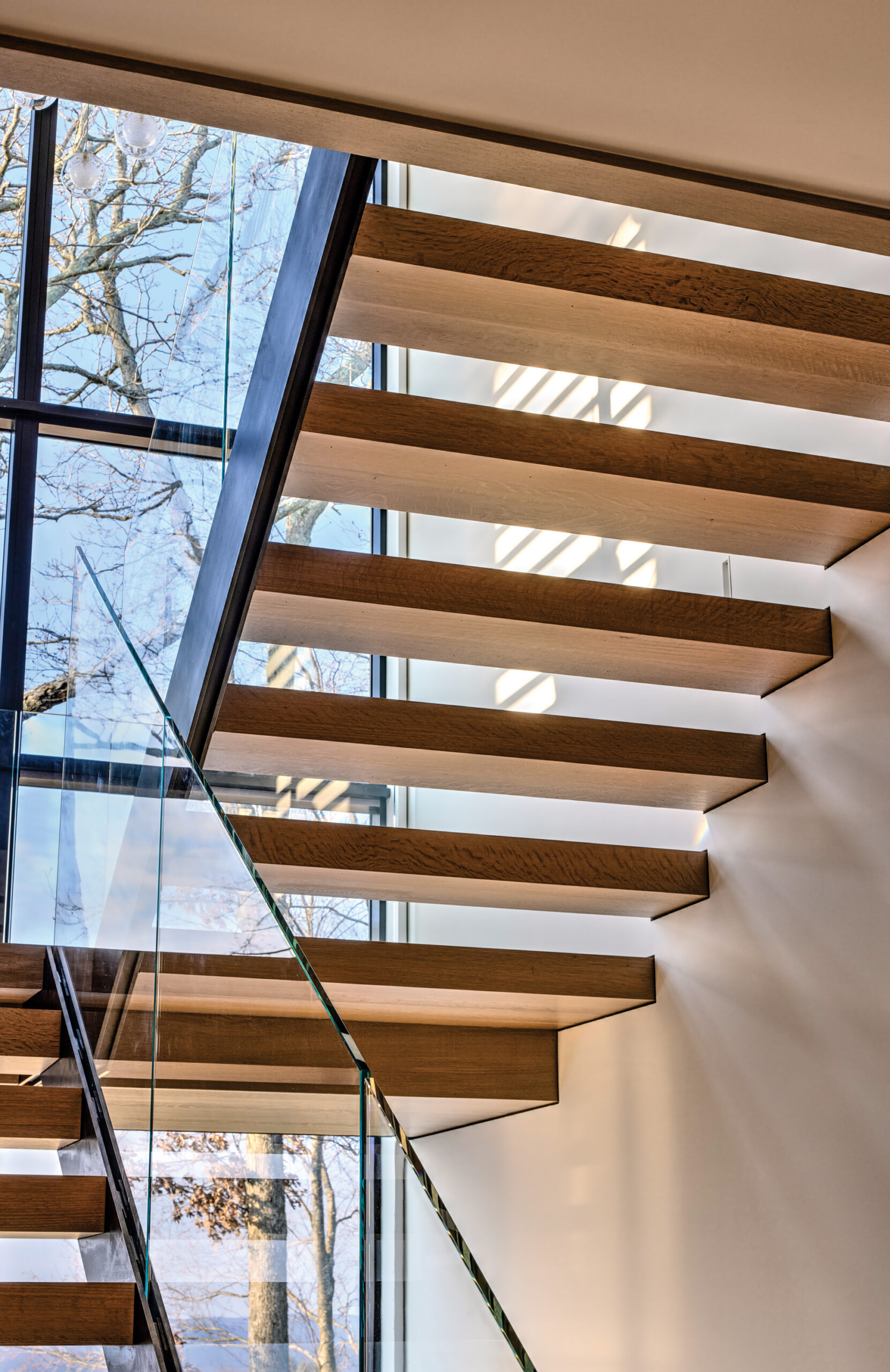
The open staircase to the lower level is enclosed by a glass and wood slatted wall. The contrasting horizontal slats cast beguiling geometric patterns.
‘I am always looking for durability in exterior materials,” says Martocchio. “Materials that have already aged and have patina and represent weathering are ones that I really like to use and also new materials that are newly innovative that have qualities of durability. The stone started it and then I had this idea of a pre-weathered siding, a grayish siding. Then to add contrast I used black or a really dark brown to highlight and emphasize the shapes. Those are the three main materials. Weaving them from outside into inside through glass walls was the goal to connect outside to inside. For example, there’s a very thin black window, two inches wide. The stone goes through that and reemerges on the interior, the exact same treatment. You really do feel like it’s an extension of the outdoors.”
Perched high on a hill, the home sustains a lot of wind, so extra care was taken to make it thermally tight and conserve energy, using layers of rigid insulation around the roof and the walls and below the slabs. White Oak Farm features high-efficiency heat pumps. “From a sustainability standpoint, we focused a lot on energy, indoor air quality, and durability because sustainability is about durability,” says Martocchio. “If you have to go back and replace something or fix something that’s not well built, you’re using more resources,” said Martocchio. “Trying to be very thoughtful about resources and having them be durable means there’s low maintenance and long-term enjoyment.”
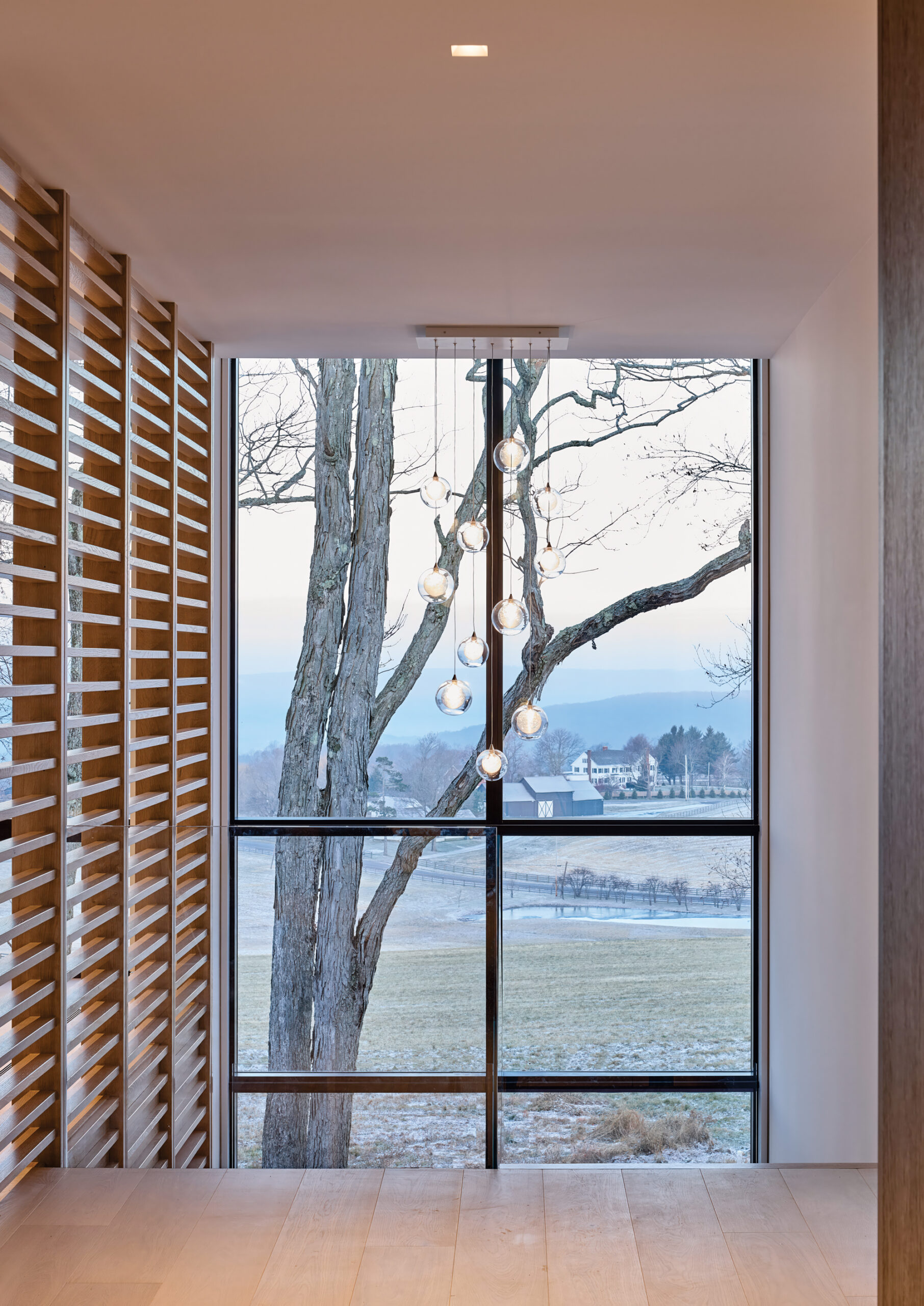
The hanging lights in the stair hall are from Brooklyn-based lighting manufacturer Shakuff.
Interior surfaces mirror the exterior siding choice with subtly hued oak cabinets grounding the kitchen. “The introduction of gray worked really well with the stone,” says Martocchio. “And we did a light-colored wood floor. The gray cabinets made a nice contrast, but were also visually soft, again, almost like wood that’s weathered.”
Carefully curated architectural lighting adds a touch of whimsy and subtle glamour. Martocchio worked with Brooklyn-based lighting designer manufacturer Shakuff to find hanging lights for the stair hall and a designer represented by New York City’s Ralph Pucci for the “cloud” light over the dining table.
“It’s almost like a little jewel to find the right light fixture,” says Martocchio. “I’m an architect first and foremost, but I also am an interior designer in that I know that objects, specific objects, can really transform a space, especially with beautiful sparkly light quality.”
Taking Flight
The home has three bedrooms on the lower level. To ensure the hilltop house wasn’t too tall and ostentatious, the design emphasized the horizontal and dropped the lower level into the hill. “The lower level features more stone, which has kind of a heavy quality, so it feels like it belongs in the hill,” says Martocchio. “There are the kids’ bedrooms at that lower level, but in a gesture towards long-term living for the clients and a single floor for their elderly years, their bedroom is on the ground floor. Everything is easily adaptably walked through on the upper level with the kitchen and their bedroom and the living room, while all the teenage kids are down on the lower level.”
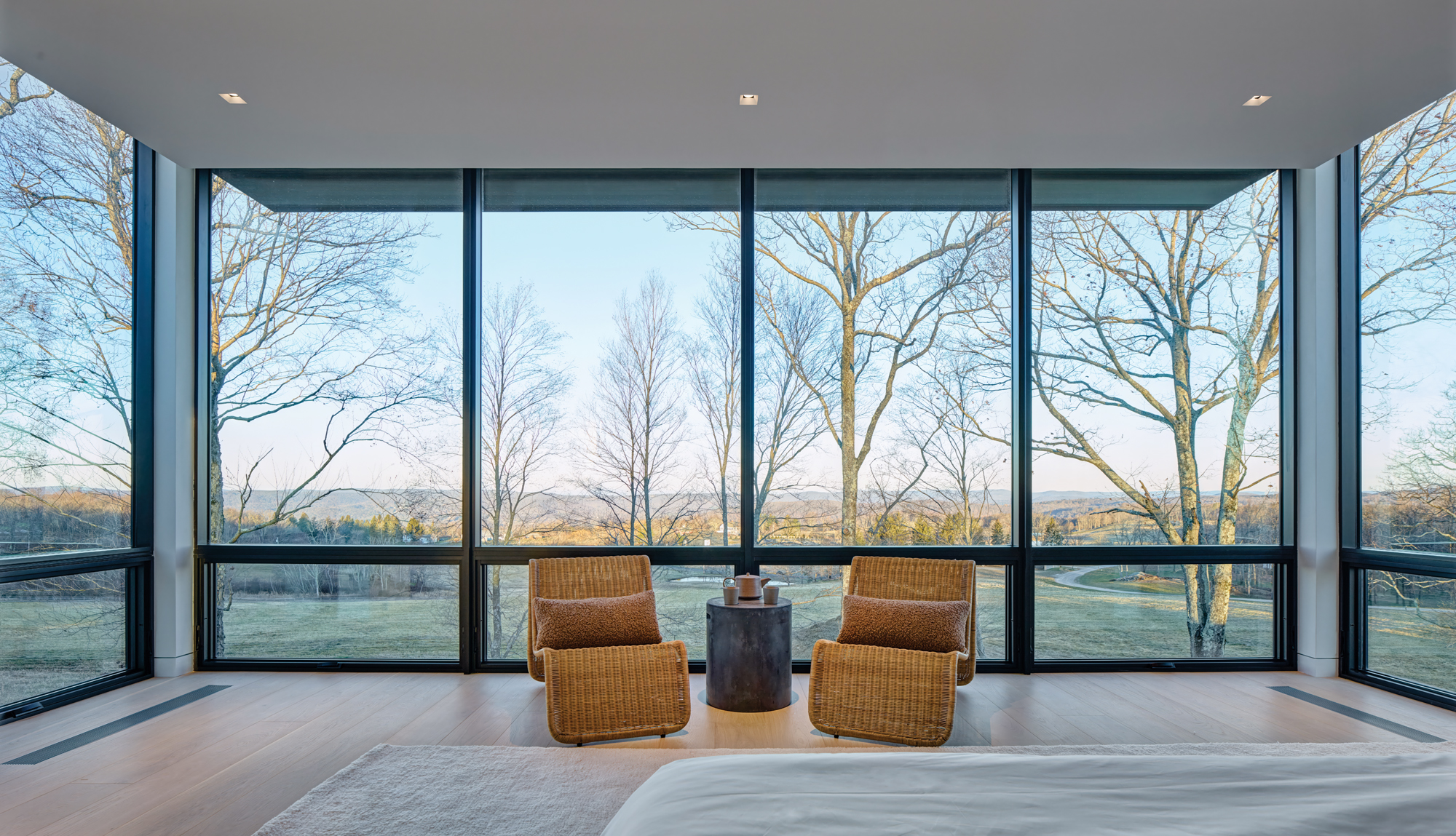
The homeowner wanted to conserve the property’s extensive woods and habitats, where he played as a child.
The open staircase to the lower level is enclosed by a glass and wood slatted wall, the contrasting horizontal slats making interesting geometric patterns. Descending the stairs involves facing a large window. “The lower level is dropped into the hill, so you feel like you’re taking flight,” says Martocchio. “It’s a very special zone to be in. Rather than opening it up to what’s called the keeping room right next to it, I wanted it to feel like its own space and also to start to reflect the woods around it. The slats give it its own space and kind of interact with the cantilever treads. There is a lot happening there, and it’s all done in oak and beautifully finished, but it’s all about the view. It’s not about the stairs, it’s about the views.”
Built with the help of Structure Works Construction in Millbrook and Gregory Hitchcock Design in New York City, White Oak Farm recently won the architect a 2025 Design Award Citation from AIA Westchester Hudson Valley.