
Steven Holl’s Architecture of Imagination
By Brian K. Mahoney | Spring 2025 | Design Feature
Steven Holl starts every day the same way: with a watercolor. Before the emails, before the meetings, before stepping into the sun-drenched studio at his Rhinebeck property, he picks up his brush, lets the paint bleed into the paper, and captures a fragment of an idea. Some of these sketches—five-by-seven inches of ink, color, and intuition—become buildings. Some don’t. But for Holl, one of the most celebrated architects of his generation, drawing is as fundamental as the structures it precedes.
It is fitting, then, that his latest exhibition, “Drawing Thought,” now on view at the Tchoban Foundation Museum of Architectural Drawing in Berlin through May 4, places over 100 drawings center stage. Split between two floors, the exhibition traces the evolution of Holl’s architectural thinking: the lower level houses his early, large-format, black-and-white drawings from the late 1970s and early ‘80s, while the upper floor showcases his now-signature watercolors. The show is a rare window into the mind of an architect whose work is at once deeply conceptual and rigorously practical, a balance struck through decades of disciplined drawing.

Palazzo del Cinema, Venice, Italy. Perspective, graphite and ink on paper, 83.5 × 75.25 centimeters, 1989
“I start every project with drawings,” Holl says. “After studying the site and the program, I begin sketching, and I write little texts beside them to try to get the idea to take form. But usually the drawing comes first.”
From the Hudson Valley to the World
Though Holl has built structures across the globe—from the Kiasma Museum of Contemporary Art in Helsinki to the Reid Building at the Glasgow School of Art—his home base has been Rhinebeck for years. Here, in the rolling hills of the Hudson Valley, he has found a landscape that speaks to his aesthetic philosophy: expansive light, deep shadows, and a kind of sublime openness that echoes through his work. “There’s something about the light here,” he says, referencing the region’s famed Hudson River School painters. “The way the glow of the sunset is picked up in the river, the way the sky moves over the landscape—it all informs the way I think about space.”

Void Space / Hinged Space, Fukuoka, Japan. Perspective, watercolor and pencil on paper, 12.7 × 17.78 centimeters, 1989
It’s no surprise, then, that he has left his architectural imprint on the valley. His most recent local project, completed last year, is a striking modernist home on Union Street in Hudson, designed for renowned collector Mark McDonald. Holl describes the house as an exploration of light and material, a theme that runs through much of his work, whether in the intimate scale of a private residence or the grand ambition of a university arts complex, like one currently under construction at the University of Pennsylvania in Philadelphia.
Yet Holl’s connection to the Hudson Valley extends beyond the projects he designs here—it’s also where his architectural philosophy takes physical form. Tucked away in the sylvan embrace of Rhinebeck, T Space is his modernist hermitage, a place where architecture, art, and sound converge in a choreography of light and form. Conceived in 2010 as an incubator for ideas, it houses an archive of 1,200 architectural models by Holl—miniature worlds of translucent watercolor and sculptural inquiry—while also serving as a gallery and performance space for artists, poets, and musicians attuned to the spatial sublime. Like Holl’s buildings, T Space isn’t just an object but an experience, a dialogue between structure and landscape, silence and resonance, where the geometry of thought meets the poetry of place.

Museum of Contemporary Art Kiasma, Helsinki, Finland. Study, section, watercolor and pencil on paper, 40.32 × 56.52 centimeters, 1993
Berlin, Then and Now
Holl’s relationship with Berlin dates back to 1988, when he won the competition for the Berlin Library—only to have the project shelved by local authorities. “It was a long story,” he says with a wry laugh. “But in a way, that project launched my career, even though I didn’t get to build it.” The library’s sweeping, fluid forms, imagined as a bridge over an existing building, signaled Holl’s arrival as an architect of ideas.
Fittingly, those original Berlin Library drawings are now the first thing visitors see upon entering “Drawing Thought.” “They’re big, black-and-white pencil drawings—part of that period in my work when I was doing these really large-format pieces,” he says. The upper level, by contrast, bursts with color, documenting his shift to watercolor as his primary medium for conceptualizing architecture.

Amerika-Gedenkbibliothek, Berlin, Germany. Perspective by night, watercolor, ink, and graphite on paper, 22.86 × 30.48 centimeters, 1988
That transition was, in part, a matter of efficiency. “The big-format drawings took me three or four days each,” he explains. “I realized that what mattered most was the idea itself. How could I get there faster? That’s when I started using five-by-seven watercolor pads. It let me work quickly and intuitively, and I could catalog everything. I have every sketch going back to 1980.”
The watercolors also serve a practical purpose: They allow Holl to communicate his ideas with clarity. “Clients love them because they’re conceptual. They’re not blinded by the artificial reality of digital renderings,” he says. “Renderings can be dangerous—they make it look like a project is fully formed when it isn’t. But a watercolor leaves room for thought.”
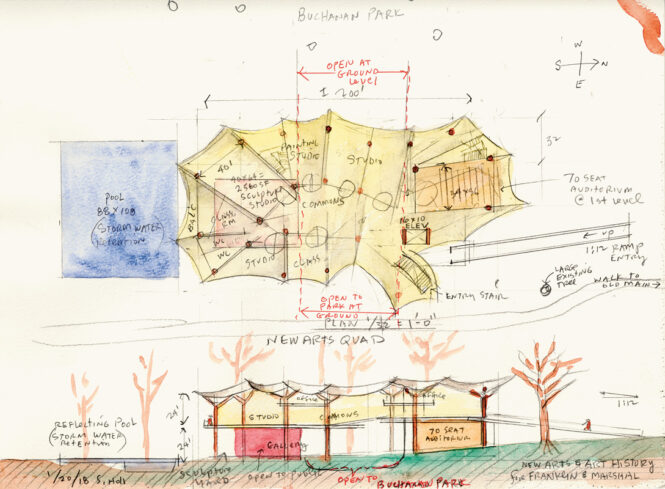
Winter Visual Arts Center, Franklin & Marshall College, Lancaster, Pennsylvania. Study, watercolor and pencil on paper, 30.48 × 40.64 centimeters, 2018
Architecture as Thought, Drawing as Process
For Holl, drawing isn’t just a way to illustrate a project—it is the project. “The process of bringing a building together is just as much a drawing process as it is a written one,” he says. His sketches don’t just depict buildings; they define them, guiding their evolution from idea to structure. His Maggie’s Centre cancer care facility in London, for instance, began as a series of overlapping sketches: a “thing within a thing within a thing,” he says, layering exposed structure, a warm bamboo interior, and an external frame resembling a staff of musical notes.
And while digital tools have become standard in architecture, Holl remains a staunch advocate for hand drawing. “I don’t allow my students to use digital renderings,” he says of his teaching at Columbia University. “Work with your ideas, however you want—charcoal, ink, watercolor, whatever—but don’t rely on a computer. If you cut and paste a building together in an hour, there’s no real thought behind it.”
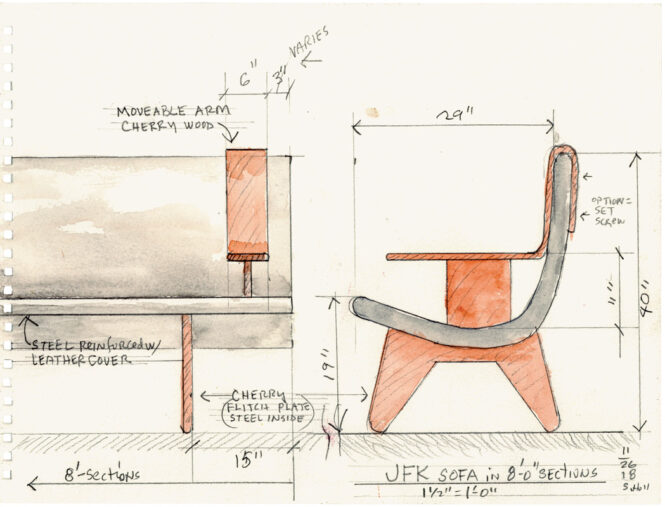
The REACH, Kennedy Center, Washington, DC. Sofa, watercolor and pencil on paper, 22.86 × 30.48 centimeters, 2018
His commitment to drawing extends beyond the classroom. Even as architecture leans increasingly into technology-driven design, Holl sees his watercolors as a vital part of his practice. He takes his watercolor book with him everywhere and paints whenever an idea strikes him— in hotels, on airplanes. “I ask the flight attendant for a cup of water, and I use that for the watercolor,” he says. “It’s how I work out my thoughts.”
The Longevity of an Idea
Unlike poets, whose best work often emerges in youth, architectural careers don’t blossom until middle age. “It just takes so long to build something,” Holl says. “Our average project takes eight years from first sketch to completion.” The Kiasma Museum in Helsinki, for instance, was completed in 1993, when he was 50—after years of teaching, drawing, and waiting for the right opportunity. “Before that, I was living in a cold-water loft in New York, sleeping on a plywood shelf,” he recalls.
Now, with over 60 built works to his name and more in progress—including projects in Tirana, Albania, and Rome—Holl’s influence is undeniable. Yet, for all the glass, concrete, and stone he has shaped into lasting form, it all starts with drawings, capturing the essence of his architecture before it ever reaches the ground.
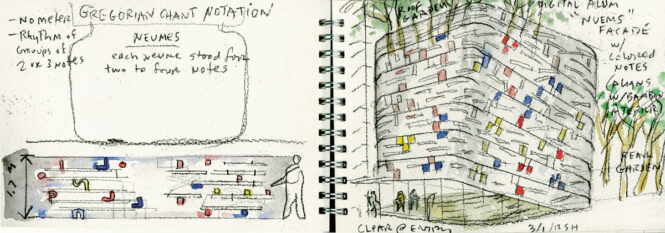
Maggie’s Centre Barts, London, United Kingdom. Gregorian chant notation, neumes spread, watercolor and charcoal on paper, sketchbook, 12.7 × 35.56 centimeters, 2012
“Drawing is thought,” he says. “It’s intuition. It’s the beginning of everything.”
But if drawing is the beginning, the real test of an architect’s work is how it holds up over time. For Holl, the best architecture doesn’t just endure—it deepens, gathering richness as the years pass.
For Holl, architecture isn’t just about the present moment—it’s about endurance. “Most buildings that weren’t well built or well thought through don’t look so good after 10 years,” he says. “But if a building is designed with care, if the materials, light, and structure are considered deeply, it can not only last but actually improve over time.” One of his own projects, the Chapel of Saint Ignatius in Seattle, exemplifies this philosophy.
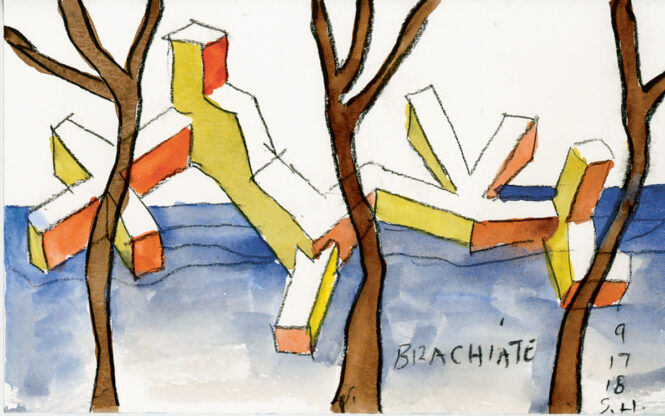
Rhinebeck Campus, Archive & Library, Rhinebeck, New York. Brachiate. Watercolor and charcoal on paper, 12.7 × 20.32 centimeters, 2018
“That building is 27 years old now, and it looks fantastic,” Holl says. “They keep it beautifully, but beyond that, the materials have developed a patina—the wood has aged, the Alaskan cedar doors have deepened in color, the bronze handles shine where they’ve been touched and darken where they haven’t. The concrete floor has taken on its own character. That’s what I love—when a building gains richness as it ages, rather than deteriorating.”
Holl is wary of architecture that prioritizes novelty over longevity. “I’ve never believed in throwaway buildings—where you build something cheap, knowing it’ll be torn down in a couple of decades,” he says. “That’s environmentally wasteful and architecturally irresponsible. If you design a building well, with good light, good space, good materials, it can serve generations.”