
The Kerhonkson Cloud House: The Architecture of Efficiency
By Mary Angeles Armstrong | Photos by Devon Banks Photography | Spring 2025 | House Feature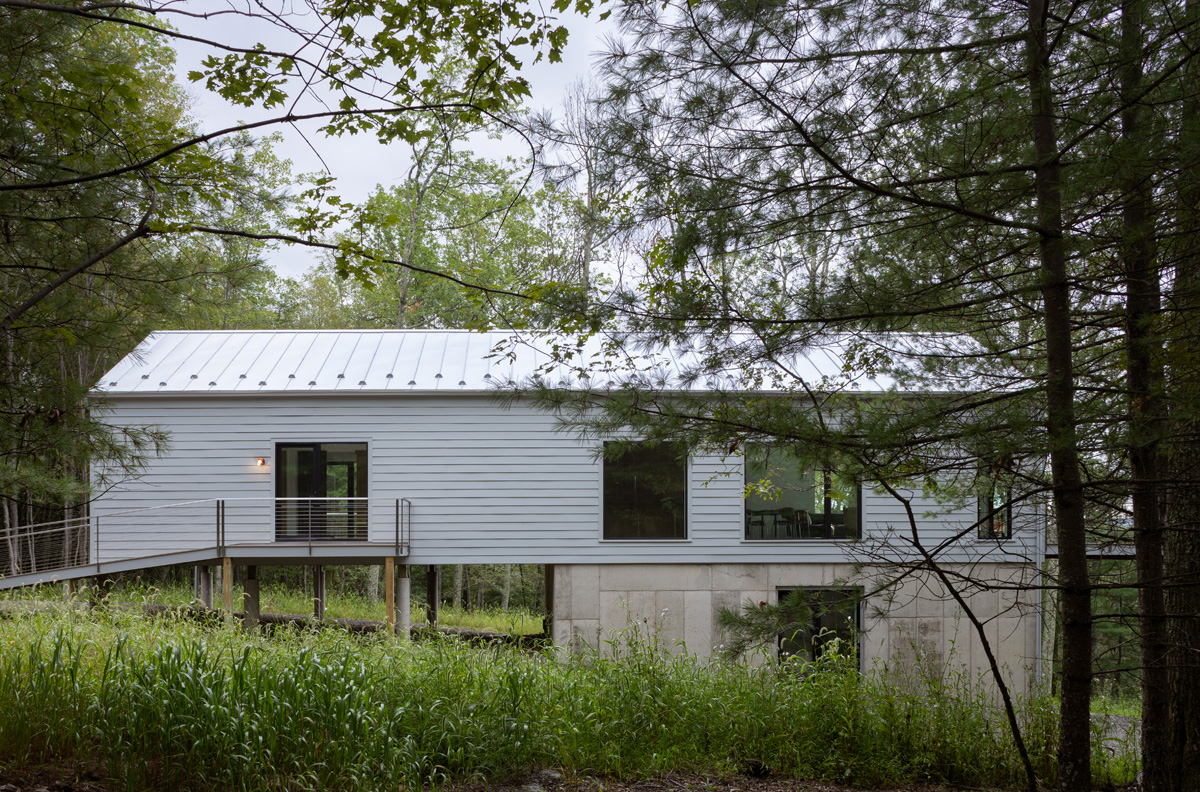
Even though economist-turned-architect Leah Solk’s take on residential design is, well, decidedly economical—maximizing resources, prioritizing functional layouts, and emphasizing adaptable spaces that yield long-term benefits—her approach is far from dry. Rather, Solk reimagines the principles of “the dismal science” and turns them on their head, creating spaces that cut through the superfluous but leave plenty of room for the simple, the easeful, and even dashes of play.
This mashup of economics and aesthetics comes to life in her Kerhonkson Cloud House. Intentional, adaptable, and decidedly off-trend, the contemporary 2,100-square-foot retreat serves as a personal escape from frenetic city life, embracing simplicity and enriched by the surrounding forest. It demonstrates how small, smart choices made consistently over time can compound into design gold.
Long-Term Interest
A former analyst for the Federal Reserve, Solk began her career writing code and observing economic feedback loops. “I worked with some incredible economists,” she explains. “But I knew I had to do something creative, very specifically involving hand drawing, to be happy.” She realized architecture would challenge both the analytical and creative sides of her brain, so she quit her job with the government and headed to graduate school. After receiving her license, she moved to New York City to pursue her design career.
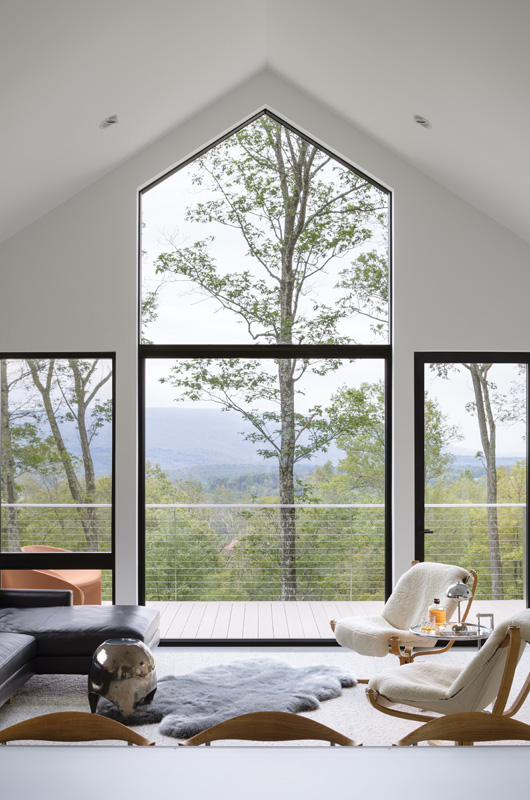
After much deliberation, architect Leah Solk designed her Kerhonkson retreat to extend from the high point of her four acres out toward the Mohonk Preserve. At the end of the structure, the living room is awash in valley views and sunlight. “In summer, it feels like a tree house,” she explains. “We left the remaining site as natural as possible—I didn’t want to look out and see a sanitized version of nature, but instead see what naturally grows and changes with the seasons.”
Solk and her husband began regularly visiting the Hudson Valley on weekends to decompress. “Once we started coming up and experiencing this side of the river, we knew it was where we wanted to be,” says Solk of southern Ulster County. “We loved all the opportunities to experience nature, especially biking and trail running.”
In 2017, on one of their local rambles, they came across four undeveloped acres straddling a ridge near the Mohonk Preserve. “The best feature was the view of the valley and Lake Minnewaska beyond,” says Solk. “We weren’t quite ready to build yet, but we knew it was a special place and couldn’t pass it up.”
They bought the property, feeling gung-ho about beginning the project as soon as they were able. “At first we thought, ‘Let’s build right away, let’s do it,’” says Solk. She designed a linear, one-story home sited in the center of the four acres. “It was basically a rectangle cutting across the slope of the property,” she explains. “The idea was to have as many rooms with a view as possible.” They visited the site often, staying with friends nearby and getting to know the region better.
Off-Trend Analysis
Meanwhile, Solk was working at different architecture firms and developing her own philosophy of design. Informed by her background in economics, a discipline that lends itself to both mindful resource management and sustainability, she evolved a thoughtful and slow approach to architecture—a deliberate counterpoint to the rapid pace of modern consumer culture. “My style is decidedly non-trendy,” she explains. “Styles come and go—maximalism, minimalism, what do those even mean? I think if you’re going to take action, spend money, and create something using resources it should be with purpose, either by being deeply functional or just by bringing joy.”
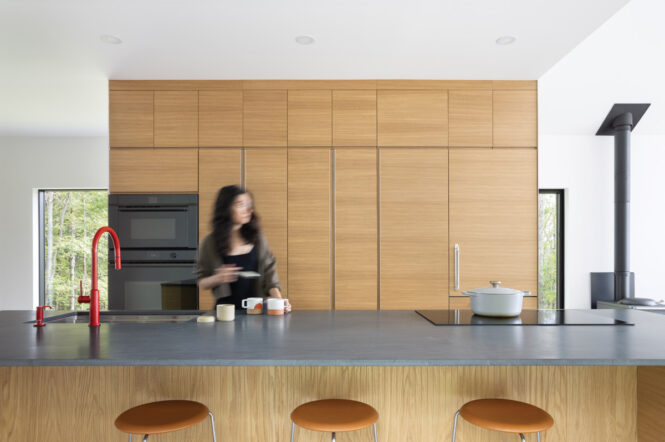
Solk, an enthusiastic cook, in her open-concept kitchen. The 12-foot center island can incorporate multiple work areas and also guests. “Everything happens around that island,” she says. “So I wanted it to always face outward; toward guests, the sitting area, and the views.” The Graff M. E. PullDown kitchen faucet in custom red changes up the otherwise subdued color scheme and adds a dash of playfulness to the design.
After tackling both commercial and residential projects, she began to hone her focus on home design and in 2019 opened Solk Architecture, a full-service design firm marrying her creativity with her analytical skills. “Economics is a mindset,” she explains. “Running a healthy business that is transparent while also respectful of everyone involved is very important to me.” Rooted in the idea that architecture should simplify and enhance daily life, she works collaboratively and transparently with clients to ensure her designs meet both aesthetic and functional needs.
Cloud Clearing
As Solk developed her own practice, she began to look at the Kerhonkson property through her evolving lens. She spent many weekends exploring the plot, walking the terrain or just sitting and looking at the view. “I watched how the land changed with the seasons,” she says. “I also begin examining the slope and grading of the ridge.” The more she returned, the more she realized her initial design wasn’t right. “The property access was at the ridge’s high point, but when I walked down the hill to the site I’d planned, I always wished I was still at that higher level,” she explains. There was also the issue of water flowing towards the house from the ridge. Solk saw that her initial approach didn’t align with the site’s topography, practically or aesthetically. “The more time we spent here, the more it became clear that the house should feel like it was floating at the high point of the site,” she explains. “With the land gently slipping away beneath it.”
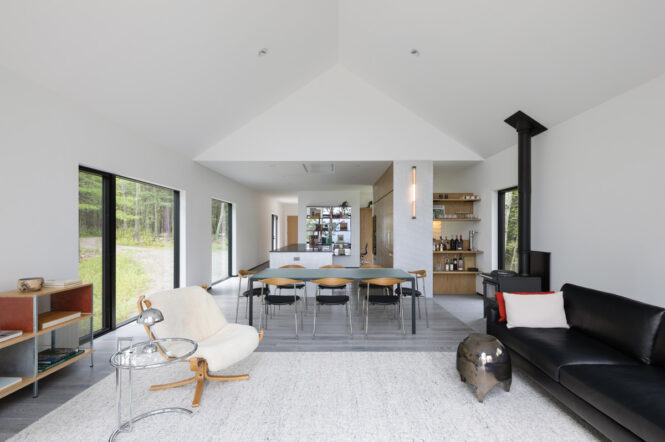
Solk selected the interior furniture and finishes early in the design process to complement the architecture conceptually and ensure the rooms remained proportional. “The interior material palette is subdued, inviting the exterior views to fill the home,” she says. Bare metal and warm white oak throughout the home suggest simplicity and turn down the busy visual and acoustical sensory experience of city life. Radiant heated, engineered oak floor boards by the Hudson Company are finished in Skyfall. Solk reupholstered the vintage Falcon chairs in shearling and matched them with a chrome and glass table by Eileen Gray and a metallic glazed, domed wood side table by Kieran Kinsella.
So, Solk started over. She tore up her original design and sketched out a new draft inspired by the property’s natural beauty. This time, she envisioned a simple form riffing on the region’s farmhouse vernacular with a pitched roof. “I kept the outside form of the house as simple as possible,” she explains. She reoriented the structure 180 degrees, divided the space between two floors, and then anchored the entrance at the top of the property. “Instead of being completely embedded in the landscape, the volume floats above the ground, almost like it’s sitting amongst the clouds.” Simple, locally sourced materials would minimize the need for maintenance and keep building costs down.
In 2023—with blueprints, fixtures, details, and finishes completely planned and drawn out—the couple finally began building. “We took the time to ensure there would be no changes during construction,” she says. With the help of Austin Sweeney of Sweeney Custom Builders, they were able to complete the project in 12 months. “The construction process was incredibly smooth,” she says. “Austin understood the design priorities and I’m proud that all of the careful details and alignments came out just as planned.”
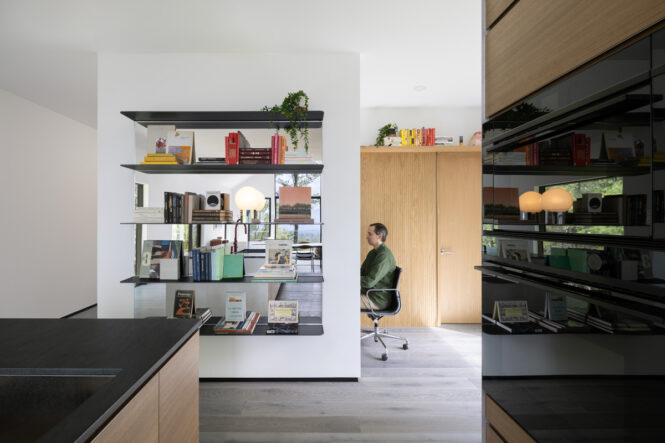
“A lot of architecture is just about playing with light,” says Solk. Case in point: At the center of the structure, Solk incorporated a mirrored bookshelf, carving out an office nook and reflecting light. “I think mirrors are under-utilized,” Solk says. “During the winter light reaches deep into the structure and hits those mirrors and lights up the kitchen, even though it’s in the middle of the house.”
The Invisible Hand of the Architect
To keep with her minimalist approach, Solk clad the exterior with gray cement board and exposed concrete. The standing seam metal roof matches the neutral exterior, is easily maintained and durable. “In a sea of Hudson Valley trendy blackened-wood siding, the design evokes a neutral and practical presence,” she says.
Inside, Solk created an intuitive layout, maximizing light throughout the seasons and adaptability over time. “Good architecture is the interior design,” she explains. “You don’t need architecture with interior design layered on top. Good design just works.” Accessed from a ramp leading from the apex of the hill, the entranceway is a transitional space between outdoor activities and the serene interior. Lined with gray porcelain tile, the entrance “is very forgiving of mud, dirt, and water,” says Solk. Direct access to the laundry is hidden in the corner behind a panel door.
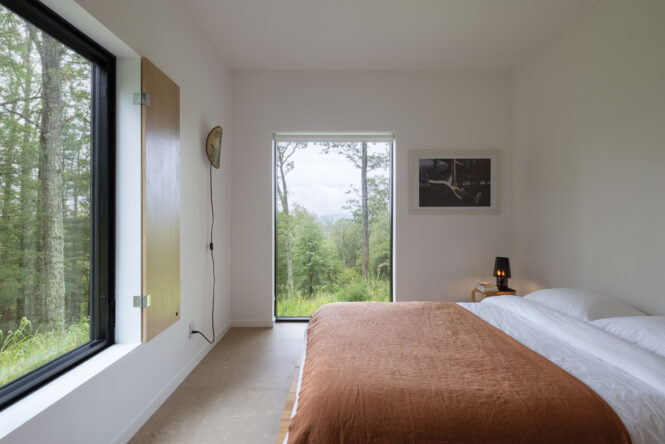
Solk incorporated Duro Design cork flooring in the downstairs bedroom and custom-designed shutters from white oak plywood for the east-facing window. “I wanted to close it off without detracting from the feeling of being open to the setting,” she says. A Servomuto Birds & Butterflies wall sconce from Italy hangs on one wall; a print by photographer Danelle Manthey hangs on the other.
From the foyer, the first-floor flows through the open-concept kitchen to the living area with floor-to-ceiling windows on three sides. “The first floor aligns with the site’s high point,” she says. “Then the main floor extends out toward the view so that the living room seems to float as the fog rolls up from the valley below,” says Solk.
The spaces are all connected,” explains Solk. “But also distinct from one another.” To distinguish the different areas, Solk varied the ceiling heights, incorporating cathedral ceilings above the lounge and a wall of double-height windows facing the valley below. Throughout the first-floor, neutral oak paneling unifies the areas and cleverly conceals plenty of storage. An avid cook, Solk incorporated a 12-foot island into the central kitchen.
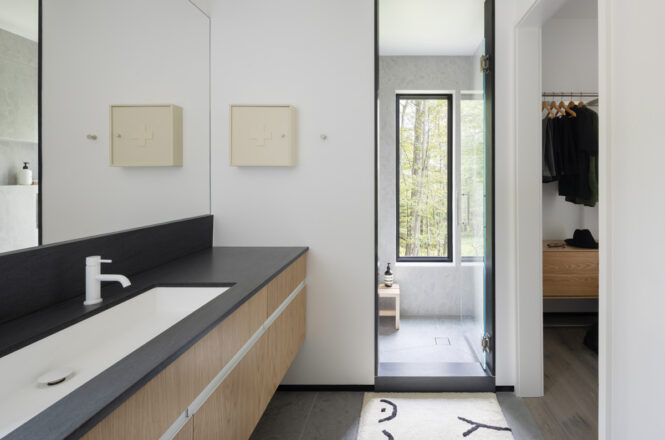
The primary bathroom shower features Graff M. E. Plumbing in matte white. The rest of the design is intentionally simplified and natural. “Incorporating economy into design isn’t just about price,” says Solk. “It’s about not adding things that aren’t necessary.” The bathroom also features zoned radiant-floor heating. Solk prioritized triple-paned windows and tight insulation in the home’s construction. “I have zero tolerance for cold so the space is very toasty, even on the coldest days,” says Solk. “The home is incredibly tight with a fresh air system circulating outside air and internal temperatures warmed with minimal energy expenditure.”
A mirrored wall reflects sunlight through the space and creates an office nook. Tucked behind, the primary suite looks onto a grove of trees. The bathroom is accessed by passing through a walk-through closet. Storage space is one thing the minimalist designer is a maximalist for. “I always add more storage than people think they need,” she explains. “It keeps things from getting messy and you always manage to fill it.”
Downstairs, Solk incorporated a guest room and a studio space for drawing and the occasional weekend design project. Working with and within the Hudson Valley landscape was rewarding for Solk. “This design might not be right for everybody, but that’s what makes it such a joy,” she says. “It’s completely customized to how we live. Architecture should appear effortless and it’s very rewarding that the house functions that way.”