
Plum Design Group Revives a Beloved Shawangunk Ridge Home
By Mary Angeles Armstrong | Photos by Nora Scarlett | Winter 2025 | House Feature
When Hudson Valley natives Lowell Deutschlander and Jesse Meisler-Abramson founded Plum Design Group, a drafting and construction management studio, they aimed to create organic, locally referencing designs close to home. They didn’t realize, however, just how close to home their work would bring them. “I like architecture that tells me where I am,” explains Deutchlander of the studio’s inspiration. “That can mean fitting into the surrounding natural landscape, or the vibe of the existing built environment. We wanted to work within natural parameters without erasing the past.” For Meisler-Abramson, Plum Design emerged from his growing environmental awareness and the hopes of working with others who love the Hudson Valley and Catskills region as much as he does. “We both grew up here and care for this area,” says Meisler-Abramson. “We love working with people who care about this place too—even if they’ve just discovered it.”
In 2022, the duo was approached by local builder Stuart Reitz to spearhead the potential remodel of a three-story, pond-side home facing the Shawangunk Mountains. Built by pioneering architect Isabella Gillon in 1989, the playful, rural modernist design was familiar to Deutchlander—like very, very familiar. “I grew up in another home Isabella designed,” explains Deutchlander. “She also designed many of the other homes in this neighborhood. So I spent lots of time in her houses, not just my own but also friends’ and neighbors’ variations.” Walking around the home was a bit like deja vu. Many of the architectural motifs that were the backdrop to Deutchlander’s childhood—double-sided stone fireplaces, playfully angled walls, rows of sliced vertical windows—echoed through the pond house. “She did a lot of interesting experiments with different shapes and arrangements, and she played with angles,” says Deutchlander. “Her very distinctive style was a big influence on me.”
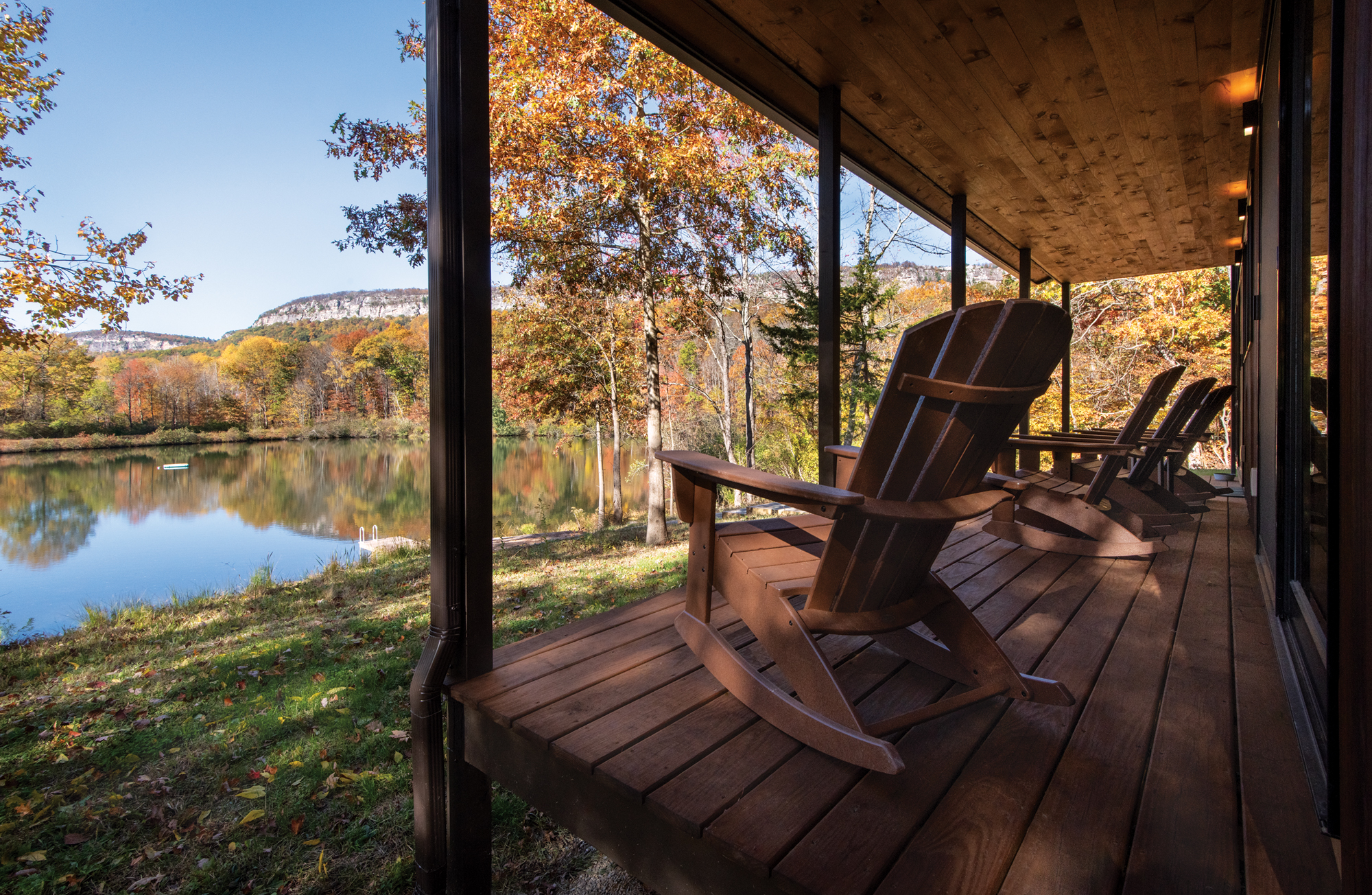
In the 1970s and ‘80s, architect Isabella Gillon designed multiple homes in the shadow of the Shawangunk Mountains, then built her own dream property on 24 idyllic acres backing up to the Mohonk Preserve. When Lowell Deutschlander—one half of Plum Design Group—was approached by the home’s new owners to help with a redesign, it felt like serendipity. He’d grown up in another of Gillon’s houses nearby and knew the neighborhood—and Gillon’s design quirks—well.
Originally Gillon’s own home, the 4,000-square-foot house and surrounding 24-acre property was a short-term rental before the new owners bought it. “They wanted a special gathering space for friends and family, and especially wanted to capture the magnificent Shawangunk Ridge view,” explains Deutchlander. “But they didn’t want to erase Isabella Gillon’s creation.” The design duo jumped at the chance to play with Gillon’s original vision while evolving it into something distinctive. “In a way, it was like catching a ball that Isabella threw back in 1989,” says Deutchlander.
The Art of Slow Building Designs
Although Deutschlander and Meisler-Abramson didn’t meet until they were adults, both enjoyed parallel Hudson Valley childhoods. The son of a sculptor, Meisler-Abramson grew up in Woodstock in a cabin his parents bought in the 1970s and slowly adapted for family life. “It was 150 square feet with no running water or electricity,” he explains. “Over 20 years, as they made money, they added to the design.” Although by the time Meisler-Abramson came along, his parents had finished most of the cabin’s renovation, understanding his parents’ slow, evolving process of constructing the family home planted early seeds.
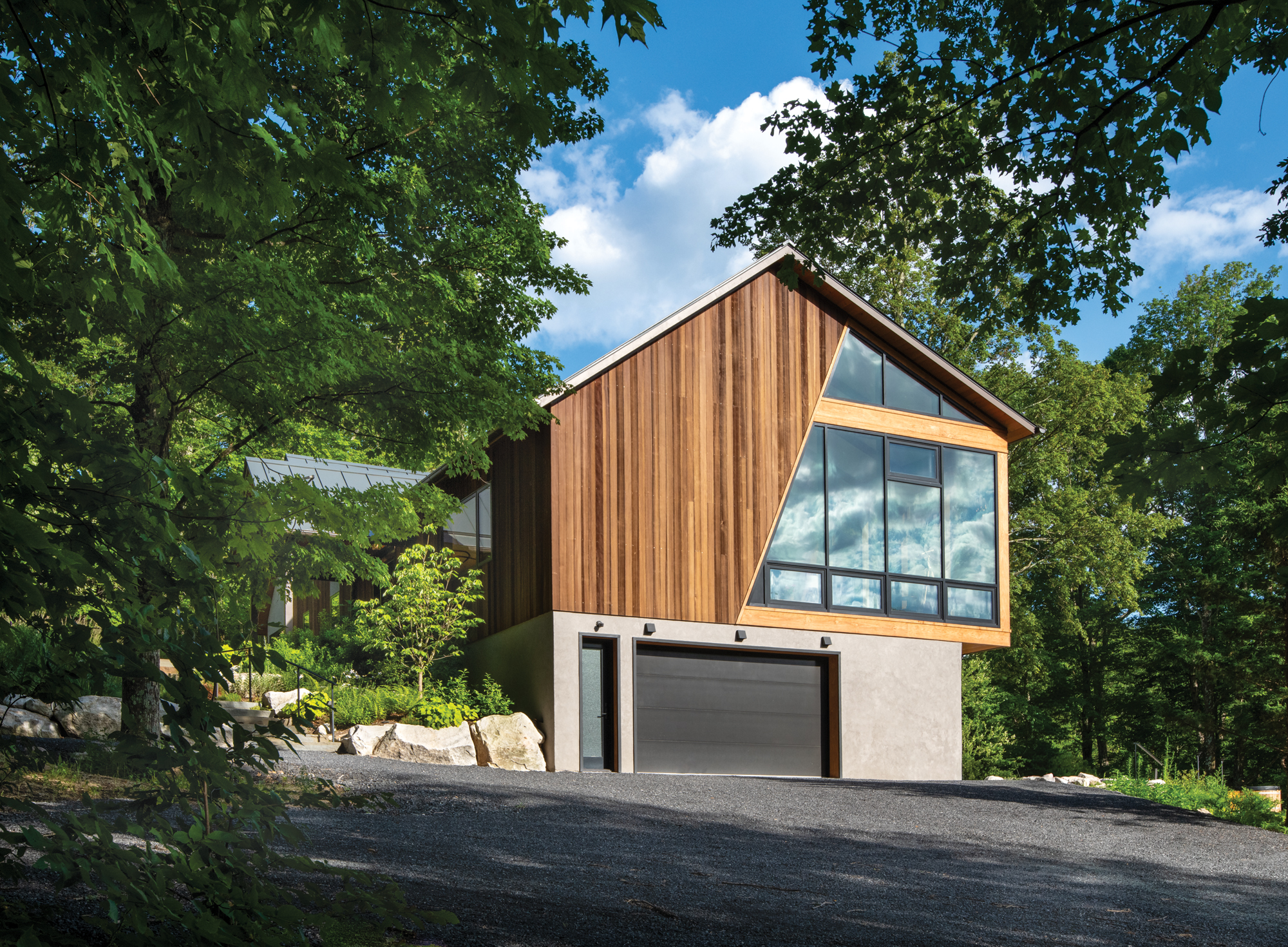
Plum Design Group’s main objective was to add light and a feeling of spaciousness to Gillon’s original design. “The initial issue with the house was that there were no good views of the cliffs,” says Jesse Meisler-Abramson. They clad the new exterior in shou sugi ban siding and added a standing seam metal roof.
A growing environmental awareness led him to Sweden, where he built straw bale houses. “That was my first time doing any hands-on building myself,” he says. “I fell in love with the process and had the vision of building things.” After college, he apprenticed with sustainability-focused architecture firms, including Earthships and Biologic Design, then took a course at UC Berkeley’s College of Environmental Design, with an eye toward attending architecture school. He realized, however, that office culture wasn’t for him. “I want to have a balanced life with time in nature,” he explains. “But I still really liked the trades, I liked building, and I love thinking about design.” He worked in construction, picked up some CAD skills, and by 2019, he’d come full circle, moving back to the Hudson Valley.
Whether East or West, Home is Best
Deutschlander also flirted with architecture before realizing the profession wasn’t a good fit. Raised by a photographer at the foot of the Gunks, he left to study architecture at the University of Buffalo. “I realized I didn’t want to spend 16 to 18 hours at a desk and not have a life outside,” he explains. Instead, he took carpentry jobs to understand construction firsthand and traveled widely around the country. “I developed an appreciation for different regional styles and how forms of architecture and design styles can create and reinforce a sense of place,” he explains. After living out West for several years, Deutschlander returned to the Hudson Valley in 2015.
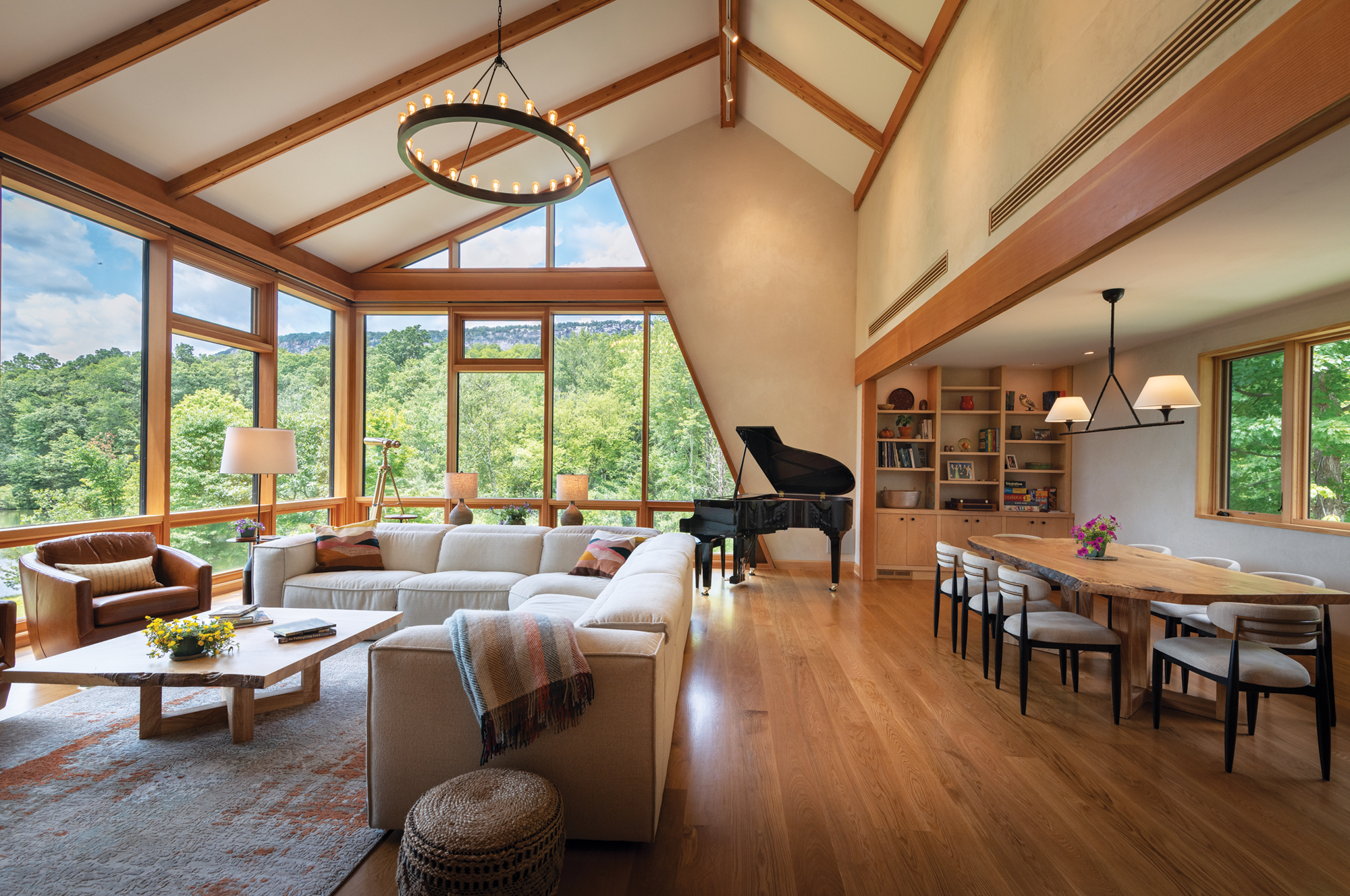
After expanding the main floor living room to include 19-foot ceilings, Plum Design Group added triple-pane glass walls from Sierra Pacific Windows. “Our goal was to create a modern aesthetic that felt comfortable and homey,” says Meisler-Abramson. While building an on-site guest house, the team found a giant dead ash tree. New York Heartwoods milled the tree, and Makers Accord built the live-edge dining table from the salvaged ash.
The two finally met on a canoe trip along the Delaware River in 2020. “Before we knew what each other’s jobs or interests were, we started discussing all the riverfront houses we were paddling by. Then the discussion moved on to our likes and critiques,” Meisler-Abramson recalls. “It was that initial conversation that built our friendship and got our business started.” They realized their sensibilities aligned perfectly. Both had a deep reverence for place; both were shaped by unconventional architectural educations; both were committed to work-life balance, and building in harmony with the regional landscape. By the time they paddled to shore, Plum Design Group was essentially born.
Panoramic Postcard
As they saw it, the home’s biggest drawback was the lack of integration between the interior and the site’s spectacular setting. Sited along the forest line, the home faced a pond built by Gillon but offered only postage-stamp views of the adjacent ridge. “Originally, the home had an H roof line with gables on each end,” explains Deutschlander. “The main double-height living space was in the center of the house. The kitchen and bathroom were situated in the corner with limited horizontal and vertical windows facing the cliffs. You had to crouch down and look through the gap to even see that they were there.”
Upstairs, a catwalk through the living area connected four bedrooms and two additional bathrooms on either side. On the first floor, two guest rooms faced back into the forest. At the basement level, a bar and family room offered direct access to the pond and a hot tub, as well as additional bedrooms. “Our simple starting concept was to flip the layout, so that the double-height space faced the ridge and a more open-concept kitchen moved towards the center of the design,” explains Deutschlander. To manifest their vision, the team had to tear the cliff-facing side of the house down to the studs. Working with Tivoli-based architect Lee Frizzell, they reimagined an expansive double-height living room with dramatic 19-foot cathedral ceilings and walls of 12-foot, triple-paned windows facing south and west. Exposed beams and posts carved from Douglas fir, as well as white oak flooring, echo the arboreal setting and further blur the boundary between the living room and the surrounding landscape.
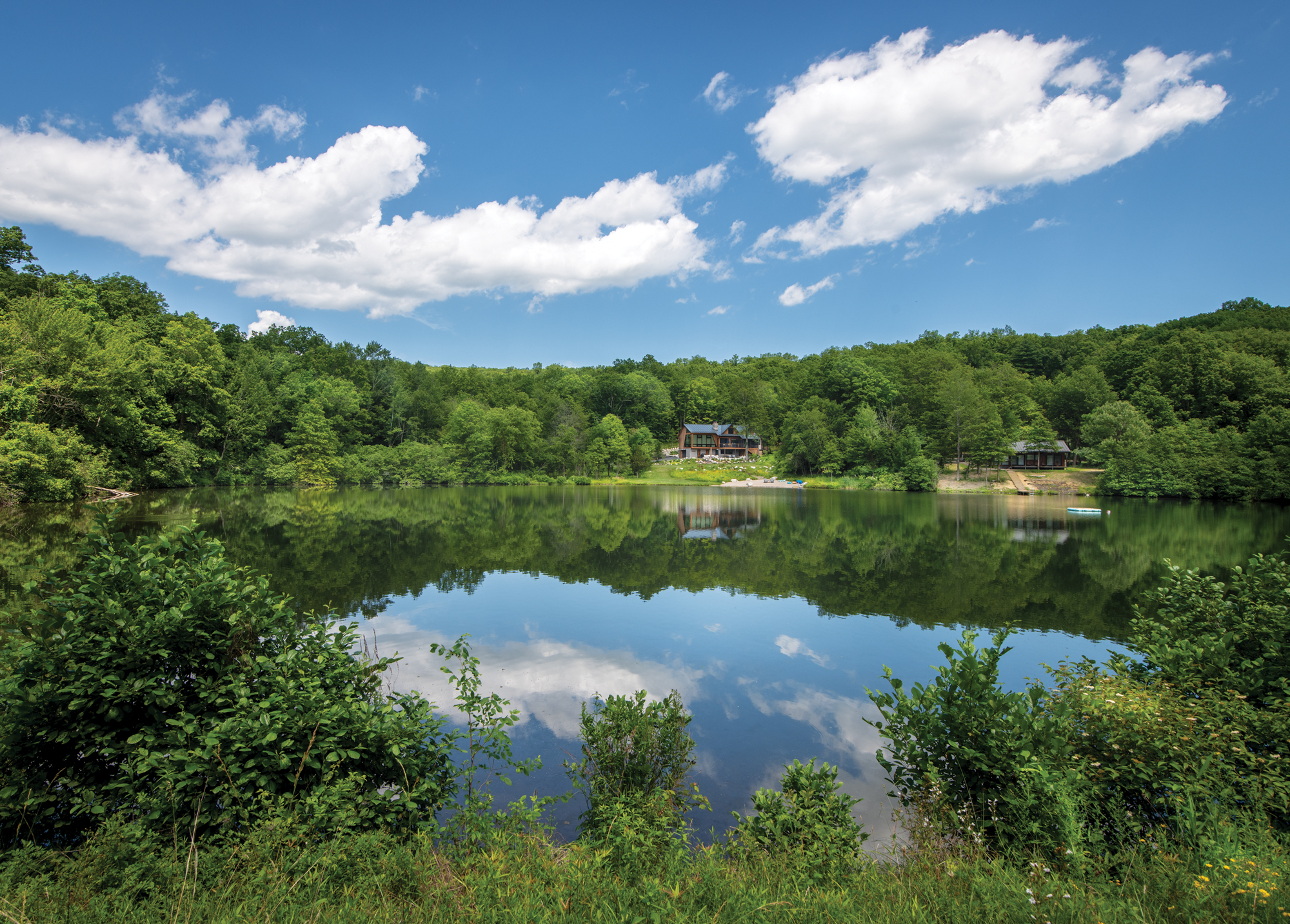
The home sits back from the road behind the lake created by Gillon. Although Deutschlander was very familiar with Gillon’s work from his own and neighbors’ homes, he had only met his architect neighbor once. “This house was a mystery to me,” he says. “I always wondered what kind of house is at the end of that long driveway?”
Central to the new layout, Gillon’s iconic double-sided stone fireplace—built from stones harvested onsite—works as a natural boundary between the living area and the home’s new kitchen, reaching from the basement level up to the ceiling. Here, Plum Design created a modern kitchen around an island salvaged from a giant, dead ash tree. “New York Heartwoods milled the bottom of the tree into a single slab, live-edge dining table,” says Deutschlander. “The remaining wood became the island, stair treads, railings, and smaller furniture pieces.” Deep blue Brazilian quartzite countertops and mixed sage and slate blue cabinetry enhance the organic stone fireplace and the exterior ridge vernacular.
Full-Circle Design
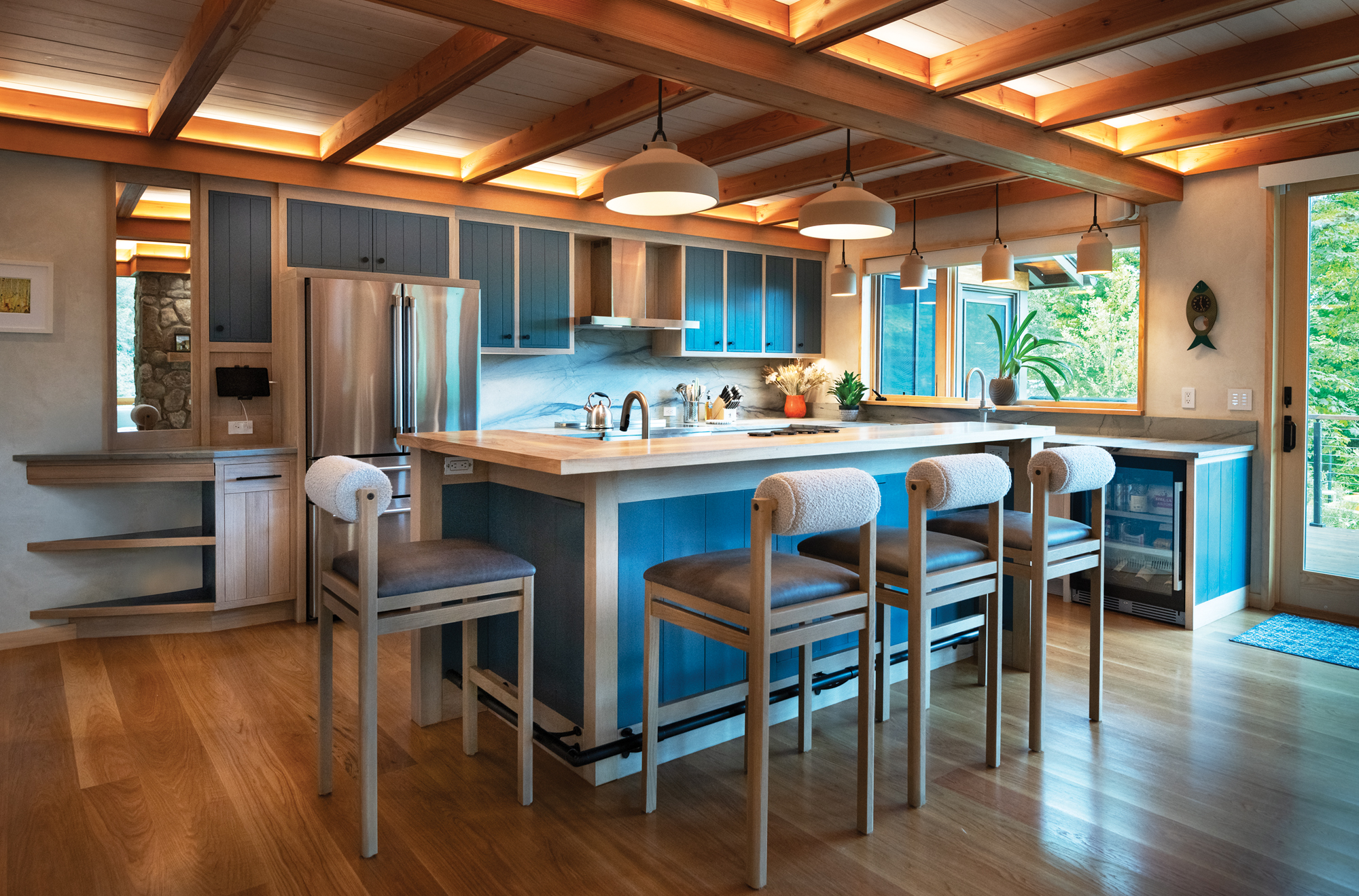
After expanding the living room, Plum Designs collaborated with builder Stuart Seitz to construct a new kitchen at the center of the main floor. Open to the home’s iconic stone fireplace, the kitchen enjoys access to a deck with views of the lake and ridge.
By combining two guest rooms on the first floor, the team created a spacious primary bedroom suite with a stone-infused spa bathroom. Double pocket doors muffle sound from the adjacent kitchen, creating a peaceful haven steps from the gathering spaces but steeped in the forest setting. By adding doors on either side of the bed, the team created a circular flow between the suite’s spaces. “Both sides of the bed have direct access to the bathroom,” explains Meisler-Abramson. A large walk-through closet separates the bedroom from the bath, and a private screened-in porch offers ample views of both the pond and the mountain range.
The eastern side of the home’s second floor required the lightest touch. “This side of the house actually worked really well,” says Deutschlander. Originally configured as two bedrooms flanking a shared bath with a small crawl space behind, the bones were sound. Eliminating the crawl space, they were able to enlarge the bathroom and push the wall further out. They also carved a new second-floor music room from the home’s former attic space by raising the roofline and adding a new dormer—as well as multiple layers of sound insulation.
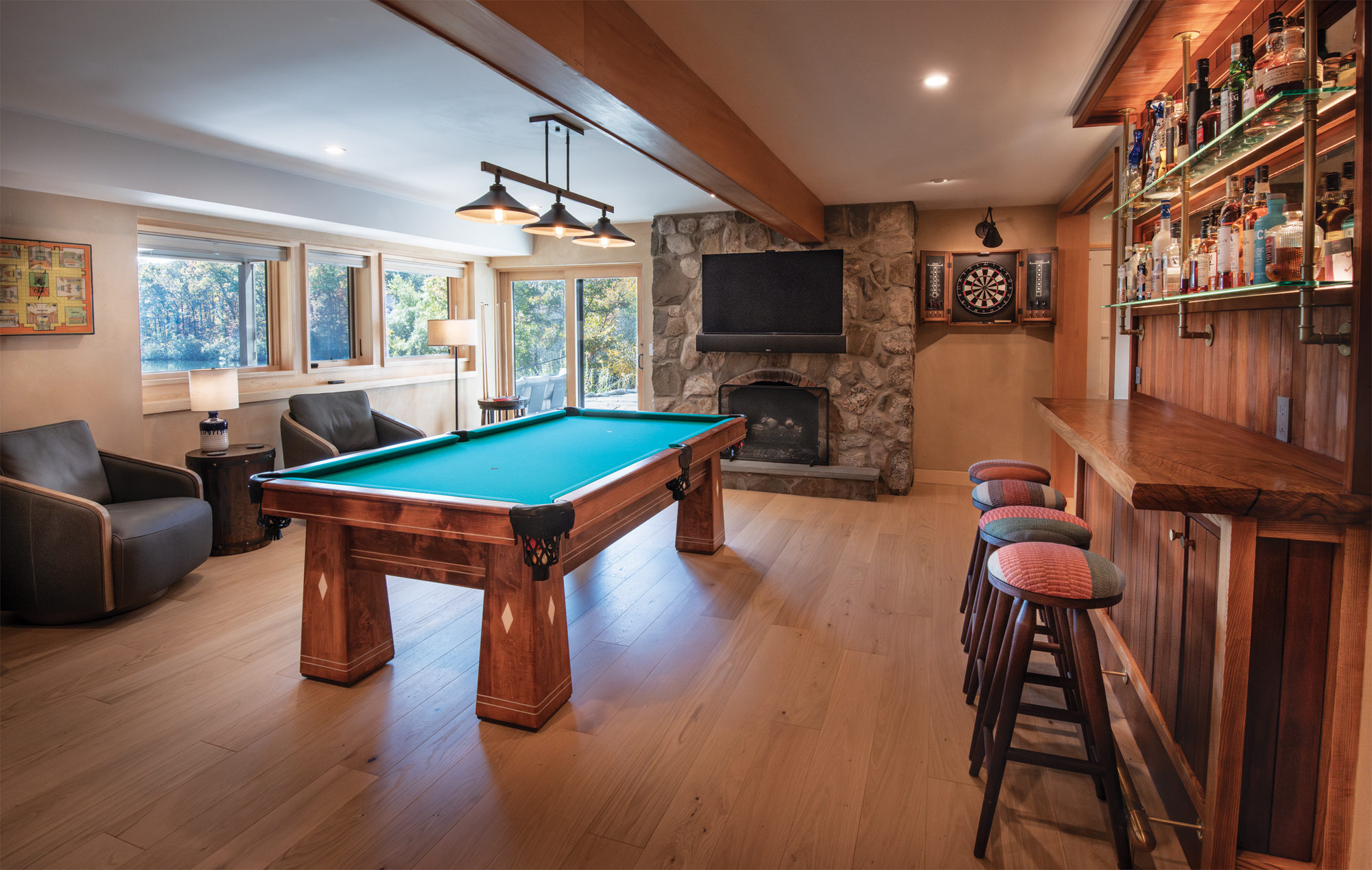
The home’s ground floor has a soundproofed family room as well as a bar constructed from redwood panels salvaged from the home’s former siding. The exterior door leads directly to another deck, the lake, and a lakeside hot tub.
After two years of overhauling the home, the project was finished in 2024. Sadly, Isabella Gillon died before the project was completed. “It would have been so wonderful if she were around to see what we did,” says Meisler-Abramson. “We played with the design and reshaped it, but the original DNA is still there,” explains Deutschlander. “It was an exciting way to work—creative decisions we otherwise wouldn’t have thought of emerged from redesigning rather than building from scratch.”