
Twisted Ridge Offers a New Slant on a Roof Line
By Joan Vos MacDonald | Photos by Noah Kalina | | Design Feature
A simple twist was all it took to create a distinctive roofline. The architects who designed the house and guesthouse known as Twisted Ridge naturally added pitched roofs to their design as the structures are found in Columbia County, which typically features snowy winters. However, there’s more than one way to slant a roof. Most A-frame houses have a sloped roof with a ridge that runs straight down the center. The design of Twisted Ridge twisted the ridges on both roofs, so they mirror irregular lines of the hilly terrain. The spine on these structures runs diagonally, sectioning the roof in triangular shapes that seem to undulate in the shifting light.
“We decided to connect the dots that way,” says Adam Wanaselja, co-manager of and a partner at The Up Studio, the architecture, interior, and brand design studio that designed the compound. “When you do that, it creates this undulation that happens in the roof. As we were exploring that idea, we noticed that when you looked at it from certain views, that undulation started to mimic the undulation of the mountains far off in the distance.”
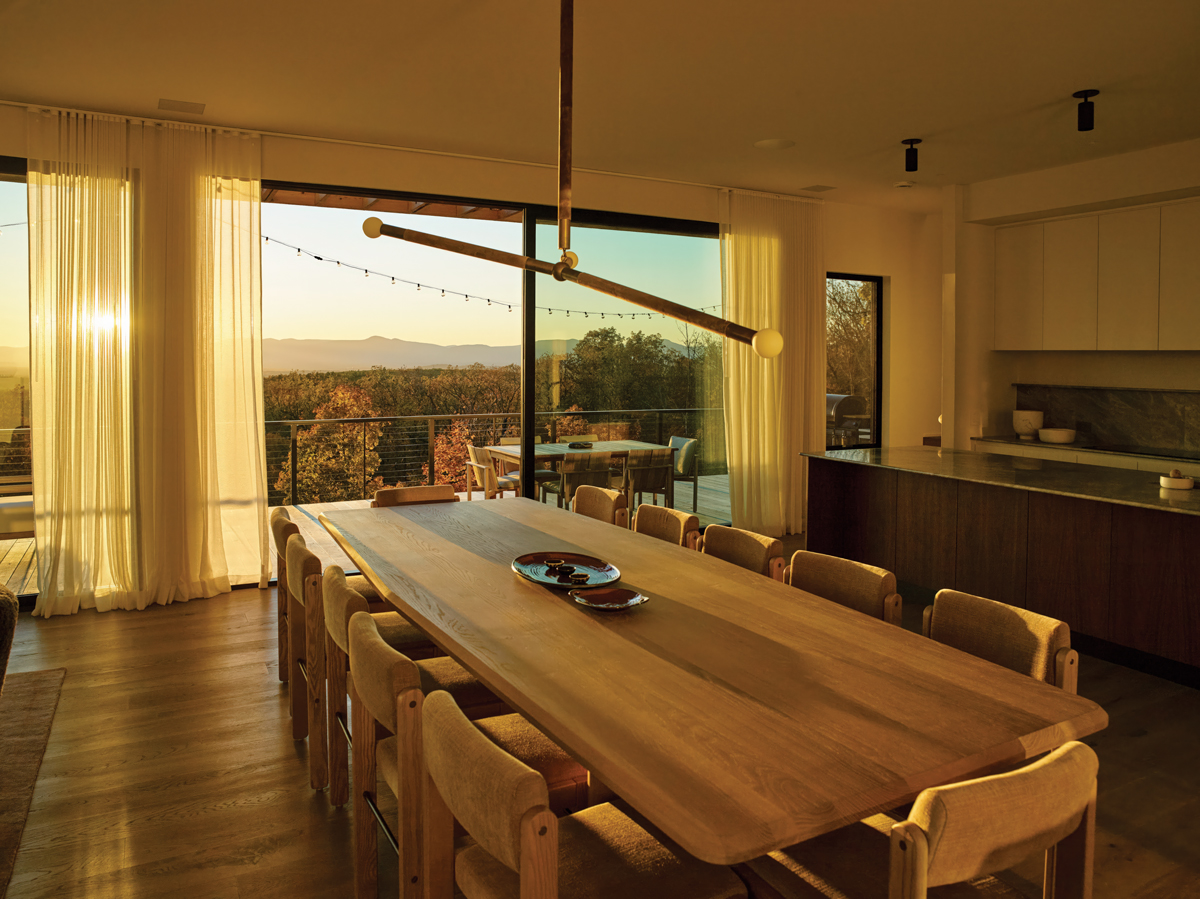
A wall of floor-to-ceiling sliding doors in the great room opens up to sweeping, unobstructed views of the Catskill Mountains.
Twisting the roof ridges is how Twisted Ridge got its name. That and the fact that it’s built on a ridge. The 11-acre building site near Hudson is lushly wooded and very hilly offering some wonderful panoramic views. There wasn’t a lot of level ground to build on, except for one ridge with an exceptional outlook.
“My partner John [Patrick Winberry] went to visit the site first and the only thing up there was a bench,” says Wanaselja. “A little three-seater bench that was facing the view.”
The architects neatly fit the puzzle pieces—a 2,600-square-foot getaway home, a 980-square-foot guest house and a 5,000-square-foot courtyard—into the level area. “There’s a pond and wetlands to the east,” says Wanaselja. “Then to the south it’s pretty heavily wooded, but there was that relatively flat spot that had a little bit of clearing. That was the peak of that property, and that’s where we were best able to exploit the views.”
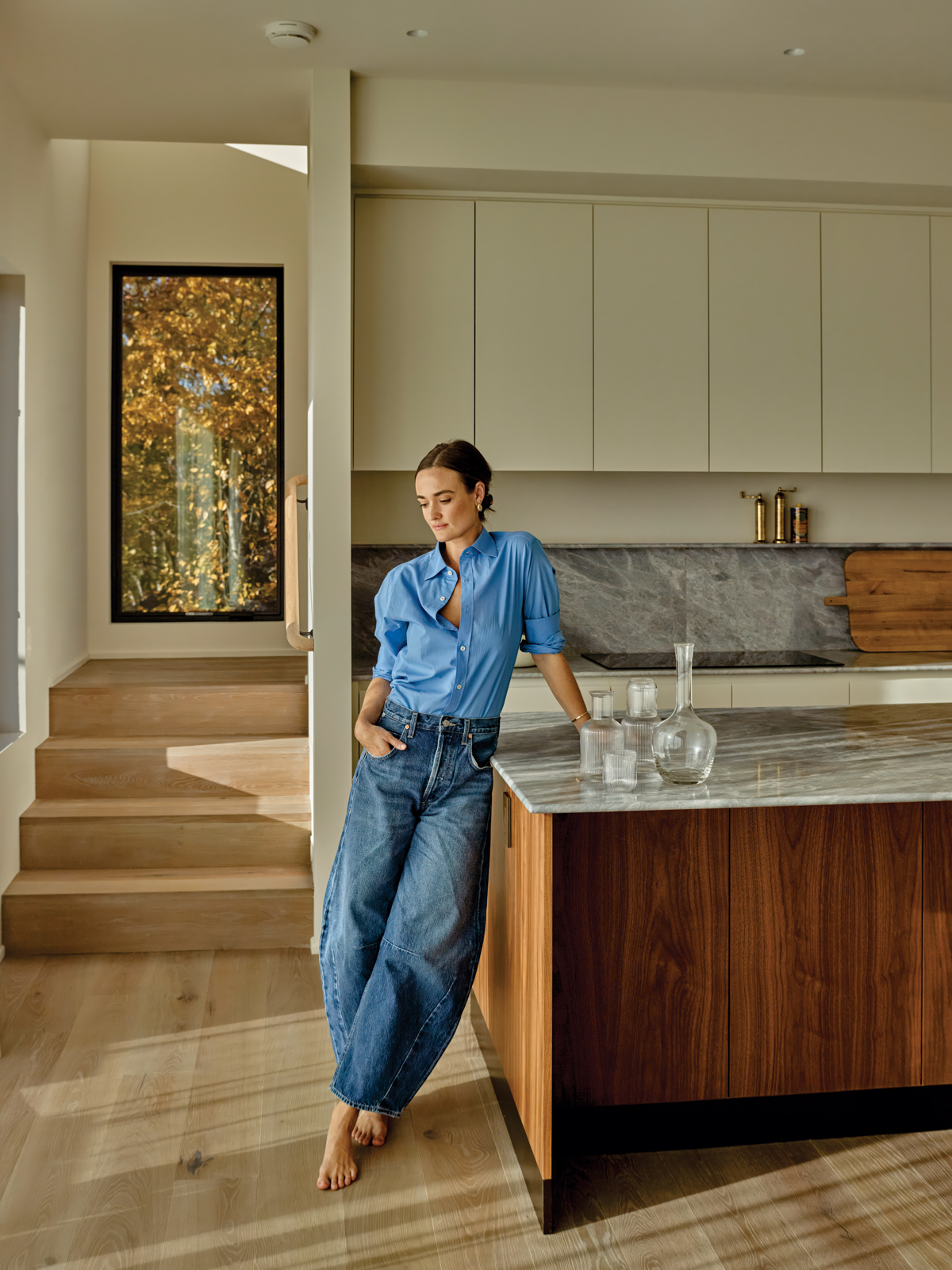
Homeowner Grace Hartmann enjoying the warm afternoon glow in the open kitchen.
Interiors in both structures were oriented to make the most of the stunning natural vistas. In the great room there’s a wall of floor-to-ceiling, sliding doors that survey changing foliage and hilltop sunsets. All three bedrooms in the main home share the same line of sight. The clients also wanted a nearby guest house so friends and family could visit, even for extended stays, but they stressed the need for privacy.
“We oriented the guest house in such a way that you would still get a view of the mountain, but not get a view of the home itself,” says Wanaselja. “You have some privacy there, but you still have the mountain views.”
Staggering the shapes and sizes of the windows provides visual interest inside and out. “There’s a five-foot-by-five-foot window that frames the tub nicely,” says Wanaselja. There’s a smaller window in the hallway just to provide a little view of the wetlands as you’re leaving the primary suite. On the view side, in the bedroom wing, we specifically wanted to provide a really big, beautiful, wow, picture-window view. So we utilized a large eight-by-eight window. In every bedroom you also need an egress window in case of emergency. So that’s a smaller functional window. The key is to oppose them in such a way that you create a nice rhythm and it looks intentional.”
Wanaselja describes window placement as an important part of curating the circulation of a home. Maximizing views is important, but the placement of windows can also be used to provide moments of pause and reflection. One example is the door-sized window that defines the landing on the stairs. It frames the outside woods, almost inviting visitors to walk up the steps and step through it.
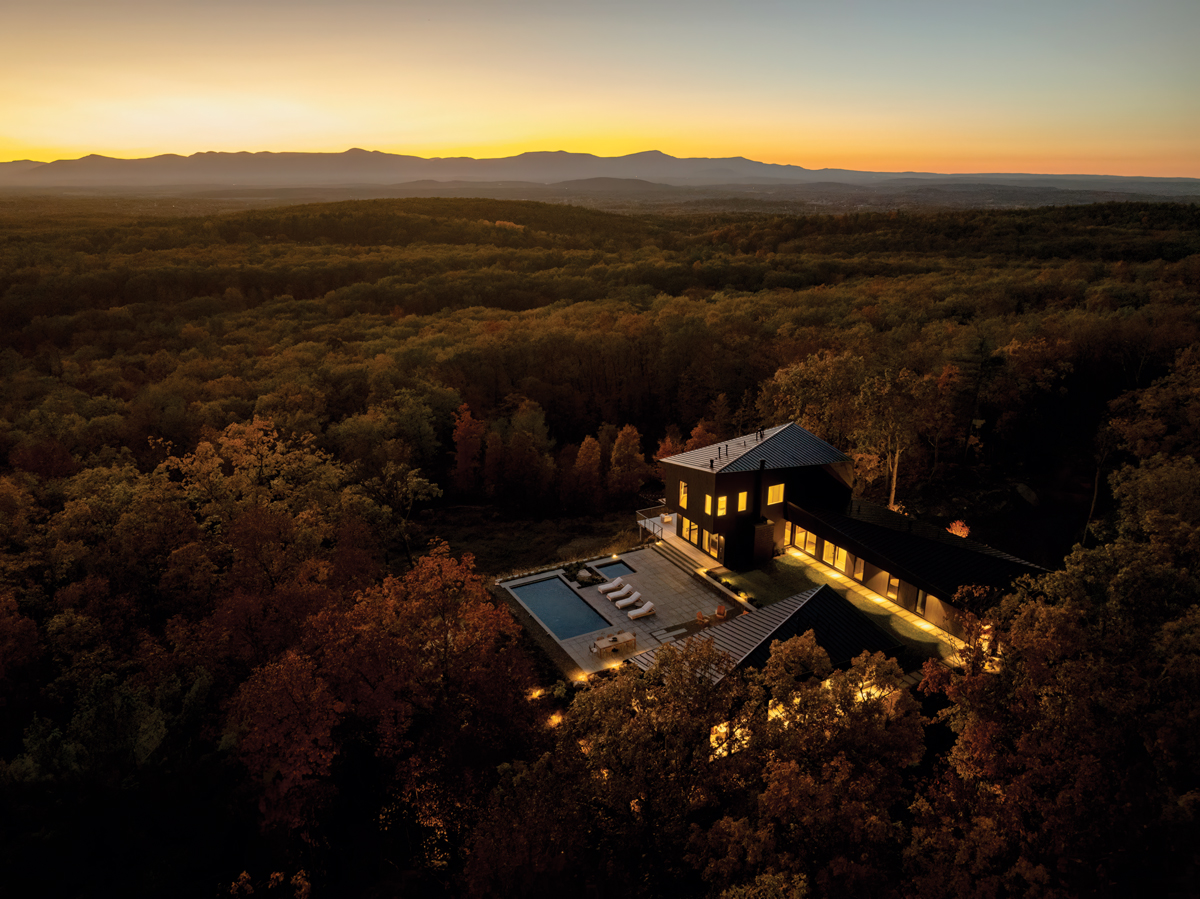
The undulating geometry of the home’s twisting roofs mimic the surrounding mountains, poetically reflecting the landscape while also facilitating the offloading of heavy snow in winter.
‘If we have a long hallway and there’s a view, we generally like to put a window at the end of it. “As you’re walking down that hallway, you have this beautiful little funnel view of a tree, or whatever it may be,” says Wanaselja. “As you come down that stair, you’re facing the mountain view. Instead of just quickly running down the stairs, you have this moment that you’re in this enclosed stairway, and directly in front of you is this beautiful little framed window looking straight out to the woods.”
With its natural shapes and muted colors Twisted Ridge is very much at home in the wooded landscape. The buildings are clad in black cedar, a wood durable enough to endure harsh winters and subtle enough to blend in.
“We also wanted something that would not pop too much, color-wise and tonally, and would allow the mountains and the trees and the landscape surrounding landscaping to really be the focal point,” says Wanaselja. “There’s a long history of dark colored homes, especially in Northern Europe being built in the woods. You can see these almost start to disappear at times, depending on the lighting. While this one is big enough that it’s not going to disappear completely, it just takes some of the punch out of it and allows the natural landscape to really shine.”
The sunken courtyard connects the structures, offering ample space for outdoor dining, a pool and hot tub, plus a fire pit to circle on frosty evenings. The space is defined by natural plantings and flanked by a wall of gabions, mesh metal cages filled with slate and shale.
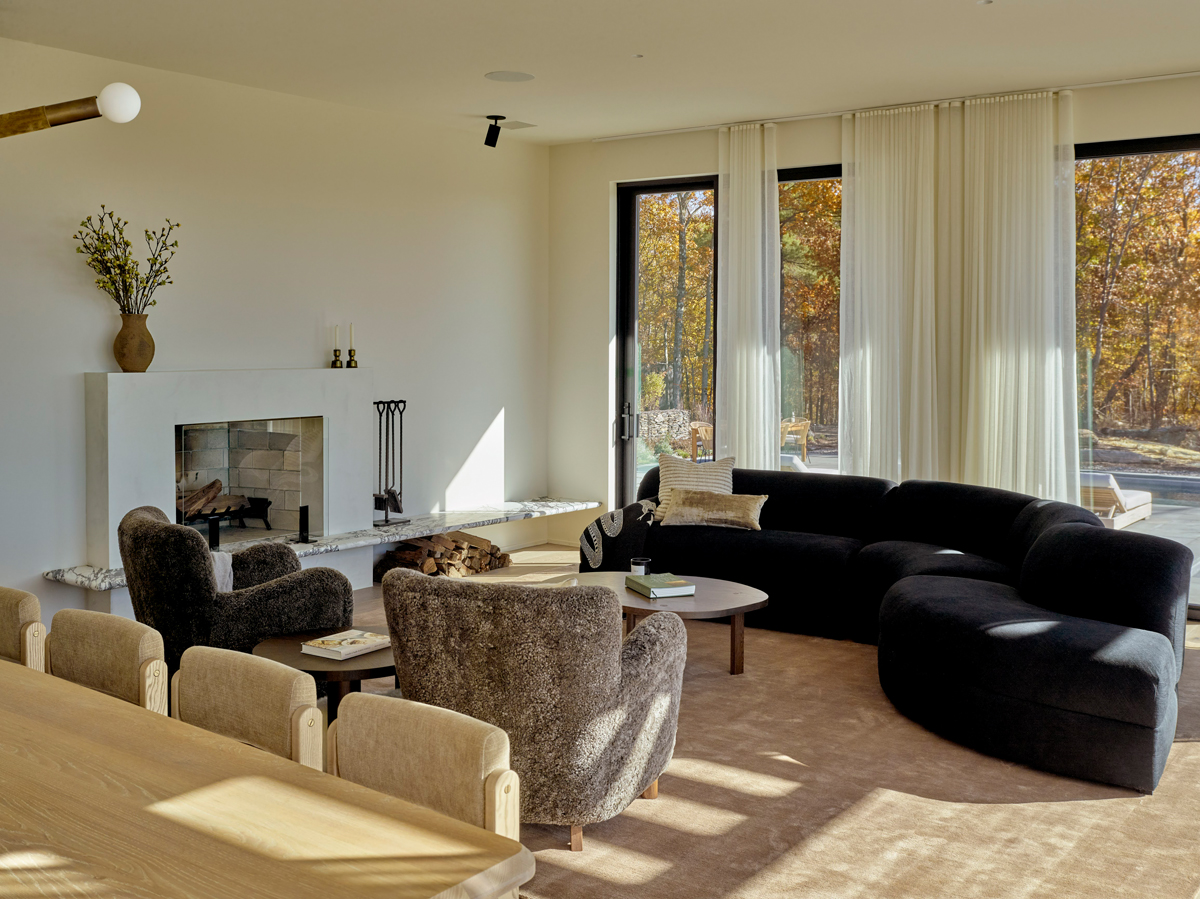
The living room.
“Actually, that was an idea that was in collaboration with the landscape architect, ourselves and the client,” says Wanaselja. “We needed retaining walls and we had all of this slate and shale on the property. Rather than carting that out, we just used the baskets with stone we found on site for retaining. We were able to take some of what would normally be waste material and put it back into the project itself. It’s more beautiful than a concrete retaining wall.”
At the courtyard edge, the ridge descends dramatically, making the house feel like it’s nested among branches.“When you’re up in the main living spaces, you’re looking at treetops and not at tree trunks,” said Wanaselja.
The Up Studio focused on the architecture, from concept through managing construction, while the homeowner, an interior designer, collaborated on design choices. She found the ideal stone for the kitchen island and backsplash and chose comfortable furnishings in muted hues.
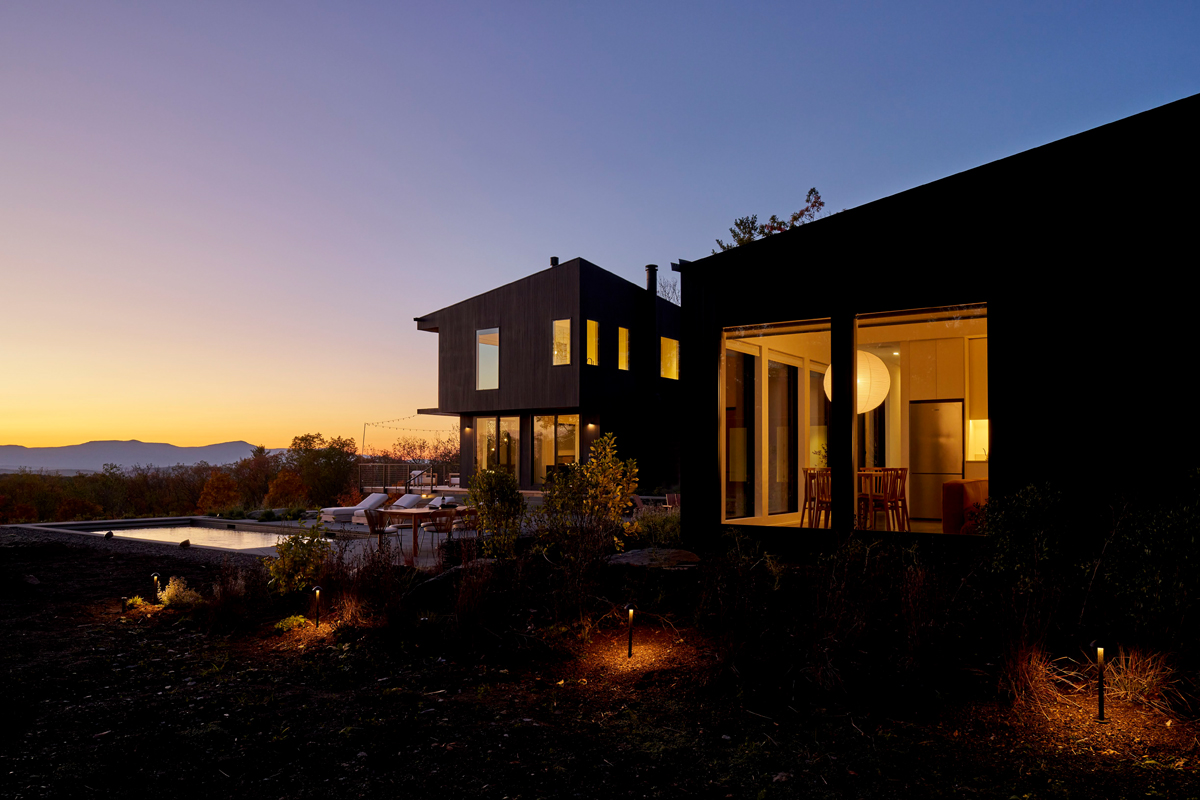
A side view of the house at dusk
“She comes from an interior design background, so we worked very closely with her,” says Wanaselja. “She had a big role in choosing furniture finishes. She has a very good eye, a very keen eye. We worked together to find the best solutions.”
Public and private spaces within the house were designed according to their function. In the reading room, for example, the dark moody wallpaper and rich furnishings created an intimate space ideal for reading in front of the fireplace, whereas sun-filled gathering spaces group furnishings to promote socializing.
Wanaselja describes The Up Studio as a firm that’s passionate about “making beautiful homes and bringing joy to people’s lives through design.” Having constructed homes from the Hamptons to Florida, they are currently working on a New York City townhouse.
“We make the house to fit the location,” says Wanaselja.
Twisted Ridge more than fits its location. Pitched like an aerie above the hilly terrain, the irregular and natural lines designed into this complex make it seem like a craggy-yet-elegant extension of the surrounding Catskills.