
Architect Kimberly Peck’s Two-Volume Woodstock Home is a Study in Duality
Sitting on Ticetonyk Mountain, Kimberly Peck's distinctive home is made up of two volumes joined together
By Brian K. Mahoney | Hanna Grankvist | Summer 2026 | House Feature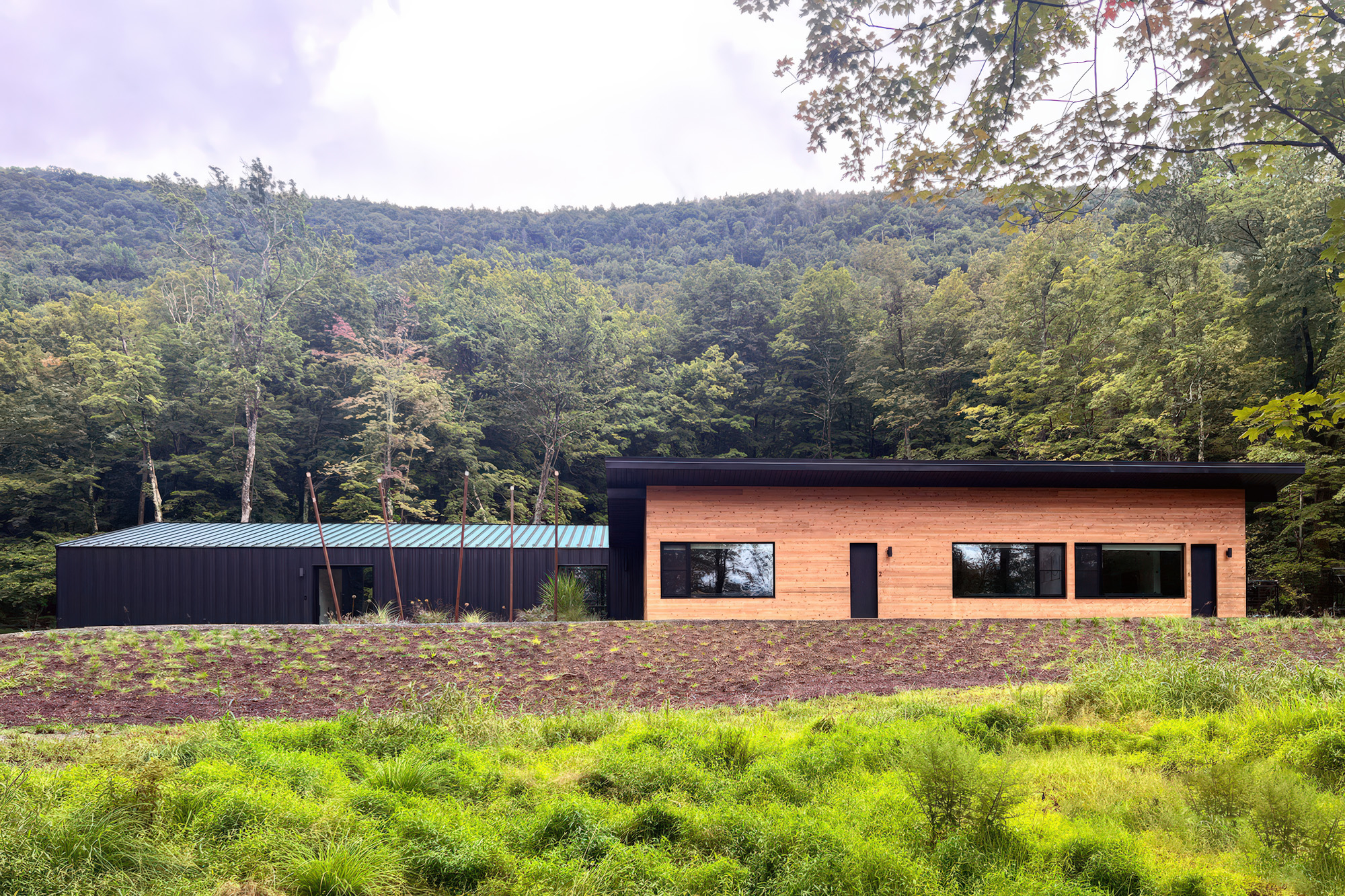
Hanna Grankvist
On a steep rise off a county road in Woodstock, a long switchback drive climbs through maples and oaks before arriving at a clearing where a house reveals itself all at once: two dark volumes—one light, one dark—spare and deliberate, set against the mountain. There’s no ornamental preamble, no hedging with shrubs or decorative borders. “I don’t like houses where they have that strip of planting right up against the house all the way around it,” architect Kimberly Peck says. Instead, the approach is open, almost stark—a field of pavers and rock that allows the architecture to stand unmediated against the landscape.
Peck designed the house for herself, and built it as both architect and client, a dual role that sharpened her instincts and tested her patience in equal measure. “Oh, I’m a nightmare client,” she says, laughing. “It makes it easier because I know what I want. But when it’s for yourself, you’re a little more on it, that everything is exactly how you would want.”
The house sits on the slope of Ticetonyk Mountain, oriented between two defining conditions: a rocky outcropping on one side and a long valley view on the other. Peck’s response was to organize the house into two rectangular volumes, joined by a narrow connector—a plan that reads as a narrow H from above. One wing is the primary living space, a long bar of kitchen, living room, and primary suite. The other, more compact volume functions as a guest wing, with three bedrooms, each self-contained.
“The idea was to keep the one rectangle really open for me and not be bothered at all by anyone that was staying in the other half,” Peck explains. “They almost don’t even need to come in here.” The separation is both social and spatial—a contemporary echo of Marcel Breuer’s binuclear houses, where domestic life is split into distinct zones. Here, that logic is updated for flexibility: private retreat on one side, autonomous hospitality on the other.
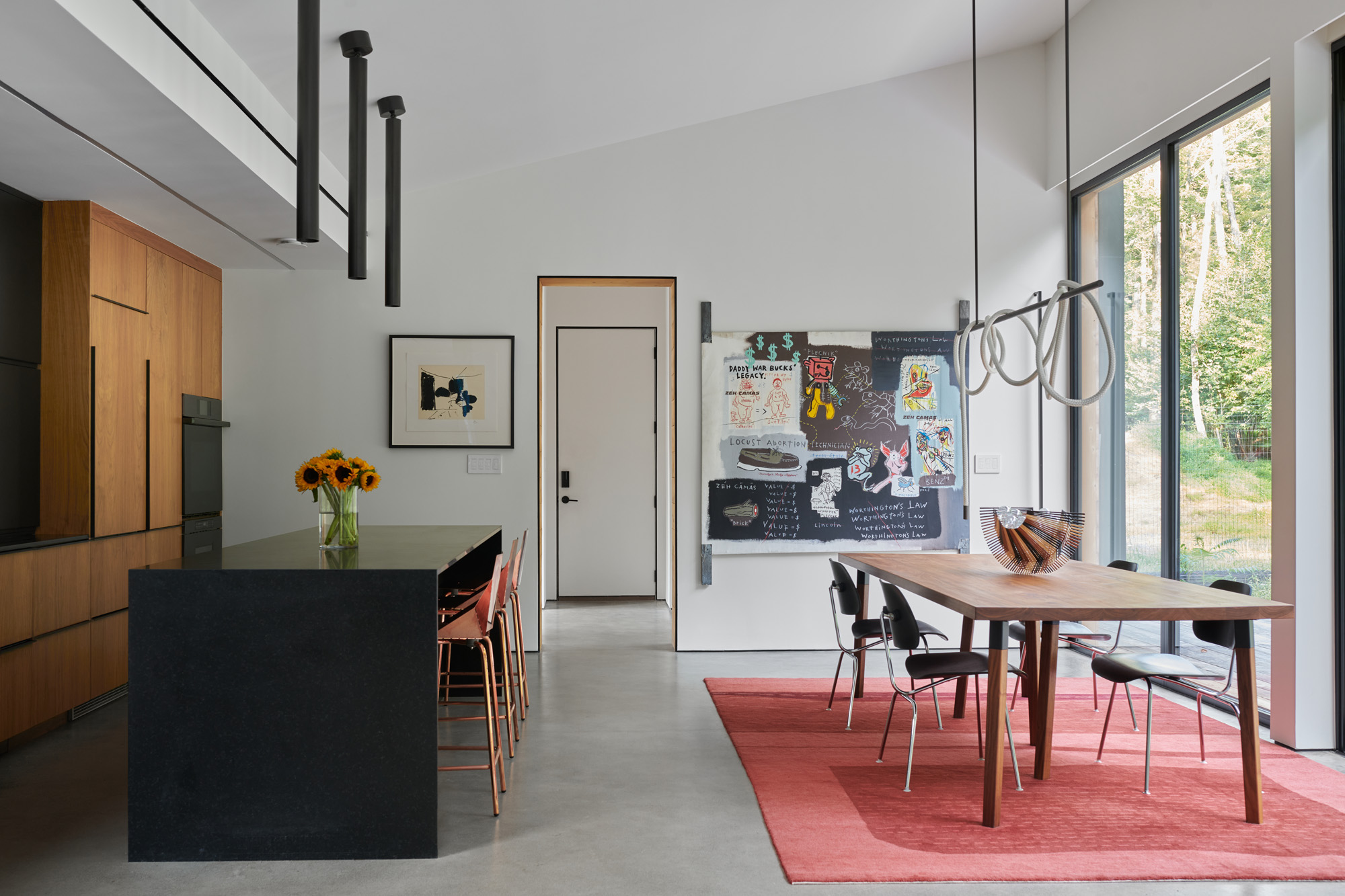
Walnut millwork, concrete floors, and expansive glazing define the restrained interior palette of Peck’s Passive House-inspired Woodstock retreat.
Passive House Principles
If the layout sets the logic, the way the house is shaped to catch light gives it life. The primary volume is lined almost entirely in glass facing the rock outcropping, turning the geological feature into a constant presence. “The one side of the house has all windows and that faces towards the rock outcropping, which is really gorgeous,” Peck says.
But those expanses of glass are not simply aesthetic. From the outset, the house was conceived as a high-performance envelope, built to Passive House principles and operating as a net-zero system. Orientation, overhangs, glazing, and thermal mass are all part of a tightly integrated environmental strategy. “All of that stuff starts very early in the design process,” Peck says. The house is constructed from structural insulated panels (SIPs), which required decisions about wall thickness, insulation, and assembly to be locked in at the beginning. “It becomes like a Tetris piece that you assemble on site based on your CAD drawing.”
The deep eaves of the primary volume are calibrated to the sun’s seasonal arc: blocking high summer light while admitting lower winter sun. The concrete slab floor absorbs and radiates that heat, reducing the need for mechanical intervention. Triple-pane windows, rooftop solar panels, and an airtight envelope complete the system. After more than two years of occupancy, the results have exceeded expectations. “We’re making way more energy than we’re using—we basically use about half of what we’re making,” Peck says.
For Peck, sustainability was never an add-on. “Aside from the aesthetics, that was important to me—to be light on the Earth and making more energy than I used,” she says.
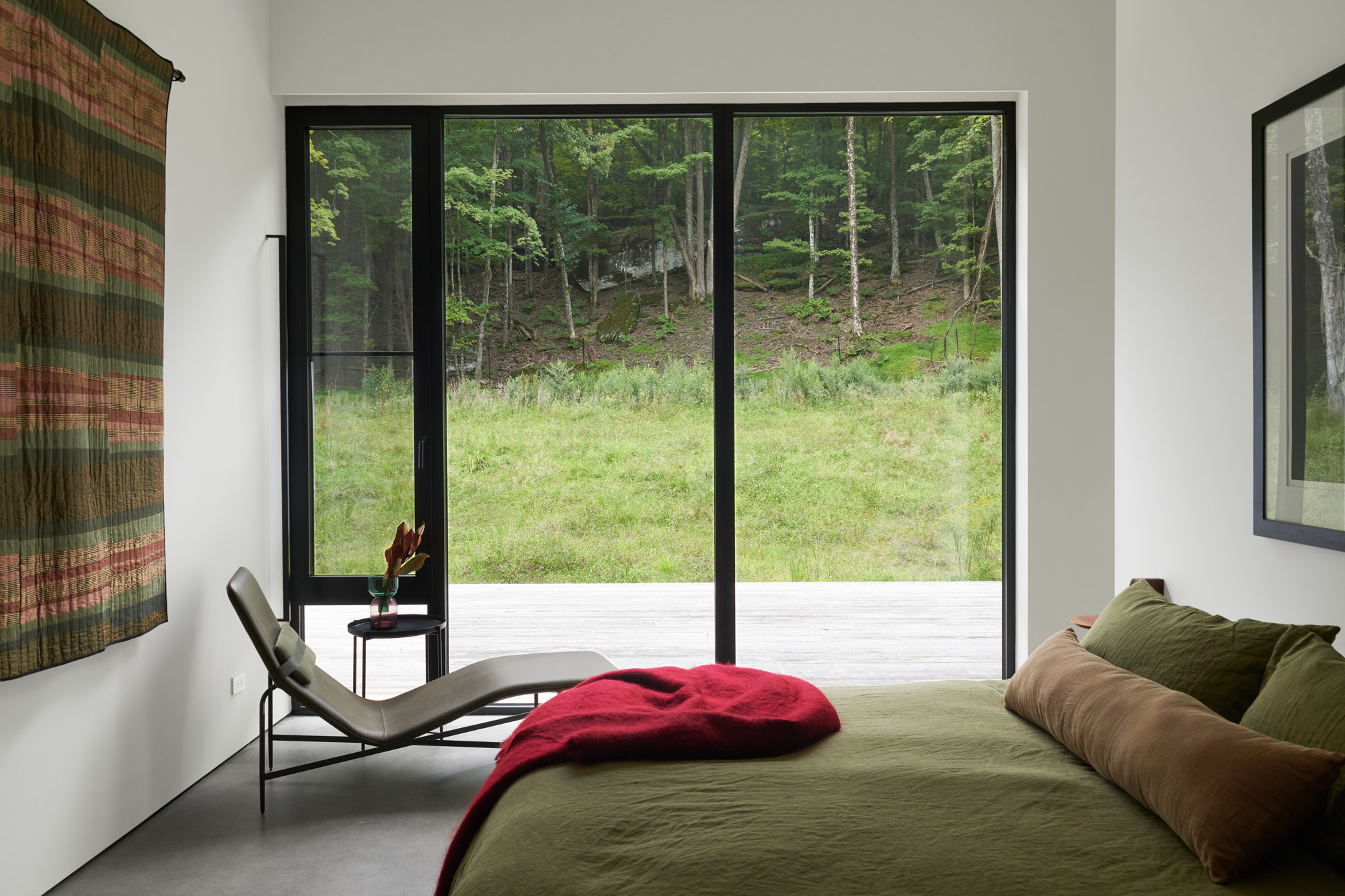
Large expanses of glass and minimal detailing turn the surrounding forest into a constant visual presence throughout the house.
Details in Plain Sight
If the exterior is restrained—black, planar, almost mute against the woods—the interior reveals where Peck allows herself expression, though even here the language is disciplined. She cites Belgian minimalism as an influence: no baseboards, no casings, no visual clutter. Instead, junctions are handled with precision. Where a typical house might hide seams behind trim, Peck exposes them, resolving transitions with thin black metal reveals.
“I don’t like the distraction of trim,” she says. The result is an interior that reads as continuous planes—walls, floors, and ceilings meeting with crisp intention. Even the smallest details follow this logic. In the bathrooms, towel bars and fixtures are designed to emerge directly from the wall, their mounting hardware concealed. “The towel bars literally come out of the wall with no trim at all,” Peck says. “You aren’t distracted by the towel bar.”
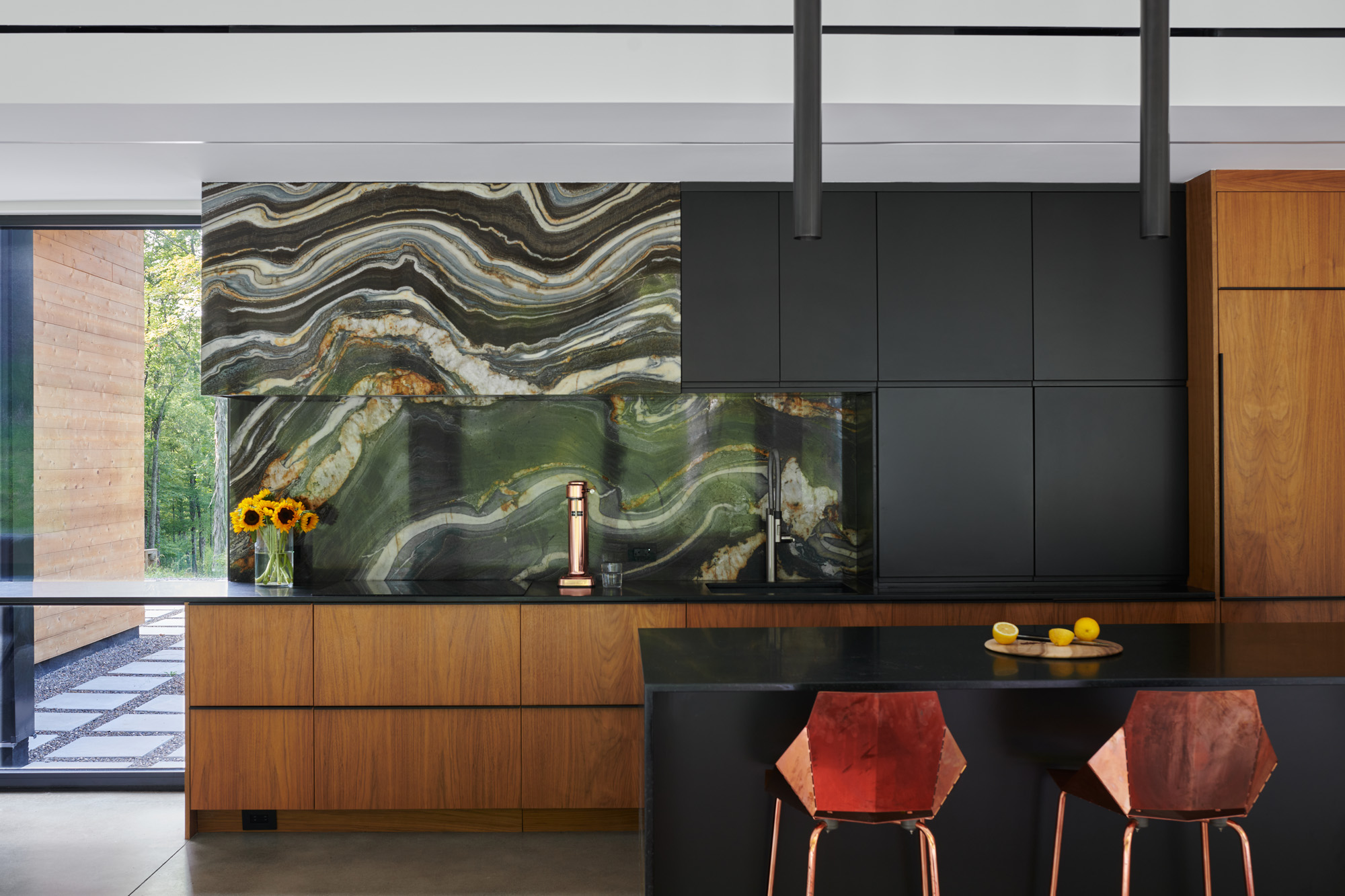
A dramatic slab of quartzite anchors the kitchen, echoing the textures and tonal variations of the surrounding landscape.
The material palette reinforces this clarity. Concrete floors ground the space. Walnut millwork runs in continuous bands, linking kitchen, living, and sleeping areas. Cedar clads door frames and entry points, bringing in a note of warmth and a nod to the regional vernacular. Black metal—used for reveals, window frames, and exterior cladding—ties it all together.
“I love the look of concrete and walnut and black,” Peck says simply.
In the kitchen, a slab of quartzite—veined in rust and charcoal—acts as a focal point, its organic pattern echoing the textures outside. The selection was serendipitous. “I was shopping with a client and I saw [the quartzite] and I said, ‘Oh my God, put that on hold,’” Peck recalls.
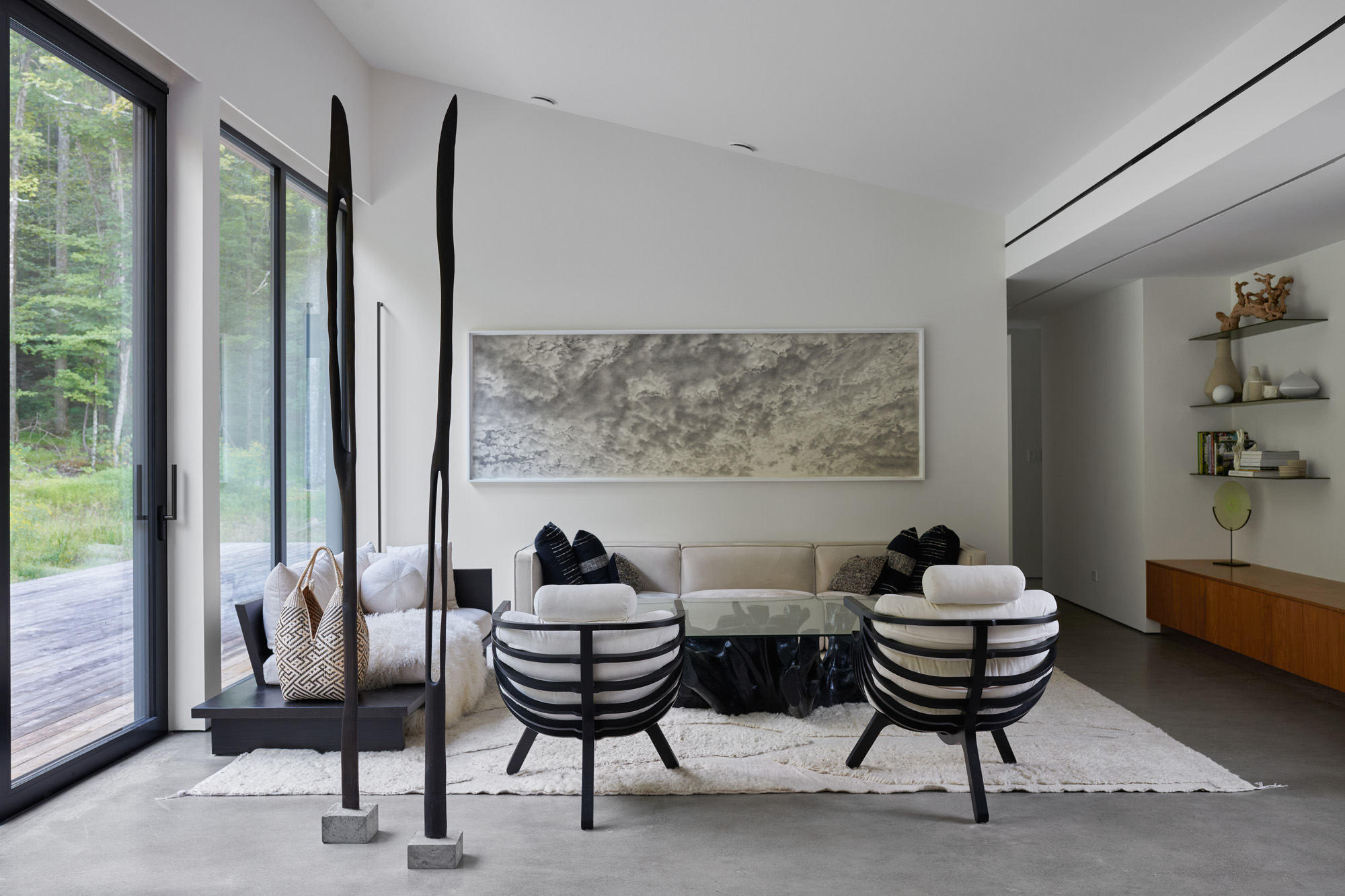
Belgian minimalism and carefully resolved details shape interiors designed to feel calm, continuous, and deeply connected to the landscape outside.
A Lens on Its Surroundings
Despite the minimalism, the house is not austere. Much of its warmth comes from how it choreographs daily life into ritual. Nowhere is this clearer than in the primary suite, where a freestanding soaking tub is positioned beside a window that captures morning light and frames the surrounding forest.
The suite is organized around a floating wall, with circulation flowing freely around it. From the kitchen, one can see through the bedroom to a triangular window at the far end—a long axial view that pulls the landscape through the interior. In the bathroom, Moroccan plaster replaces tile, creating a seamless, sculptural enclosure. “When you’re showering there, you literally feel like you’re showering in the forest,” Peck says.
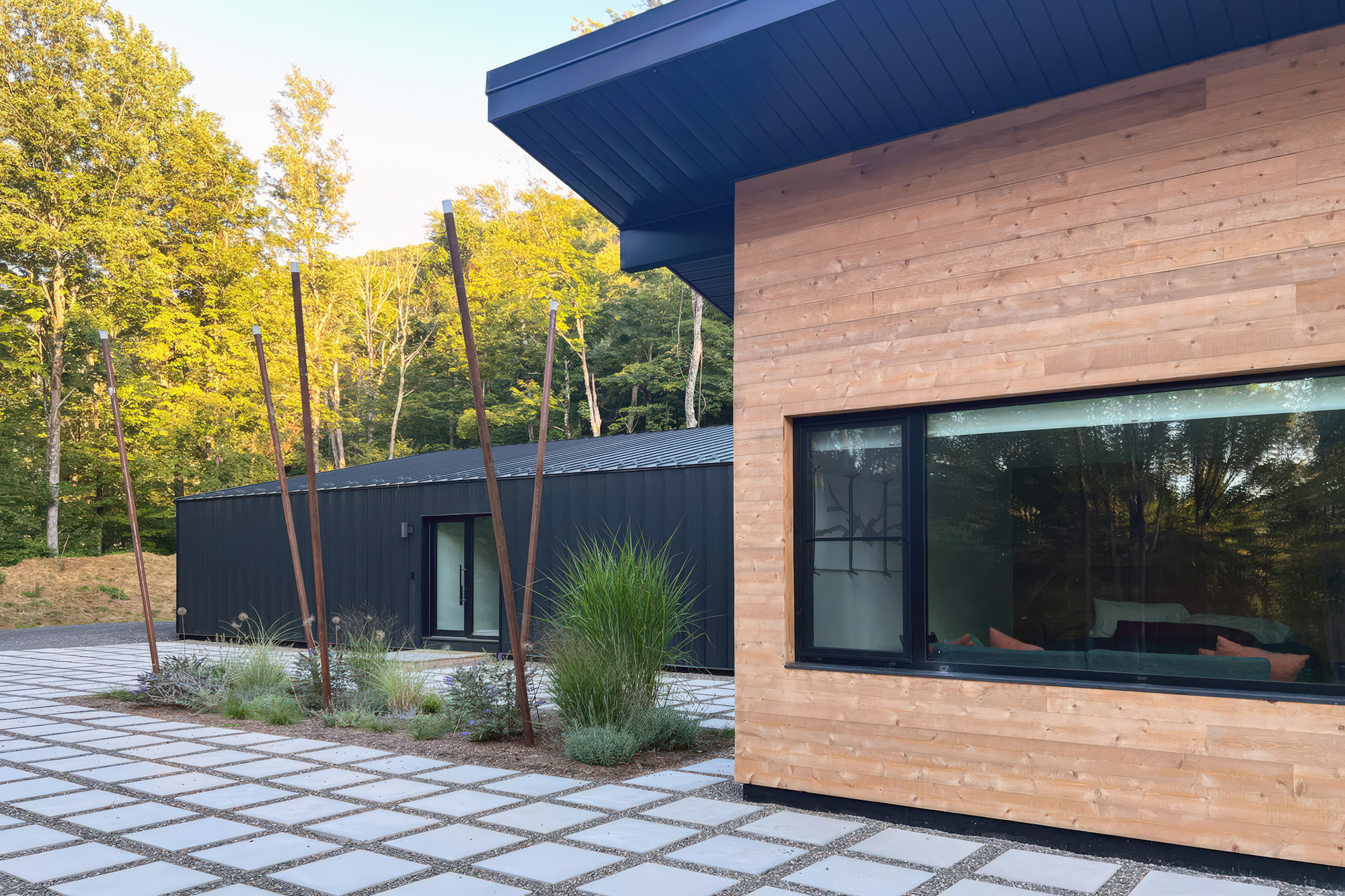
Cedar cladding, deep overhangs, and restrained landscaping reinforce the home’s balance of high-performance design and understated modernism.
That sense of immersion—of the house as a lens onto its surroundings—guides Peck’s approach to the question of how architecture should sit in a dramatic landscape. The exterior remains deliberately understated, allowing the woods and rock to dominate. Inside, the experience is heightened through framing, light, and proportion. “When you’re here, you just want to feel like you’re in these woods,” she says.
Designing and building the house herself gave Peck a deeper understanding of the emotional stakes of construction. “It’s your finances on the line. It made me realize why people get as stressed as they do,” she says. The experience has reshaped how she relates to clients, offering a firsthand view of the anxieties that accompany a project of this scale.
Living in the house has also revealed practical lessons. The energy systems have performed better than expected, but mechanical realities—backup power, equipment space—have introduced compromises. “I didn’t know that I needed a giant room to put solar backup batteries in,” Peck says. A propane generator now serves as emergency backup, a concession in an otherwise fossil fuel-free system. If she were to do it again, Peck would allocate more space for infrastructure.
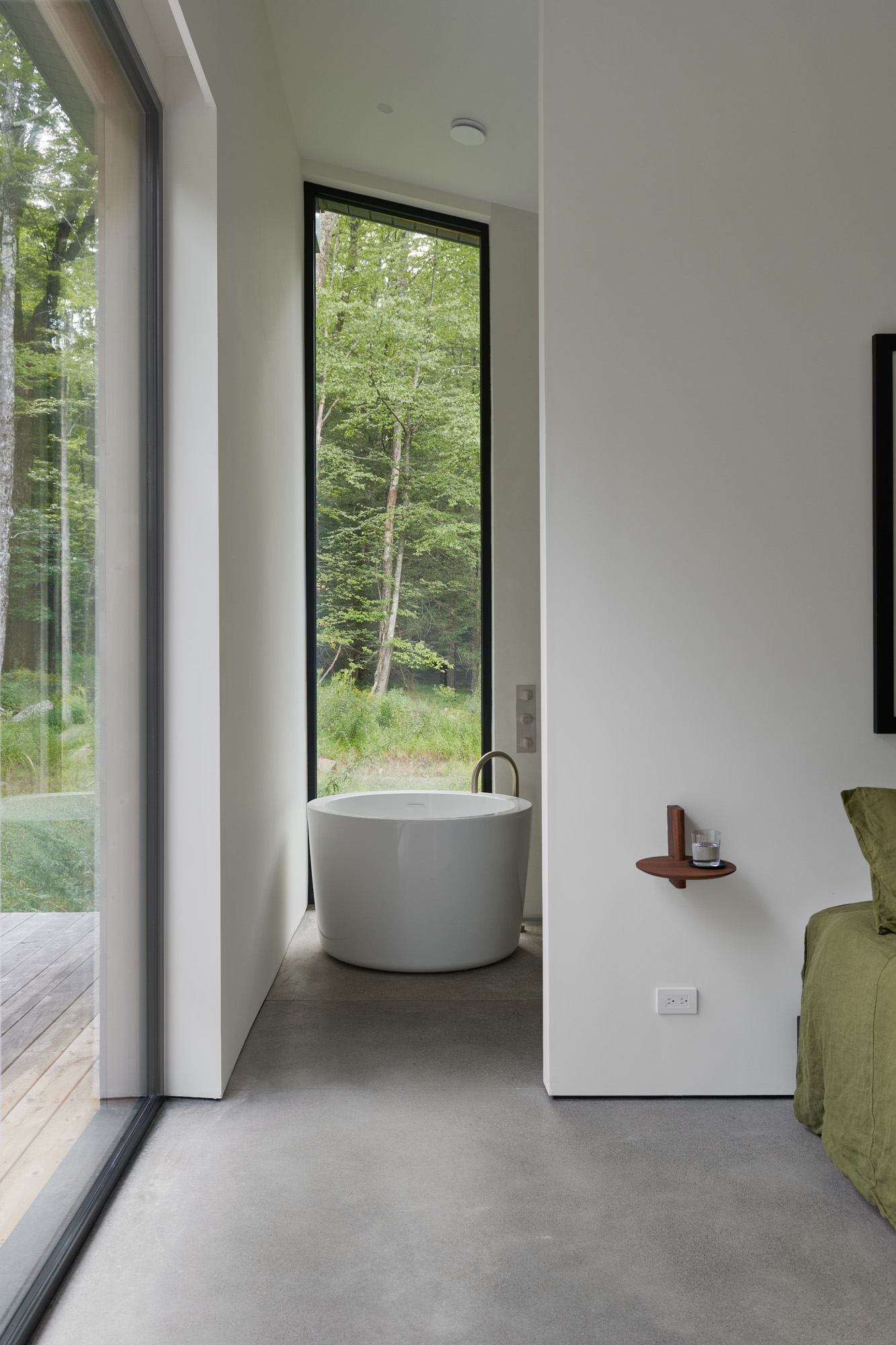
In the primary suite, a freestanding soaking tub and floor-to-ceiling glazing heighten the sense of immersion in the surrounding
woods.
Still, those adjustments are minor compared to the overall success of the design. The house functions as intended, its spaces flowing easily, its systems operating efficiently, its relationship to the landscape intact.
Outside, Peck has extended the design into the land itself. Beyond the paver court at the entry—anchored by sculptural light fixtures—the property is a woodland garden. Native plantings are introduced sparingly among existing trees, and the ground plane is left largely undisturbed. “Everything else is just going with the land and kind of leaving it as it is,” she says. The approach mirrors the house: intervention without imposition, clarity without excess.
Peck expects the materials to age in place, without artifice. The walnut will lighten, the cedar will weather, the concrete will endure. “It’s all just meant to age gracefully,” she says. There’s no attempt to freeze the house in time—only to ensure that it remains coherent as it changes.
At 3,200 square feet, the house is not small, but it feels controlled, its spaces edited down to essentials. It is a house that reflects its architect’s sensibility at every scale, from the siting of volumes on a mountainside to the concealed mounting of a towel bar.
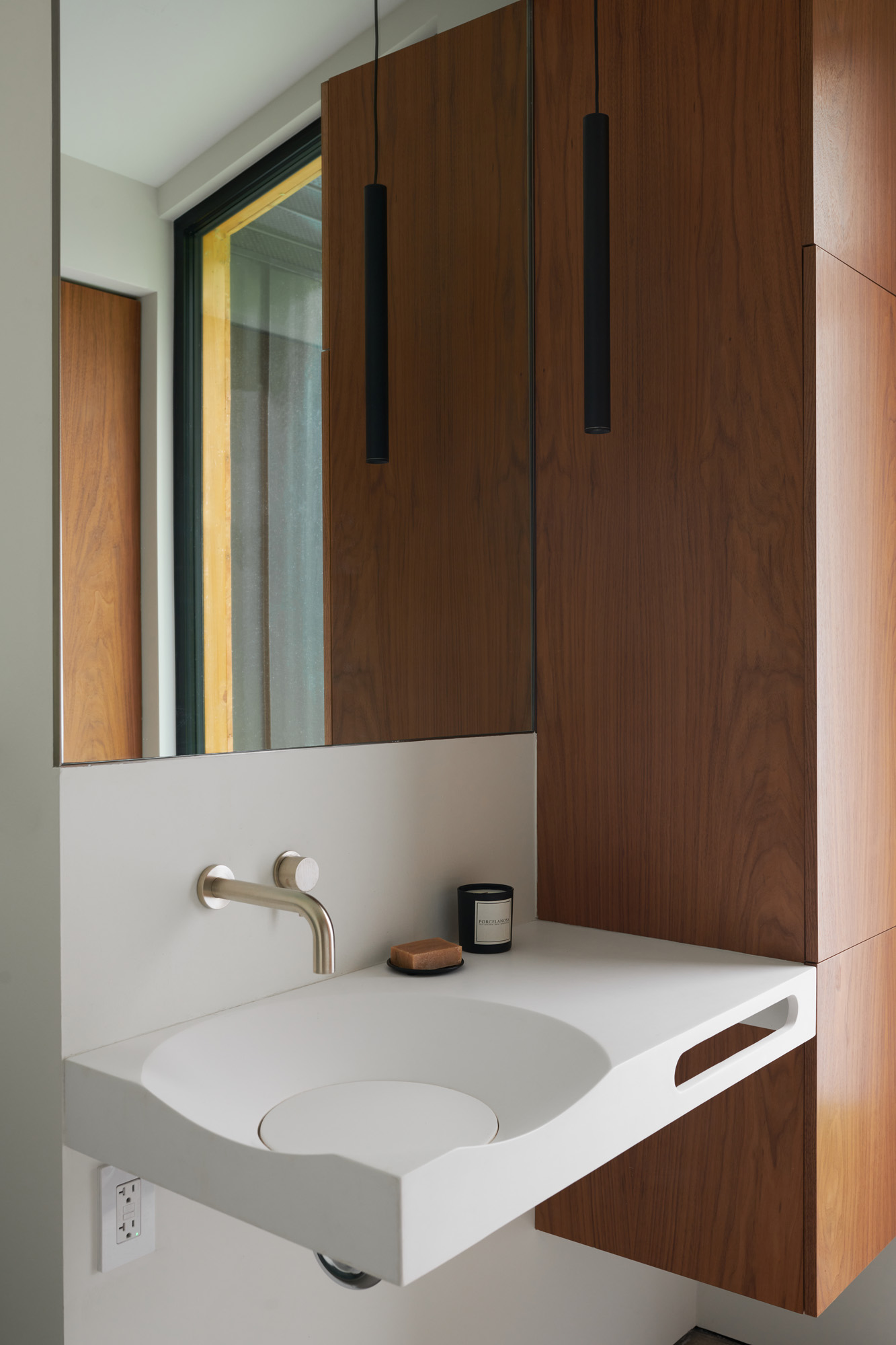
In the bathroom, floating fixtures, concealed hardware, and uninterrupted surfaces reinforce the home’s precise, minimalist language.
For Peck, the project was both culmination and experiment—a chance to test ideas about minimalism, performance, and domestic life in a setting that demands clarity of intent. (She credits general contractors Rainbow Home Improvement Inc. with help realizing her vision.) The result is a house tuned to its surroundings—amplifying light, framing views, and showing how restraint can carry its own expressive force.