
Glass House Glow: A Mid-Century Revival in Kingston
By Joan Vos MacDonald | Photos by Eduard Hueber | Winter 2024/2025 | House Feature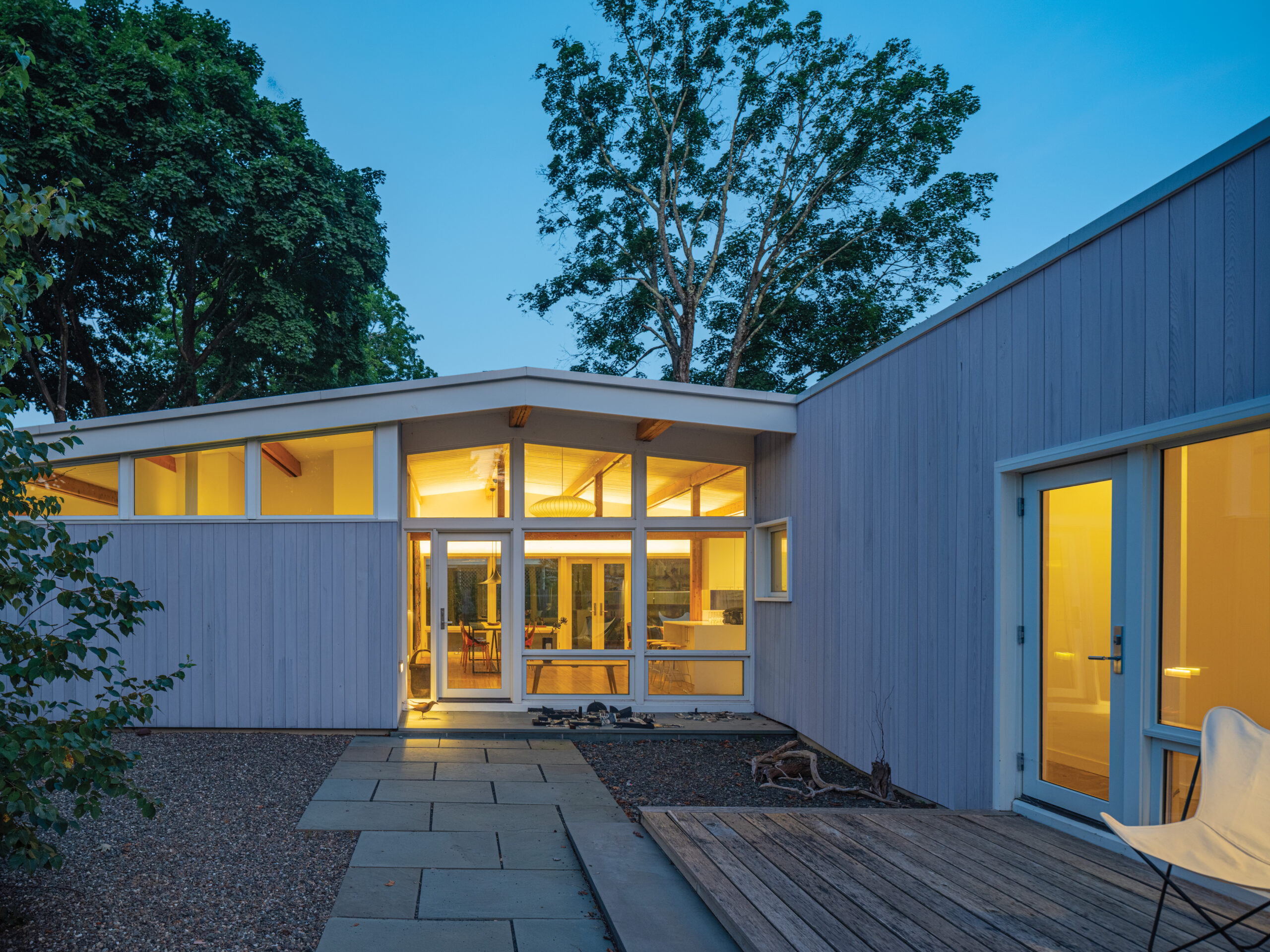
When Amy Rolnick bought a Mid-Century home in Kingston, she turned to childhood friend David Wallance, to supervise the renovation. Rolnick’s Mid-Century home is tucked neatly between rows of pedigreed Victorian mansions on the city’s historic West Chestnut Street, yet both Rolnick and Wallance have more of an affinity for Mid-Century Modern design. It’s a style they grew up around during their childhood in Croton-on-Hudson.
“My parents were designers,” says Wallance, whose architecture firm DRA/W has constructed award-winning projects from residences to museums, and laboratories to high-rise housing. “Her parents were not designers, but they had an interest in Mid-Century design. We’re talking late `50s, early `60s, that was our childhood. So, we had that common frame of reference.”
Rolnick bought the 1,400-square-foot home in March 2020 in what she describes as a “lightning bolt” decision. Something about the house resonated at a time when she was only thinking about moving north from Savannah. The home had great bones, but its interior was carved into a rabbit warren of rooms.
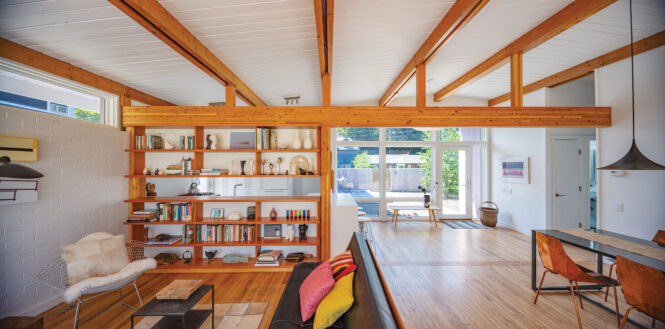
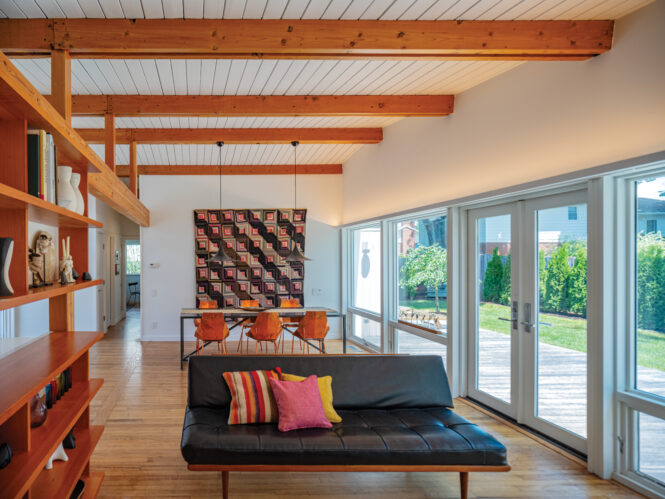
Wallance removed a supporting wall, which allowed room for a dining table across from the living room area that now faces a wall of windows looking out onto a tranquil yard.
“When I saw this house, I knew immediately what I would do with it and what I wanted,” says Rolnick. “I knew that I would need an architect for that and I knew that David was the one. I knew that he would get it.”
Given their mutual appreciation of bright modern spaces, it was obvious most of the interior walls would be removed.
“I don’t know whether this sort of partitioned-off room arrangement was something that was added over the years or whether that was there from the beginning,” says Wallance. “But we were able to clear it out and basically restructure half the house to be this generous, open, airy, living, dining, kitchen arrangement.”
All Stripped Down
Not being a pedigreed Mid-Century specimen made it easier to reconfigure. “It was a good builder’s house, which in that era took cues from the really good architects,” says Wallance. “But there was less attention toward details and spatial sophistication. So that gave us the freedom to reimagine what we were doing. We didn’t have to stick to a faithful historic restoration.”
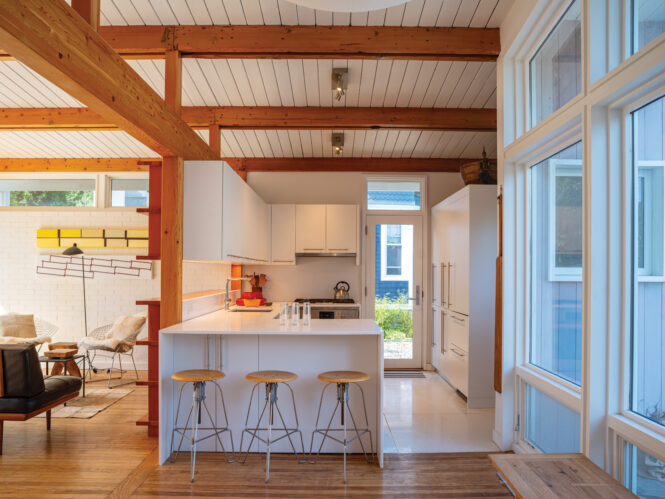
One of the walls Wallance removed was a supporting wall, so he bolstered the ceiling with a wooden candelabra beam that also helps define the kitchen space. Once the walls were removed, there was room for a dining room table across from the living area. The expanded informal living space now faces a wall of windows that look out onto the tranquil yard. With so much glass on both sides, the home’s interior glows with sunlight.
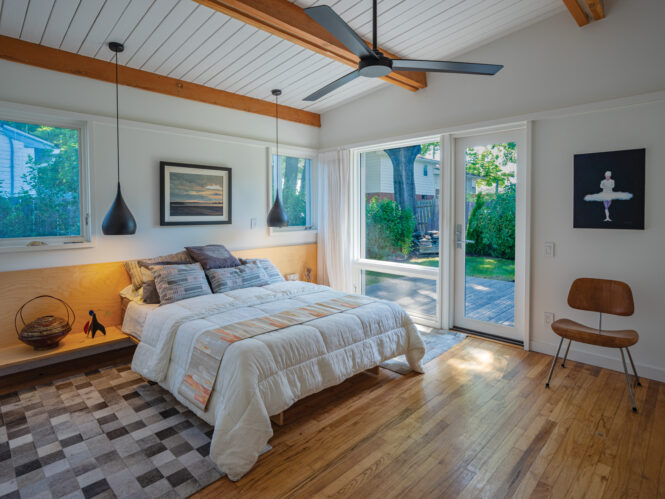
The home’s original floors were still in good shape when Rolnick moved in. “We kept the original floor, which had a really nice kind of patina quality,” says Wallance. “It registered the age of the house without looking run down. That was really a lucky find.”
“There were four bay windows that were part of the old living room,” says Wallance. “The fifth bay was captured from within one of these small room spaces.”
To further brighten the interior, Wallance stripped the dark brown varnish from the ceiling beams and painted the wood clad ceiling.
“At first, we tried to just strip all the varnish off from everything, but there’s tongue-and-groove planking that is resting on the beams and the little grooves in the tongue-and-groove planking were impossible to strip,” says Wallance. “So we painted the planking white and then stripped the beams and brought them back to their light Douglas fir color. It just absolutely transformed the mood in the space.”
Fortunately, the home’s original floors were still in good shape.
“We kept the original floor, which had a really nice kind of patina quality,” says Wallance. “It registered the age of the house without looking run down. That was really a lucky find.”
People who live in primarily glass houses do have to consider privacy, so the home and front yard was enclosed in a tall fence that creates a sheltered, park-like courtyard.
“I knew I wanted the courtyard,” says Rolnick. “Because I didn’t want to have to blind all these beautiful windows. I wanted the light to come through, but I also knew that I needed a little bit more privacy, so I didn’t scare the neighbors when I was wandering into the kitchen in the morning for coffee.”
The compound-like fence, which extends almost to the curb, is fashioned from Western red cedar that received a pale transparent stain. It required a zoning variance because it’s taller than the mandated four feet.
“I’ve used Western red cedar in a lot of my work,” says Wallance. “It’s a wood that was used by a lot of mid-century architects, like Breuer. The vertical patterning is very typical of mid-century houses. I didn’t want a uniform color or grain. I was trying to get variation in the grain from board to board to create some texture. Western red cedar is a very rot-resistant durable material.”
Easy Access
To add living space, Wallance transformed an adjacent garage into a guest bedroom with its own door and deck access. “I knew I would turn this very derelict garage into a guest suite,” says Rolnick. “And I knew David would get it. The very first time he walked into the house, he looked around and it was really in sad shape. But he looked at it and he went, ‘Oh, Amy!’ He was romanced by the house.”
The surrounding fence was integrated with the form of the house to establish one cohesive idea. As a result, the garage-turned-guest suite opens out onto the courtyard, so guests can quietly enjoy the yard by themselves.
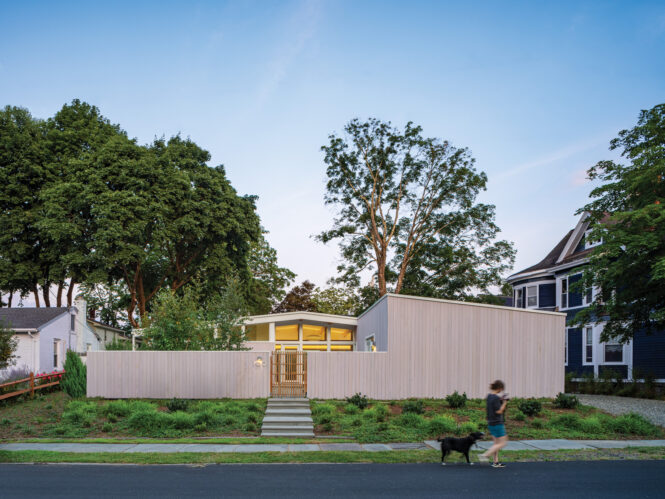
“I wanted to activate that courtyard by fronting the guest bedroom onto it and having a little sort of deck,” says Wallance. “Kind of a front porch for the guest bedroom.”
While the interior was gutted, Wallance took measures to improve the home’s energy profile. “We stripped everything down to the studs, took all the old windows out and insulated the walls to current energy code standards, even beyond, actually,” says Wallance. “We put a new layer of insulation on the roof and installed high-performance windows with low E glass and then replaced the heating system with a new heat pump HVAC system.”
Rolnick wanted the home to be accessible, so the renovation removed any barriers. “There are no door jambs or anything,” says Rolnick. “There’s nothing to trip over and everything is on one floor.”
She expressed her dislike of curtain rods, so Wallance created a distinctive trim to surround the doors and windows. “They frame out the details of the house beautifully and hide the curtain tracks over the windows,” said Rolnick.
On the Light Side
For Wallance, the best part of renovating the Kingston house is hearing how much Rolnick likes living there. It’s music to his ears. “What I love most about the house is that it’s suffused with light even on the darkest winter days,” says Rolnick. “The postman came up to me and said, ‘It’s so beautiful to look inside your house, because it’s almost all glass, so it’s pretty transparent.’ I gave him a tour and he was talking about how the light pouring in from all angles made a huge difference.”
The challenges involved in renovating a home can put a strain on any friendship. Not so for Wallance and his client. “I think there was a strong bond that got us through the usual rough spots that occur in any renovation process,” says Wallance. “We remain friends. So, that was a success.”
Rolnick describes the collaboration as a “joy and a wonder. After knowing each other for more than 60 years, we got to do this together. Who would have imagined it when we were kids in nursery school together?”