
At Pidgin in Oak Hill Esoteric Antiques Meet Contemporary Oddities
The Grammar of Things
By Elias Levey-Swain | Summer 2025 | The Source
At Pidgin, in the Greene County hamlet of Oak Hill, esoteric antiques commingle with contemporary oddities, huddled together around a single shared principle: longevity. From two-dollar rubber eggs, writing implements, and local honey, to mammoth artifacts like a six-foot-tall tree trunk previously used for limewashing buildings, store owner Kostas Anagnopoulos is interested in objects with staying power. Not only bent on finding “forever homes” for singular relics, he is fascinated by how new objects, touched by time, will become antiques themselves. “In 50 years,” he says, considering one example, “someone will find it and think, ‘Oh wow, that’s a really old pencil sharpener.’” In this way, the contents of Pidgin are ghostly, sitting in tension between past and future.
A pidgin is an informal, simplified mode of communication, improvised between entities who share no common language. Objects converse in a pidgin; wordless, they are nonetheless imbued profoundly with meaning and implication, memory and sensation. For Anagnopoulos—a poet, salesman, and son of immigrants—language sits at the crossroads of intersecting interests and identities. But rather than thinking with words, he prefers “thinking with the objects. And thinking about how they riff off each other, finding humor within the relationships. Making little tableaux, little still-lives.”
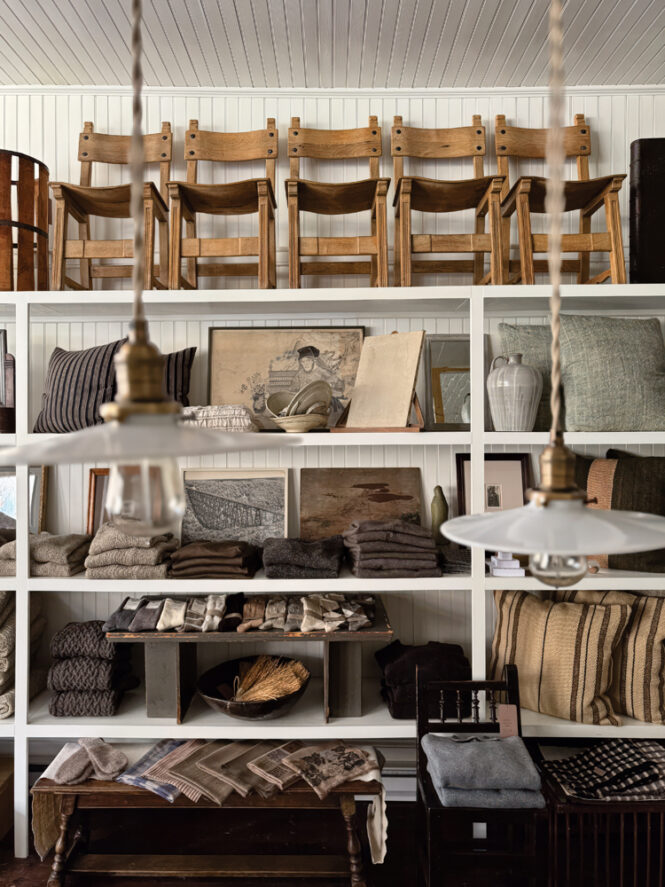
A curated collision of past and present, Pidgin’s interior is a living still life where antique darning eggs share space with contemporary ceramics, forged knives, and rubber novelties. Every surface invites inspection—each object part of a carefully composed, ever-shifting dialogue.
Pidgin is thus a complex ecosystem. “When something sells, it throws off the whole equilibrium of the store,” Anagnopoulos says. Restoring order is “not always so simple as just putting another piece of furniture in its place.”
Anagnopoulos, a collector, pilfers much of Pidgin’s inventory from his own archives. “I’m collecting,” he says, “but I’m also detaching.” He recalls an instance, a few months ago, where he brought something out to the floor only momentarily before regret washed over him. “Oh God,” he remembers thinking, “I don’t think I’m ready for this.” He brought it back upstairs, where it now sits on his desk. The object in question? An oversized and quite weathered darning egg with an accompanying stand. “I just couldn’t part with it,” he admits.
Though reverence occasionally interrupts detachment, it’s the very thing that makes the store work. “Affection, I think, is infectious,” Anagnopoulos explains. “I have to love what I’m selling, because otherwise my patrons won’t.”

Anagnopoulos restored the 1870s interior of this former general store with reverent restraint—reinstalling original transoms, beadboard, and partitions to make the space feel untouched by time.
Anagnopoulos grew up in and around his mother’s tailoring shop in Chicago, and as a traveling sales rep, he spent years working with merchants of all kinds. He always imagined opening a store in his old age, graduating from his career into a working retirement. But, during the pandemic, “life became more immediate and pressing,” he reflects. Priorities and ambitions shifted underfoot, and his timeline moved up.
He was tipped off by a friend about an available storefront in Oak Hill, a Greene County hamlet with a population below 300, not far from his home in Rensselaerville. Known as “Ford’s Store,” the two-story Italianate building dating from 1870 was added to the National Register of Historic Places in 2001. Over the years it has accommodated businesses selling plants, antiques, books, and records, and for a time was home to the local post office. An eclectic history befitting of the store Anagnopoulos had in mind.
In 2020, he moved in, seeking to restore the interior “to feel as though it hadn’t been touched.” He reinstalled the original transoms, put up beadboard, and added dividing walls to support the second story. “I feel obliged to be a steward for these buildings,” Anagnopoulos explains. “When the time is up for me, I want to pass them on in good working order.” Speaking in the plural, he’s referring both to Pidgin and the new store he’s opening down the street, in a space previously occupied by Norman Hasselriis, an interdisciplinary, idiosyncratic artist who passed away in 2006.
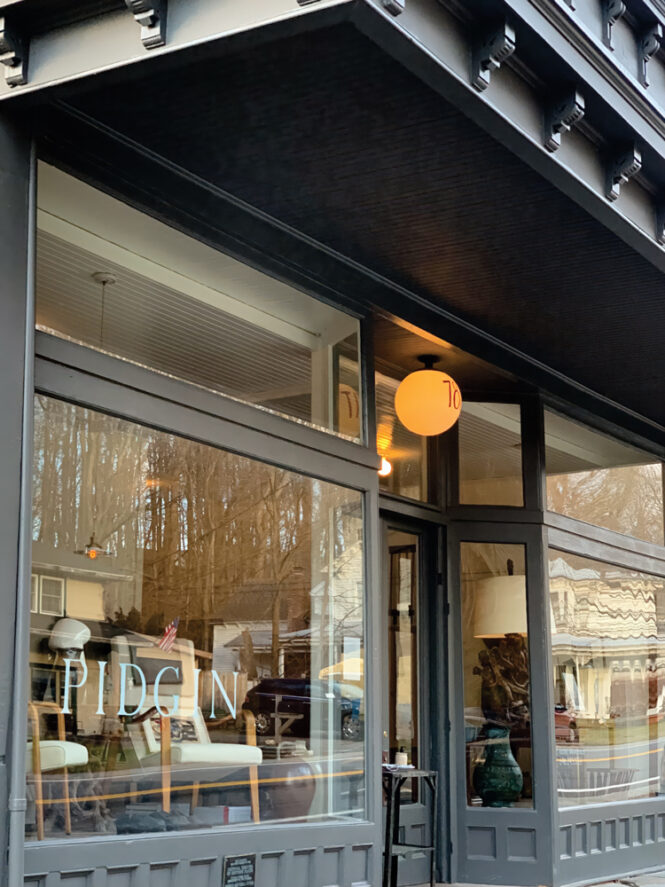
The Ford’s Store building is emblematic of an Italianate style popular at the time it was built, with a recessed entry and large display windows, perfect for viewing the wares within.
“An assemblage artist, a sculptor, an antiques dealer, a poet,” Anagnopoulos explains, Hasselriis was a local fixture whose legacy looms large in Oak Hill. The forthcoming store, named after Hasselriis, will include some of his assemblages. Selling primarily table-top and kitchen items, it will celebrate “gathering, breaking bread, and the great ritual of communing around the table.”
Also nascent is an online marketplace for Pidgin—a response to growing demand from afar. This is an addition, not a transition. “I still want people to come visit the store in person,” Anagnopoulos urges. “There’s nothing like that tactility.” Anagnopoulos describes Pidgin as “part self-portrait, part love letter.” Both are expressed through the objects within, painstakingly assembled in ornate, deliberate compositions that varyingly emphasize, subvert, or obscure their intended uses, assumed meanings, and particular histories. They speak in a pidgin best understood in immediate confrontation, unmediated by screens and unmitigated by distance.