
A Storied Lake Compound in Esopus Gets an Eco-Conscious Uplift
By Mary Angeles Armstrong | Photos by Nick Glimenakis | Fall 2025 | House Feature
One summer in the 1990s, when Richard Maltz was a kid attending sleepaway camp, his father got jealous. “My parents came up for visiting day and my dad looked around,” explains Maltz. “He said, ‘wouldn’t it be cool to have something like this that’s all ours?” The elder David Maltz’s musing sparked a years-long search, which ended in 1999 when the family hit Hudson Valley pay dirt: a 164-acre compound surrounding a 37-acre lake. The property’s four rustic stone and shake buildings—including a lodge, a manor house, and two small seasonal cabins—hugged the shoreline. “The size and the total privacy and solitude were the primary draws,” says Maltz, who now runs the auction business started by his father. “The lake is the main focal point—everything is situated to enjoy the lake. “
The property’s seclusion made it the ideal setting for a free-spirited chapter in Hudson Valley history. Once part of a much larger farmstead run by the Auchmoody family, the property was acquired in the early 20th century and became the Auchmoody Fresh Air Club—one of the country’s first nudist colonies. Sometimes known as the Out-of-Door Club, it was founded by pioneering queer researcher and writer Jan Gay (born Helen Reitman) who wrote about the nudist movement and included the setting in her book On Being Naked.

In the main house’s primary bedroom, the team balanced the rich wood paneling with softness, adding a custom Moroccan rug by MK Objects, a camel sheepskin sofa, and a canopy bed by Four Hands.
Clothes on or off, the home became a four-season haven for the Maltz family. An oversized stone fireplace in the rustic, timber-framed manor house and another in the lakeside lodge were perfect for family game nights or curling up with a book in winter. Many meals were shared in the manor’s formal dining room or lakeside, on the lodge’s wraparound deck. Canoe trips were launched from the dock, which was also the ideal spot for plunging into the lake when the weather turned warm. “Since I was a kid, this has been one of my favorite places to come and relax,” says Maltz. “The way that the house interacts with the lake which interacts with the forest is the perfect combination of privacy and adventure.”
In 2015, David Maltz passed away and Richard and his sister Sheryl Etzin faced a dilemma. The beloved family retreat had deep sentimental value, but decades of accumulated additions and various upgrades had left it feeling cluttered and disconnected from its original character. “My father loved this place—it was so special to him,” explains Maltz. “However, the property had not had a serious renovation in some time.” The siblings wanted to continue their father’s legacy of both enjoying and sharing the property, but modernize it to include more easeful, serene interiors. They also felt a responsibility to steward the property’s abundant natural resources for the coming generations. What came next was a masterclass in sustainable re-design.
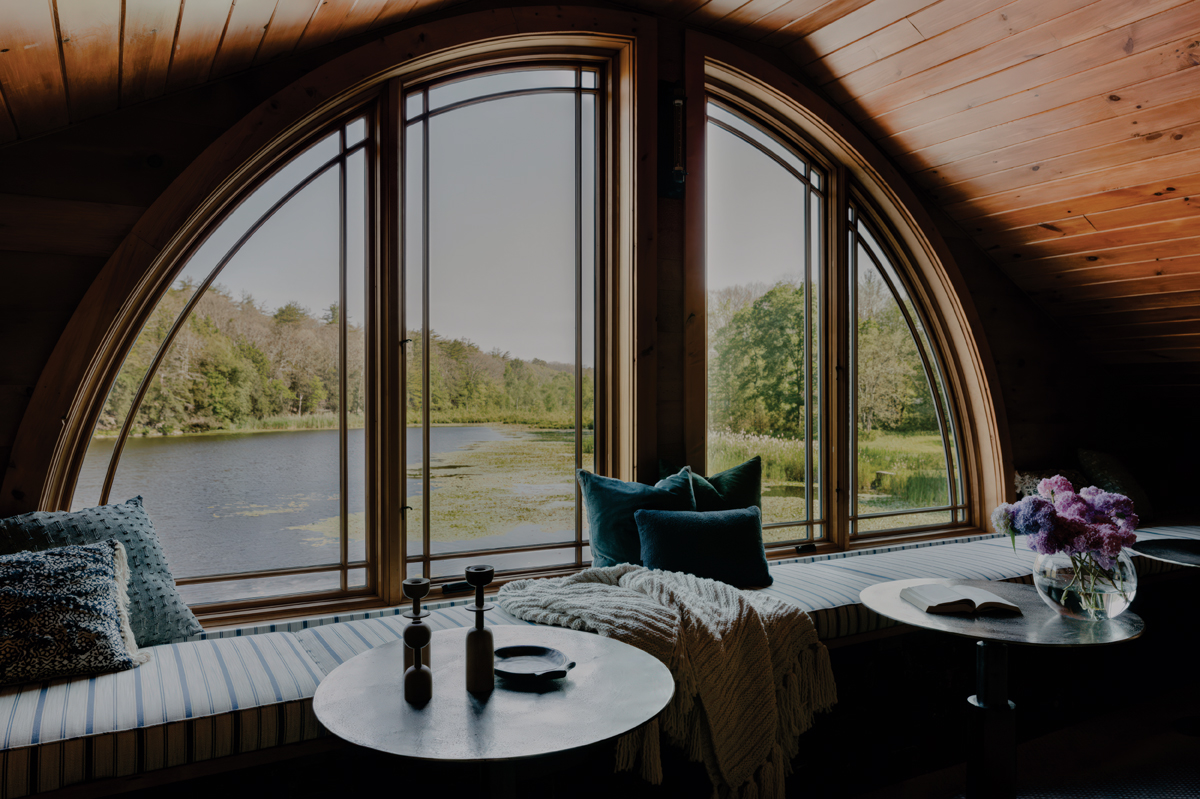
On the second floor of the lodge, the sunroom enjoys ample views of the lake and woods through an oversized arched window.
First, Do No Harm
To spearhead the renovation, the siblings brought in Brigid Walsh of the Saugerties-based design firm, 100 Miles North. “We wanted to keep an ecological and conscientious eye on any changes,” explains Maltz. “Every update we made was designed with sustainability and efficiency in mind.” Specializing in regenerative permaculture and sustainable design, Walsh began 100 Miles North to package sustainable solutions and “dish them up on a platter” for homeowners. “People want to do the right thing, they often just don’t know how,” Walsh explains. “100 Miles North is about making regenerative design accessible and easy for everyone, whether they have a tiny backyard or 200 acres.” The 200-acre property abutting DEC land needed a comprehensive strategy that addressed both its rich history and its environmental future.
Walsh began by conducting a forest and lake ecology report analyzing their health and biodiversity as well as the potential for conservation easements. She also tackled a crucial infrastructure improvement that most homeowners overlook. “Good gutters and downspouts are paramount to the longevity of a home’s foundation, exterior walls, and also prevent erosion and improve soil health,” she says. By rerouting water runoff, Walsh was able to make sure moisture flowed away from the exterior walls and into the lake.
Stripped Down
Inside the structures, the renovation began with the philosophy of subtraction. “What’s great about sustainable design is that it doesn’t have to be heavy-handed,” explains Walsh. “The main lodge and house, as well as the smaller cabins, were built over a span between the 1910s and 1930s and were a bit out of date but had beautiful original detailing.”
Each distinct chapter of the property’s history was layered throughout the structures, creating a busy blend of architectural styles and materials. In the larger gathering spaces and in multiple bedrooms, naked stone walls and roughhewn wood beams spoke to the property’s rustic origins. Other bedroom suites featured formal coffered ceilings and walls painted in contrasting reds. More modern additions—think gold leaf and a mid-`80s style Florida room—had been layered on top. “There were a lot of competing details,” says Walsh. “There was ornately carved wood next to stacked stone next to a crystal chandelier. The biggest issue was that there was way too much clutter.”

The main house offered the design team a challenge. In the formal dining room, a mix of textures, including rough stone arches, wainscoted walls, and a variety of exposed wood needed to be harmonized. The 12-seat formal dining table, a family heirloom, presented a common design dilemma. The team softened the table with a painter’s canvas tarp for a lived-in feel. Linen slipcover chairs surround the table and vintage Tamegroute pottery adds a soulful centerpiece.
To create modernized spaces harmonized around a few beloved family heirlooms, Walsh brought in Petra McKenzie and Jonah Kilday of MK Workshop based in both Brooklyn and Austin, Texas. The duo understood their assignment from the get-go. “The whole project was about making inherited things work,” explains McKenzie. “Instead of having unlimited resources and a blank canvas, we had to work with what was there—and the constraint led to maximum creativity. “
McKenzie and Kilday stripped away many of the property’s overly kitschy and ornamental elements, allowing the original structure to shine through. Then they focused on toning down the interior surfaces. “First we simplified,” says McKenzie. “There were so many different finishes and materials that the eye didn’t know where to go first. By working with color and texture rather than demolition, we created calm without destroying character.”

Updating the property’s rustic bathrooms into serene spa-inspired spaces was another challenge. “The upgrades honored the home’s original architecture,” says Kilday. “It was more evolution than overhaul.” Neutral paint and wallpaper shades lighten the spaces, while new fixtures and flooring add elegance. In one private bathroom nook a circular freestanding tub was positioned so that bathers could enjoy the lake view through the circular window.
They chose a palette of soft whites and earthy tones to complemented without obscuring the rougher texture of the stone walls and roughhewn beams. Sanding and staining the hardwood floors throughout all four houses created property-wide visual cohesion. The team also ripped the property’s eight bathrooms down to the studs, addressing outdated plumbing while installing modern, spa inspired fixtures that maintain the compound’s lodge-like character. “We were pleased with how they were modernized yet still in line with the rustic feeling of the cabins,” says Maltz.
Adventures in Sourcing (Sustainably)
After paring down the interiors, the design team had to source new furniture and fixtures for the streamlined homes. To stay true to Maltz’s sustainability mandate they took a renew-reuse-and-recycle approach. “We prioritized sourcing vintage and antique furniture and artwork, both locally and beyond,” says Kilday. “We intentionally leaned into a texture rich approach to complement the raw materials of the original structure. We wanted the interiors to feel like natural extension of the architecture.”

Throughout the cottages the team layered vintage, locally sourced, and new fixtures to create what they describe as a “cohesive-yet-lived-in feel.” Custom headboards upholstered in striped Lee Jofa fabrics create a unifying thread throughout the 11 bedrooms. In a lakeside guest room, rough wood walls are softened with textiles.
To minimize emissions without sacrificing variety, McKenzie and Kilday traveled to Round Top Antiques Fair in Texas—one of the world’s largest vintage markets spanning 20 miles of fields with 6,000 to 7,000 dealers. “We went out there with our shopping list and acquired about 50 percent of what’s in the home,” McKenzie says. The duo carefully curated and collected pieces in their Austin warehouse, then restored and reupholstered to match the home’s aesthetic. When they were finished they shipped everything north in a single truck.
What they didn’t find in Texas, they sourced locally, finding multiple pieces at Hudson Valley Antique Warehouse and other regional antique shops. “More than 50 percent of that house is vintage,” McKenzie explains. “We needed cool things that weren’t off the rack. But buying old things really works in an old house.”
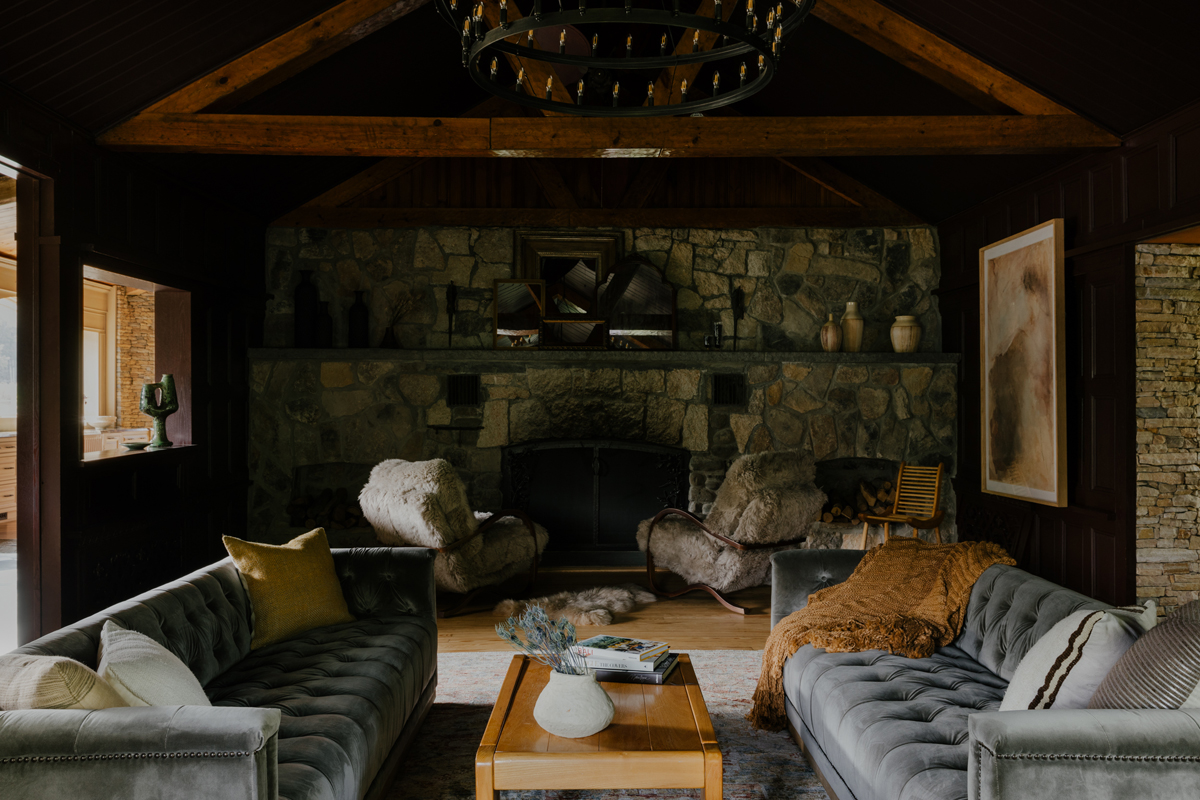
Today, the compound continues as a rotating family retreat. Different relatives and friends enjoy visits throughout the year, honoring both the property’s legacy and its sustainable future. Maltz and Etzin are happy to continue their father’s legacy. “We always hosted a huge family Thanksgiving here, and everyone knew not to make other plans,” remembers Maltz. “I’m happy that I get to share the uniqueness of it all again with my family and friends.”