
Saugerties Architectural Marvel the Spiral House Now Open to the Public
By Abilene Adelman | Fall 2025 | Design Feature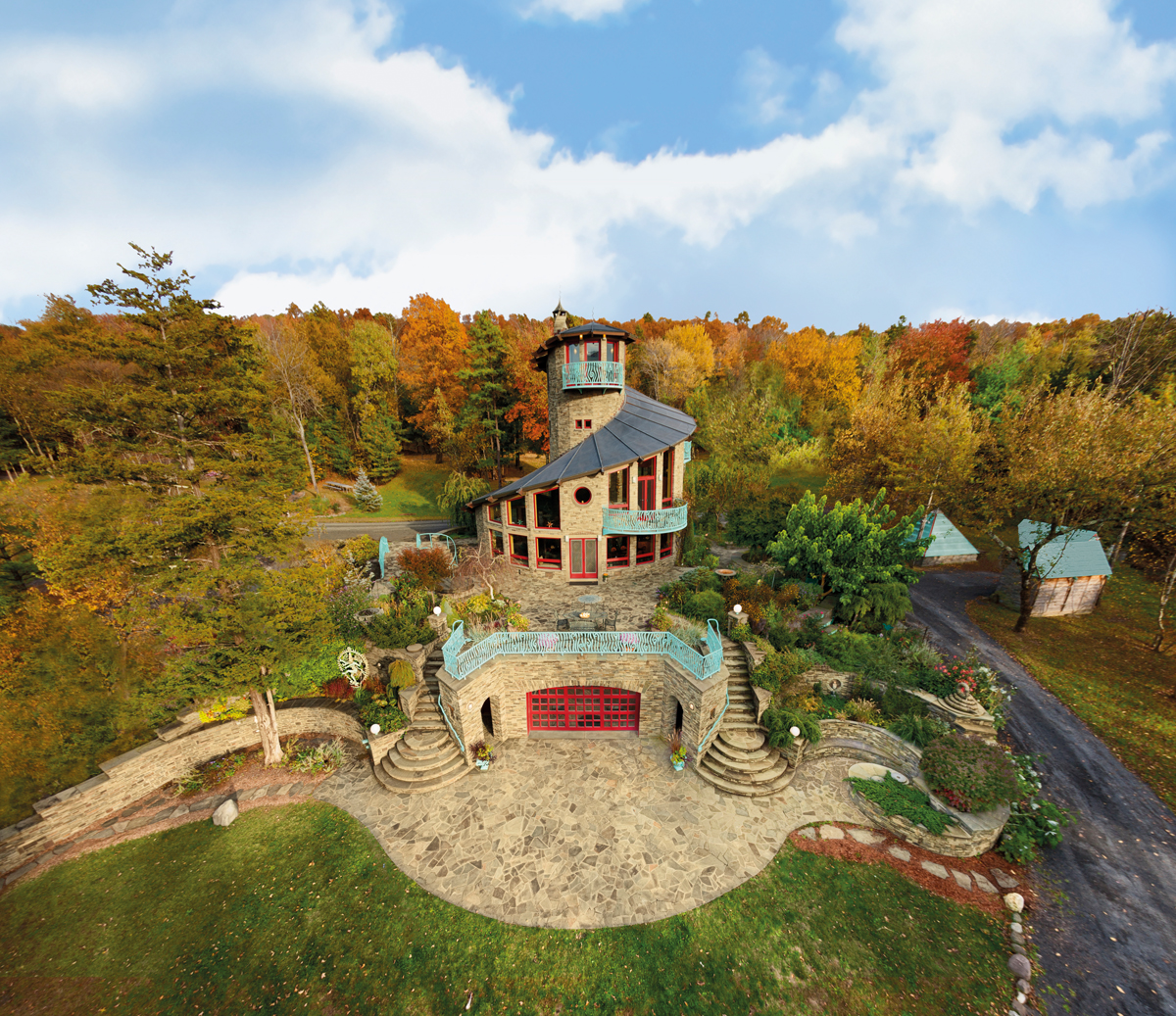
Off a quiet road between Saugerties and Woodstock, heaven and Earth collide into five tapering stories of Catskill bluestone. The Spiral House emerges from the quarry like a fossilized prayer, transforming geometry into a sacred form. This structure began as a desire for a guest cottage to accompany the ranch house Patty Livingston had been living in since 1981. However, it later turned into the home she and her artist husband, Tom Gottsleben, would reside in for over 20 years.
Gottsleben died in 2019, but the house and property remain as a link to both his spirit and the holy energy that he channeled in his art. In 2024, Livingston officially moved out of the Spiral House and back into the couple’s original ranch house. In keeping with Gottsleben’s legacy, she has donated the site toward the formation of a nonprofit called Spiral House Park—a place where all people can gather to experience the divine connection between nature and art.
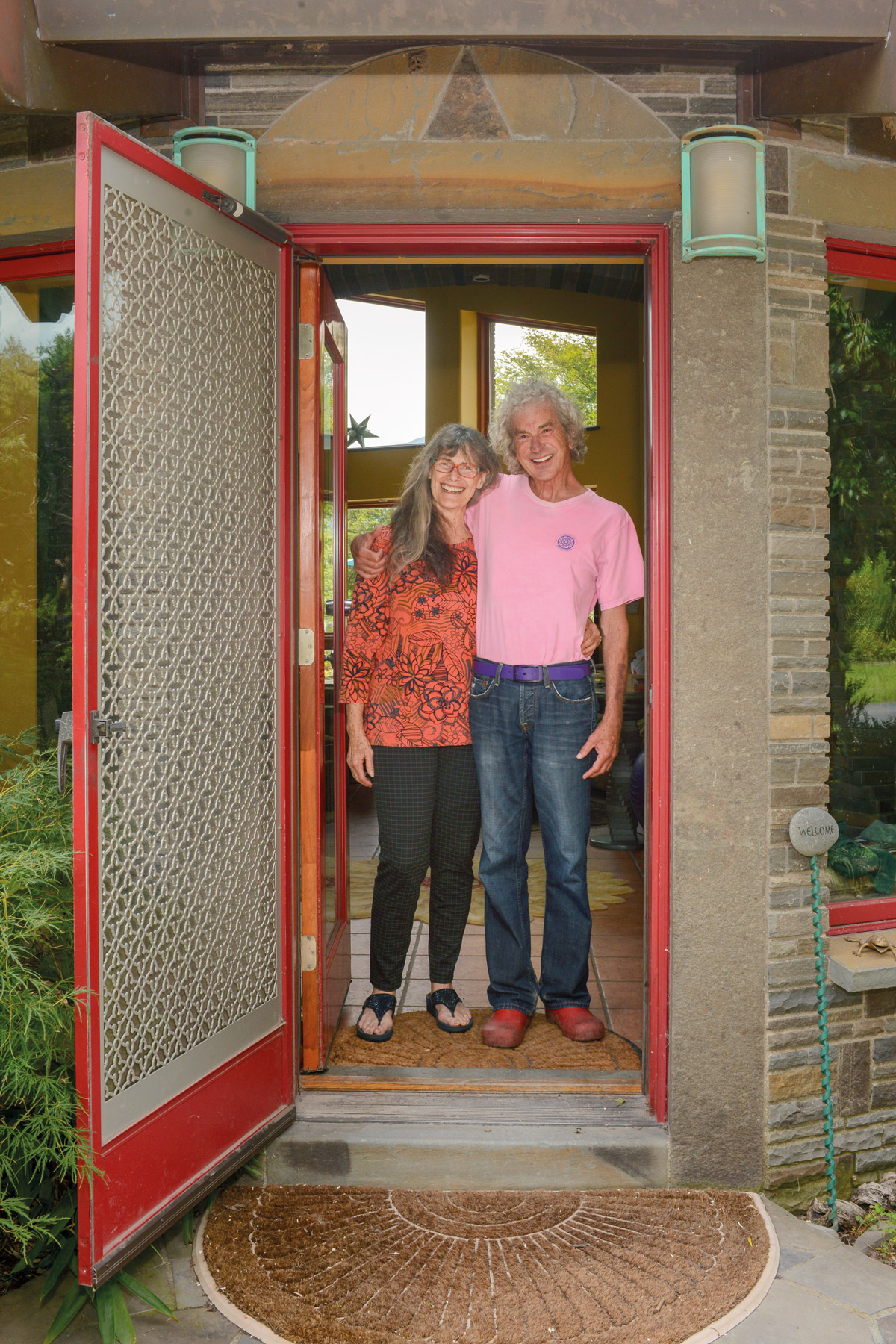
Tom Gottsleben and Patty Livingston had long planned to turn their property into a public foundation geared to appreciation of the arts and preservation of the environment. The creation of Spiral House Park is the fulfillment of the legacy of Gottsleben, who died in 2019. Photo: Andrea Barrist Stern
Gottsleben was an artistic connoisseur. He was a celebrated sculptor and painter, known for his stone and glass work. Since his youth, he had had a special appreciation for Eastern religions and spiritual design. In 1988, Gottsleben built a bench out of bluestone as a memorial for Rafferty, the couple’s beloved Airedale Terrier. The creation of Rafferty’s Bench marked the artist’s foray into the world of stone sculpture. Before the Spiral House, he had been pulling bluestone for his sculpture business, Rafferty Rocks. Many of his sculptures incorporated spirals, connecting the nature that Gottsleben could see and touch with the divine he knew existed. When Livingston, his creative muse, requested he design a guest house, it became a stepping stone in his spiritual journey with sculpture.
Ancient Geometry
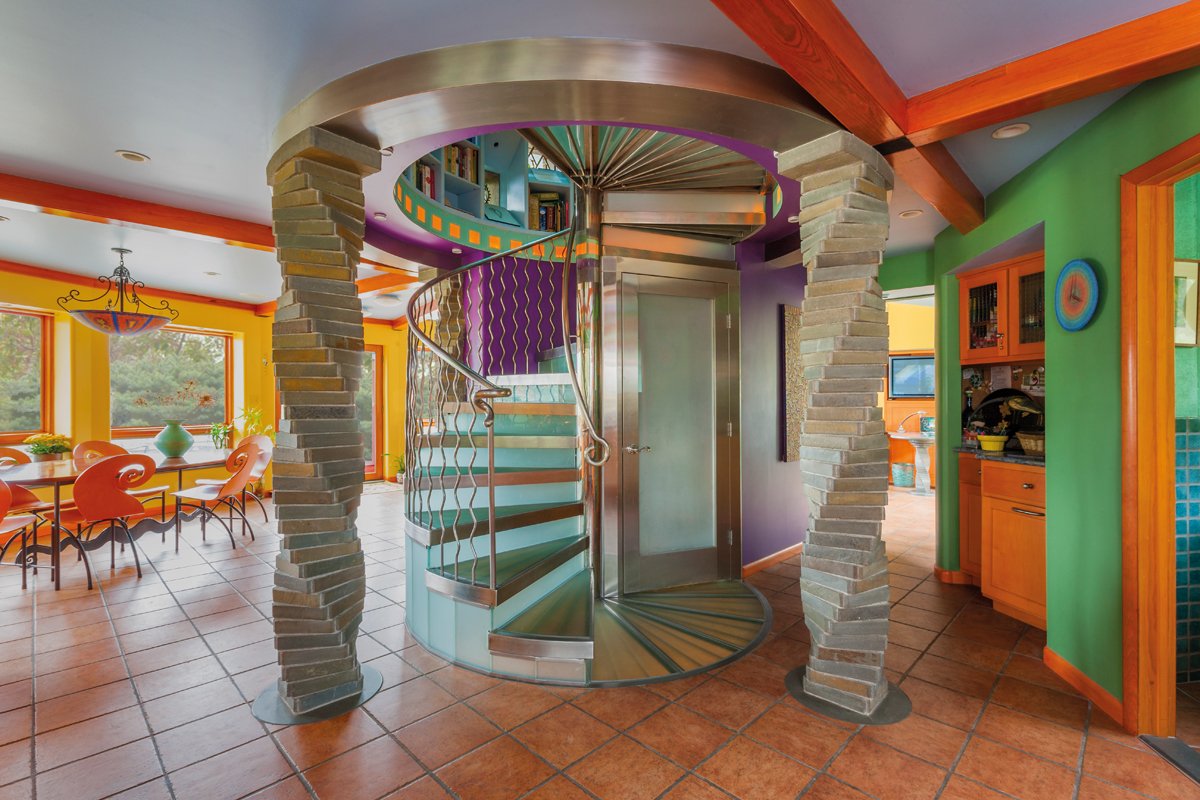
A large portion of the stairwell was cut away to expose the spiral staircase and allow for more movement without having to walk all the way around the spiral. The glass enclosure from the bottom of the staircase allows direct sun from the dining area windows to pass through to the lower staircase and down into the basement. Photo: Phil Mansfield
A large portion of the stairwell was cut away to expose the spiral staircase and allow for more movement without having to walk all the way around the spiral. The glass enclosure from the bottom of the staircase allows direct sun from the dining area windows to pass through to the lower staircase and down into the basement. Photo: Phil Mansfield
To build the house, Gottsleben gathered together a team of local artists, craftsmen, and friends. He drew on the 1967 book The Secrets of Ancient Geometry and Its Use by Danish engineer Tons Brunes—the definitive work on the principles of the geometric principles encoded in ancient monuments like the Great Pyramid of Giza. Gottsleben was also inspired by the bond between science and nature found in logarithmic spirals and sequences like the Fibonacci sequence.
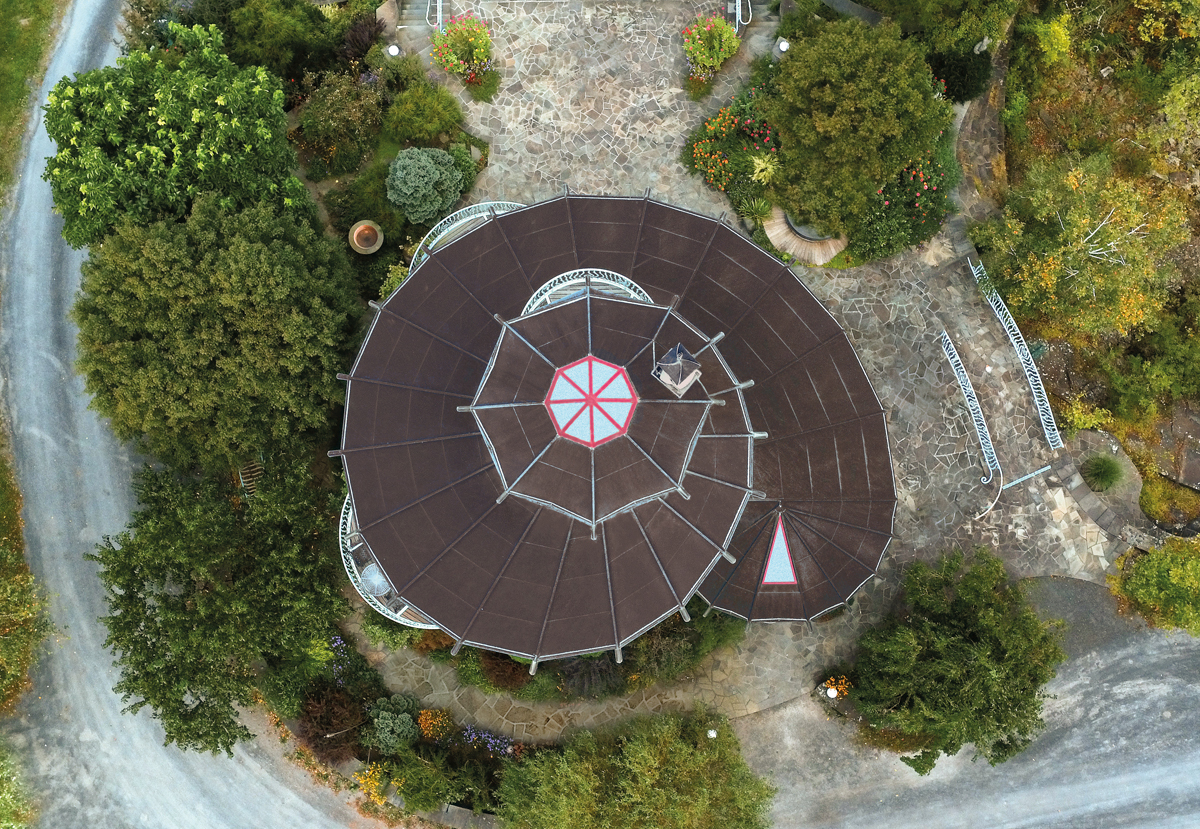
Seen from above, the Spiral House reveals its nautilus-inspired form—an architectural echo of logarithmic spirals found in nature, with each level diminishing in scale as it coils upward in a geometrically precise ascent.
Photo: Michael Nelson
These forms mirror the idea of the nautilus shell, which expands upward while maintaining a mathematically constant shape. Each floor of the five-story, 4,000-square-foot house is about 50 percent smaller than the floor below it. Made mainly from bluestone gathered from the quarry it rests in, the house emerges from the ground in a desperate leap to reach the heavens above it. While the house appears perfectly round, its structure contains 52 flat walls intended to honor one of Livingston’s basic requests: that she be able to fit a sofa easily along the interior walls.
The railings that surround the house’s various patios and balconies are twisted in a way that echoes the outline of the Catskill Mountains looming behind them. The bookcases that line the spiral staircase in the center of the house switch from books about cooking and science on the floor that houses the kitchen, to books about spirituality on the floor that leads to the observation deck at the top of the house: a culminating moment of the house where a glass floor allows for full sight down the entire staircase. The outside grates are shaped into spirals. The bluestone above the interior fireplace twists upward to resemble the way smoke rises.
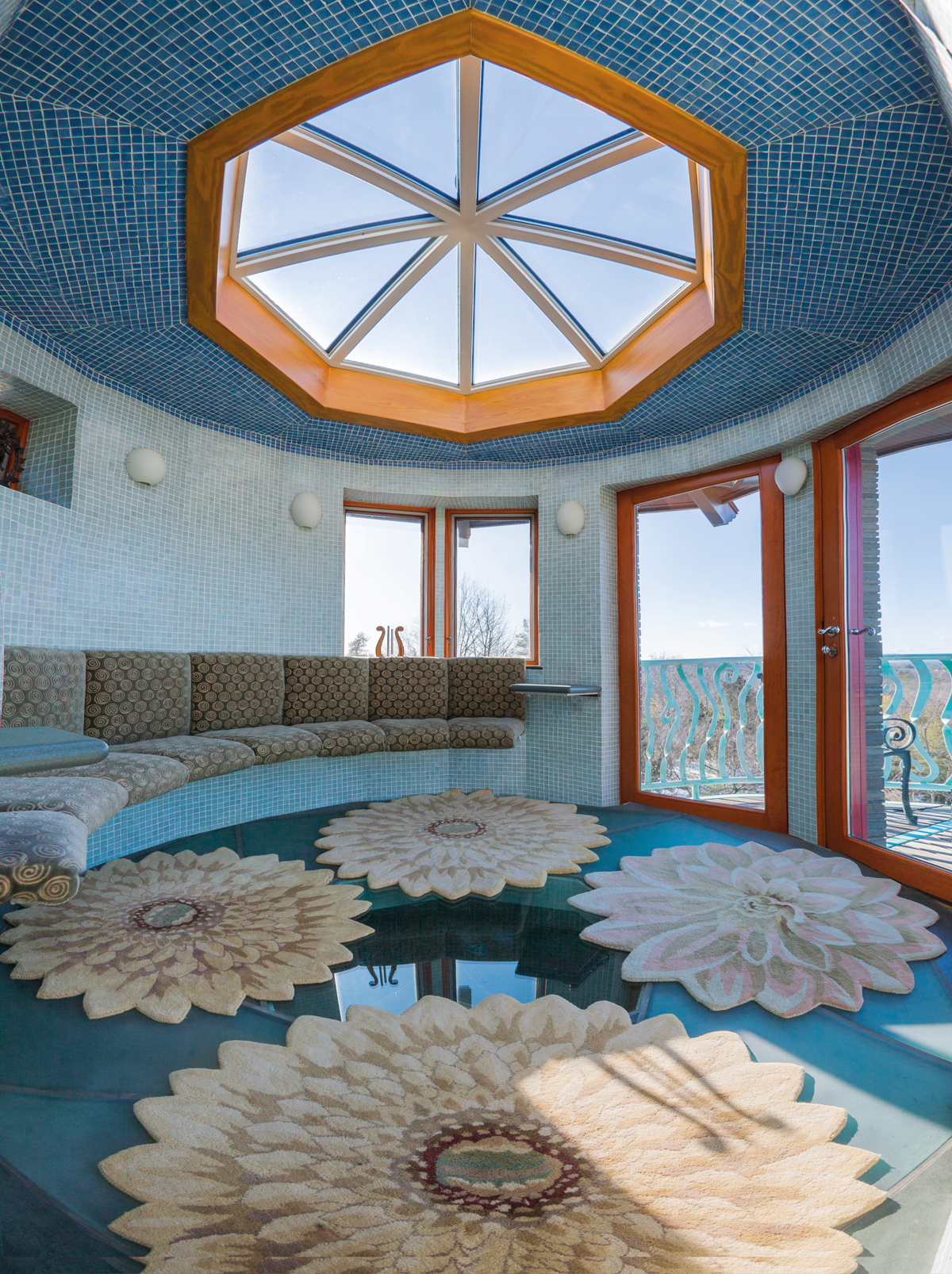
At the apex of the Spiral House, the glass-floored observation room offers a vertiginous view down the central spiral staircase—a celestial perch where sky, stone, and spirit align. Photo: Phil Mansfield
“He [Gottsleben] had the mason redo the fireplace a few times,” says Joshua Cohen, executive director of Spiral House Park. “As they went up, he realized that the measurements increased, and it got a little wider than he wanted. He wanted it to really resemble smoke, so he wanted a very specific way to inset each stone.” Even the outbuildings that contain the trash, recycling, and generator are meticulously designed. The power pod, a building that houses the boiler, generator, and other mechanicals, is an architectural feat in and of itself—a round hobbit house of a building built with stacked stone under a metal roof worn like a helmet, reflecting a gradient of colors when hit by the sun.
Between the 45 acres of gardens and trails, the design of the house, and Gottsleben’s scattered sculptures reflecting light in every direction, Spiral House Park offers a conjunction of the arts with the natural beauty of the Hudson Valley akin to Harvey Fite’s nearby bluestone masterpiece, Opus 40.
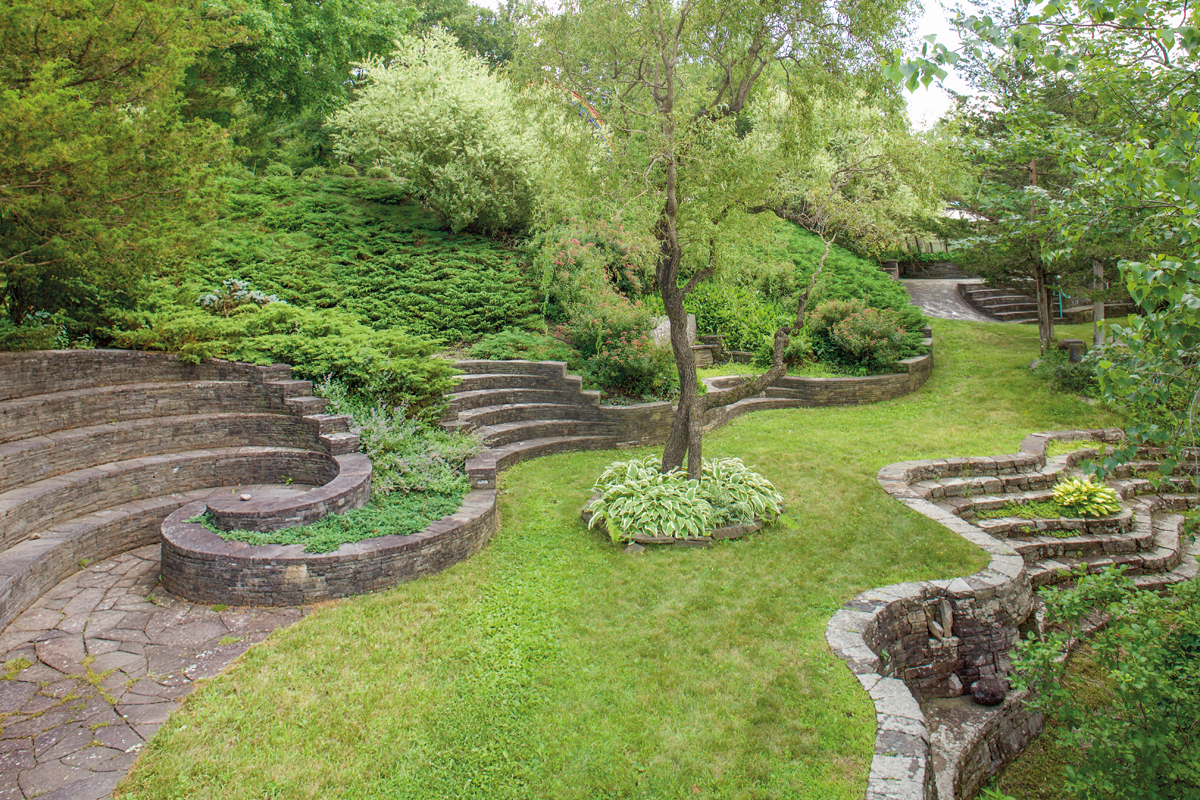
The grounds of Spiral House Park opened to the public in August 2025.
Leaving a Legacy
“I’ve heard a lot of people refer to this place as a sanctuary,” Cohen says. “You feel the intentionality here, because of how well integrated this house is, and the gardens that wrap around it. I find it really holds people here.” The gardens are as much of a temple as the house itself. Gottsleben’s sculptures are scattered throughout them, many created from rainbow crystals containing glitter from a jar that can still be found in the observatory. The walls of the garden are made of the same bluestone as the house, shaping the landscape in waves that settle into the hill the house rests on. Some walls and benches create a half circle pointing outward, welcoming meetings and conversation, while others point inward, dedicating space for meditation and solitary reflection. The gardens, which used to be more ornamental, are being transitioned to native and pollinator gardens as part of Spiral House Park’s dedication to conscious environmental practice. The park is also, excluding an as-needed generator, powered by solar panels.
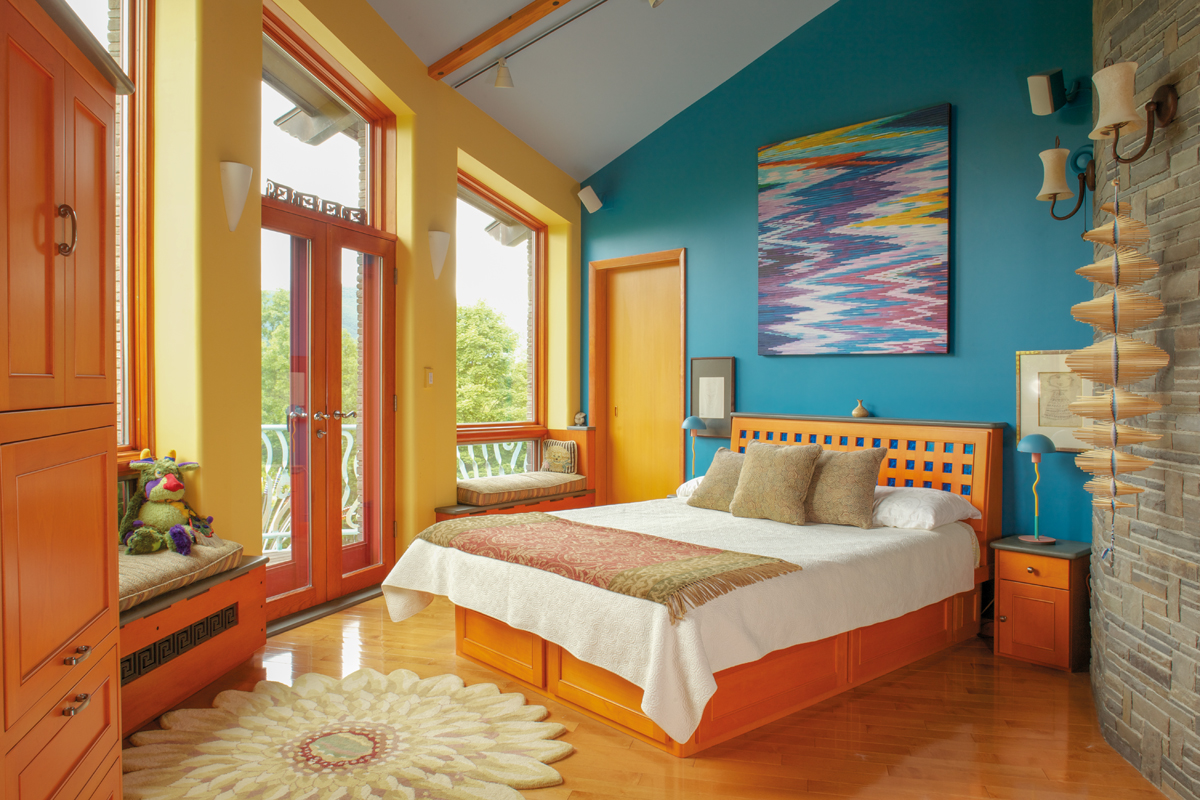
The second-floor primary bedroom has an open plan with discrete but connected spaces. Here, the stone facade of the stairwell column (not seen in this image), the built-in cabinetry, and different ceiling heights and window configurations all help to define a sitting room and bedroom. Photo: Mick Hales
Spiral House Park opened to the public in August. Its inaugural event was a geology walk held on August 10 with Dr. Robert Titus, coauthor of The Hudson Valley in the Ice Age: A Geological History and Tour. The park has a trail network that is scheduled to be open to the public on Saturdays beginning in mid-October, pre-registration requested. House tours are also scheduled for October, pre-registration required. Workshops are currently offered with pre-registration. Check Spiralhousepark.org for updates and a schedule of programs. “Patty’s generosity has brought this place to life in a new way, and I’m excited to see what we’re gonna be able to do going forward,” Cohen says.
Cohen and Livingston are developing a lecture series around the intersection of science and art, and planning cooking classes, family days, and various workshops, including a possible bee-keeping workshop. They plan to launch an artists’ residency, turning Gottsleben’s magnum opus into an inspirational focus for other artists, particularly ones interested in stone work. “There’s so much opportunity for bringing artists in to be inspired in the same way that Tom was and to create their work as well,” Cohen says. Information and registration for tours and events can be found on the website Spiralhousepark.org. Park memberships are also available on the website; these will support its development and allow for regular visitation and event discounts.
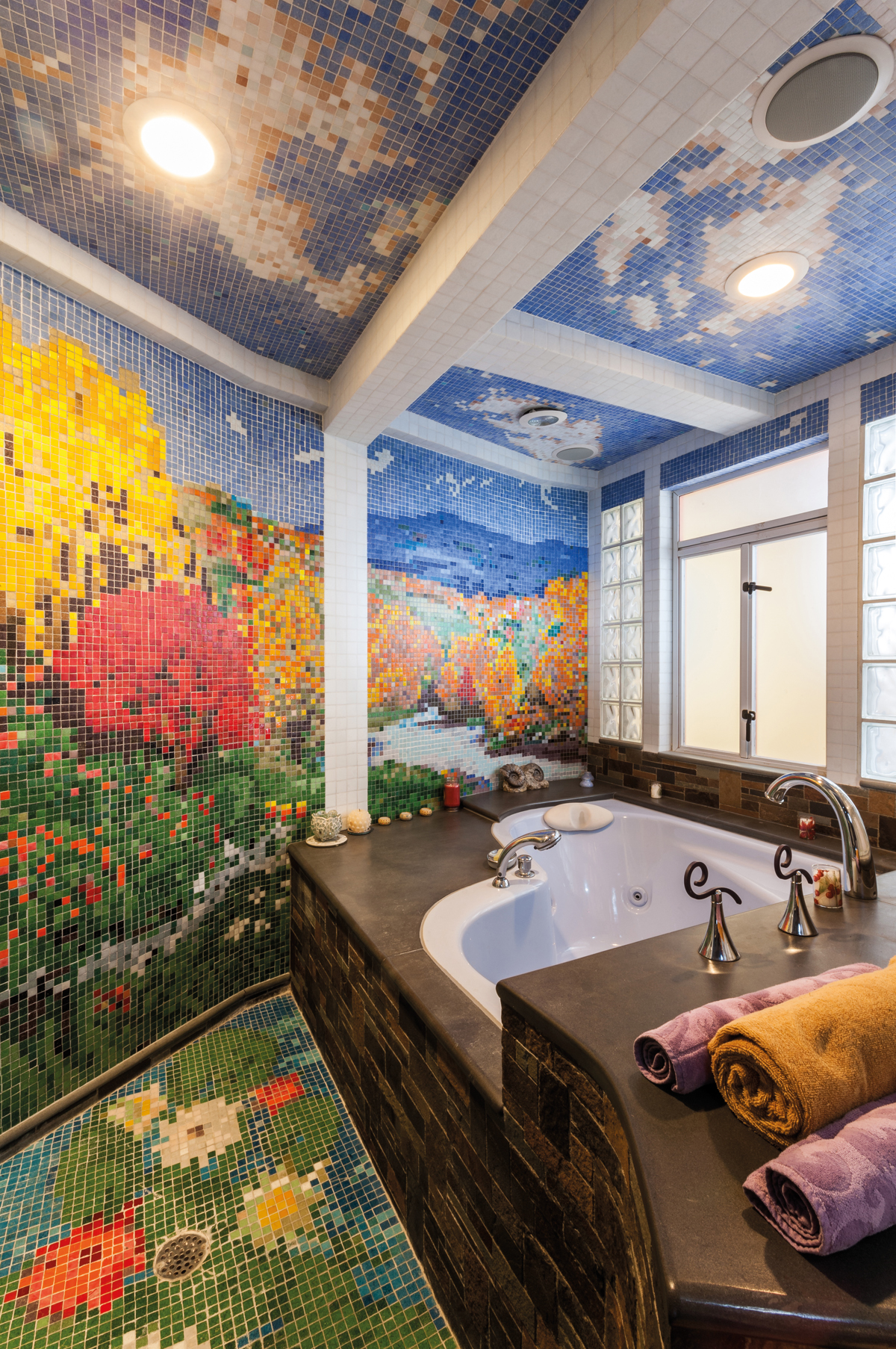
Given the spiral shape and the fact that each floor of the spiral house is half the footprint of the floor below it, a bathtub, even a Japanese tub with a small footprint, would have made the upper bathroom spaces feel confined. The couple decided early on to put a large bathtub in the basement bathroom, a decision that freed them up to maximize space in the upper bathrooms. Photo: Mick Hales
“It has been a place for community building and gathering in Tom and Patty’s life here together,” Cohen says. “Now, as we create this nonprofit, it’s very much about community and inviting the public to come feel that sense of calm, that sense of inspiration, that sense of awe.”
Hanging along the staircase in the Spiral House is a tapestry that reads “In the end what matters most is / How well did you love / How well did you live / How well did you learn to let go.” Inspired by his love for his wife and his dedication to the principles of sacred geometry, Gottsleben has left behind a legacy as formidable as the stone he used to build it. Now, Livingston has let that legacy go so that it might serve as a source of divinity for other minds looking to be inspired. The Spiral House grows out of the Earth, while reaching to the heavens above it. It unites realms: heaven and Earth, nature and art, math and humanity.