
Upstate Modernist’s Signature Approach to Landscape-Driven Architecture
How the Spruce residence showcases everything Upstate Modernist stands for
Presented by Upstate Modernist | Ethan Abitz | Summer 2026 | SPONSORED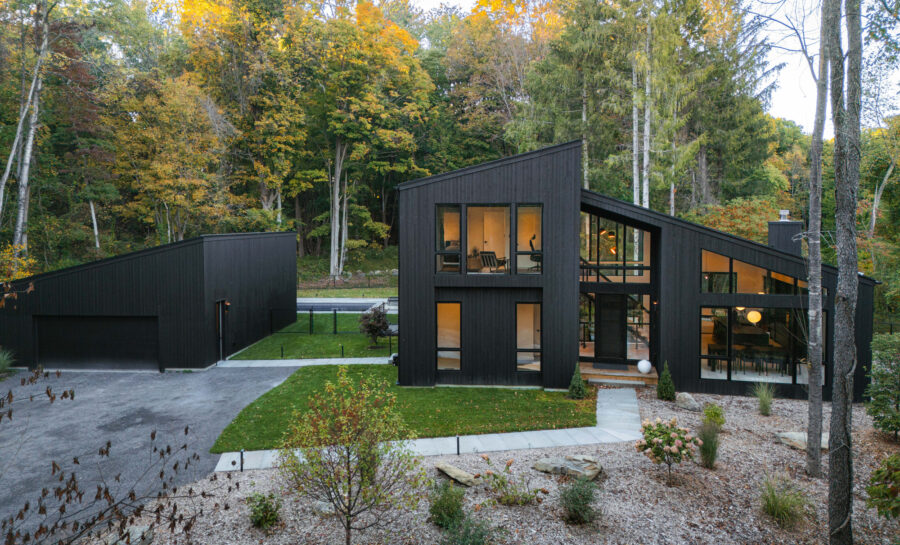
The first thing you notice about the Spruce house is its silhouette. Two dark cedar-clad volumes angle toward one another beneath asymmetrical rooflines, framing a recessed entry that pulls the woods inward rather than shutting them out. The house has a strong graphic presence, but it sits low and measured against the trees, in dialogue with the landscape. It’s dramatic, certainly, but not in the way contemporary rural architecture often is. The house doesn’t arrive in the landscape as an alien object or a monument to itself. It settles into the site. The angles echo the surrounding trees. The dark cladding recedes into shadow. Through expanses of glass, the forest presses inward.
That relationship between modernism and landscape sits at the center of what Upstate Modernist has built its practice around. Founded by Christopher Dierig, a registered architect, and Doug Maxwell, a licensed real estate broker and managing partner, the firm operates as a vertically integrated design-build company focused on high-end modern homes across the Hudson Valley and Catskills. Their projects combine architecture, construction management, interiors, and development under one umbrella. But more than the logistics, they’ve built a recognizable aesthetic vocabulary: modernist houses softened by natural materials, contextual siting, and an emphasis on warmth over severity.
“We practice a version of modernism that we call Upstate Modern,” Maxwell says. “It’s much warmer in character than other forms.”
That distinction matters. In popular imagination, modernist houses can still conjure images of sterile white boxes or glass pavilions that feel disconnected from the realities of everyday living. Maxwell understands the stereotype. “People think of soulless boxes,” he says. But Upstate Modernist’s approach moves in another direction entirely. Their homes are deeply site-responsive, drawing from the topography, vegetation, and rhythms of the surrounding landscape.
“Everything we do is site specific and one of a kind,” Maxwell says. “It’s really meant to integrate with the landscape.”
Inspiration from the Land
The Spruce residence, completed in May 2025, exemplifies that philosophy. The home began not with a client brief, but with the land itself. Upstate Modernist pre-designs homes for specific parcels before selling them, allowing the architecture to emerge directly from the conditions of the site rather than retrofitting a generic house plan onto a piece of property. In this case, the catalyst was a stand of mature spruce trees.
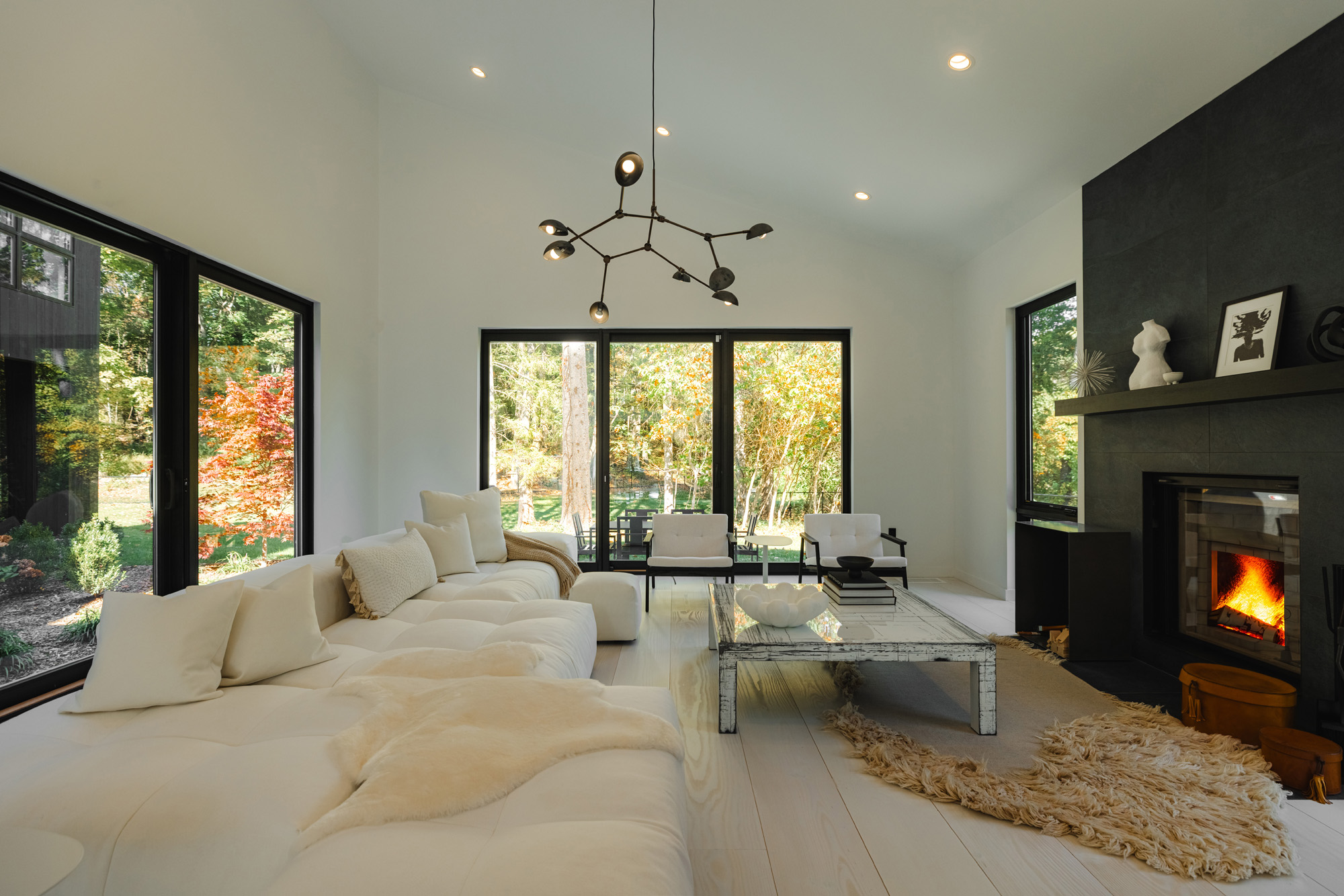
The living room balances the homeowners’ monochrome aesthetic with tactile materials and natural textures that soften the palette.
“We were inspired by the spruce trees on the site,” Maxwell says. “We love this idea of it representing branching out of the ground at different angles, which you see in the roof line.”
The intersecting shed roofs mimic the branching geometry of the trees, while the home’s layout creates a series of layered relationships between interior and exterior space. A courtyard carved into the middle of the structure functions almost as negative architecture—an absence that allows the forest to penetrate the footprint of the house itself.
“That courtyard area directly integrates with the landscape as if the landscape is growing out of the residence,” Maxwell says.
The courtyard also creates unusual sightlines through the home. From the open-plan kitchen and living area, views extend not only outward into the woods, but across the courtyard toward the den and secondary spaces. The effect is simultaneously expansive and intimate. “It was really to bring the outdoors in,” Maxwell says. “And then also to have these really interesting cross-views across the residence.”
That emphasis on flow and spatial sequencing is one of the less obvious but most essential aspects of the firm’s design philosophy. Maxwell speaks less about individual fixtures than about circulation—how a driveway approaches the house, how the entry unfolds, how the transition from public to private space feels over the course of a day. “A lot of times people focus on fixtures,” he says. “But one of the aspects of a home that is less noticeable, but maybe more important in the way a home feels, is the flow.”
In Spruce, that flow is organized through two distinct volumes. One single-story wing contains the public-facing living spaces: kitchen, dining, and entertaining areas. A second two-story volume houses more private functions, including the primary suite upstairs and office and den spaces below. The separation creates a subtle zoning effect that supports both entertaining and retreat. “The separation of space is one of our core tenets when it comes to design,” Maxwell says.
Balancing a Black-and-White Palette
While the architecture was largely conceived before the clients entered the picture, the interiors became an unusually collaborative exercise. The homeowners—a jewelry maker and a technologist relocating from New York City for full-time upstate living—brought a highly specific aesthetic sensibility to the project. Chief among their requests: a rigorous black-and-white palette.
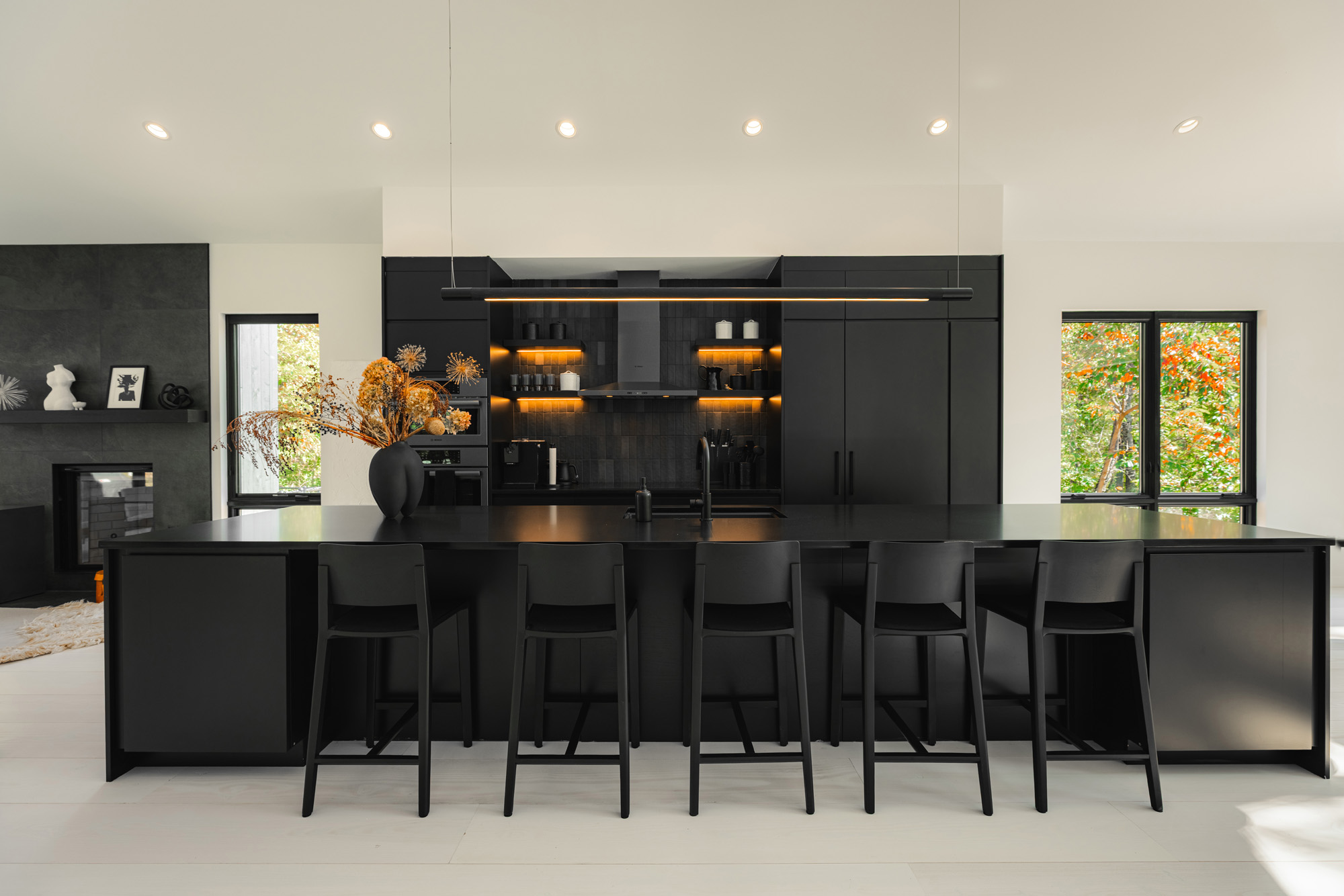
The kitchen’s black-on-black look incorporates textured materials and warm lighting to maintain a sense of depth and livability within the home’s restrained aesthetic.
For a firm whose work often leans toward muted natural palettes, the request represented a challenge. Minimalism can easily tip into coldness, especially when stripped down to monochrome. The solution came through texture and materiality rather than color.
The Douglas fir flooring was heavily whitewashed but retained visible grain and character. Black Zellige tile in the kitchen introduced irregularity and tactility. Throughout the home, matte finishes and natural materials soften the graphic palette. “We’re bringing in natural textures and materials to balance the palette,” Maxwell says.
That interplay between restraint and warmth extends throughout the house. A floating staircase rises through a double-height entry foyer framed almost entirely in glass. The gesture has some of the grandeur of a traditional foyer, but stripped of ornament and redirected toward the exterior. “There’s not a lot of art walls,” Maxwell says. “The windows turn the landscape itself into art.”
A Design-Build Firm
The project also reflects broader shifts in how Hudson Valley homes are being conceived. Many Upstate Modernist clients arrive from urban environments seeking not rustic nostalgia, but a different relationship to space, privacy, and landscape. Increasingly, those homes are designed for full-time living rather than occasional weekend use. “There’s a lot more consideration around everyday living,” Maxwell says. Storage, circulation, workspaces, and durability become central concerns. “Not everyone is a minimalist,” he adds.
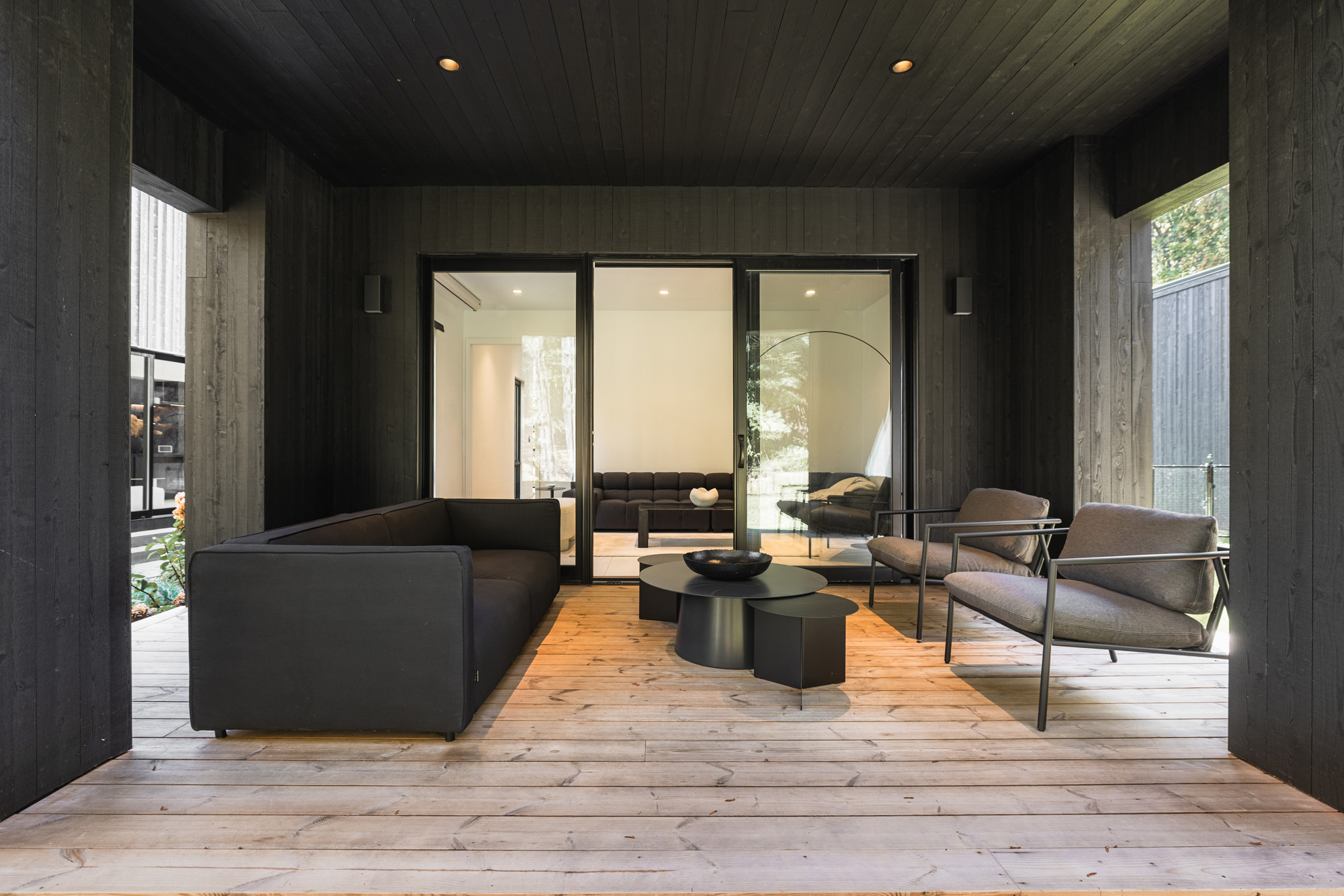
A covered porch positioned between the home’s volumes creates an outdoor living space that connects the courtyard to the surrounding woods.
As a design-build firm, Upstate Modernist also occupies an unusual niche in the regional market. Rather than operating purely as architects or contractors, they manage the entire process—from land acquisition and permitting through construction and interiors. Maxwell describes the model as a hybrid between custom architecture and speculative development. “Our approach comes to the table with 95 percent of the legwork done,” he says.
That includes extensive visual renderings and pre-construction planning, which helps clients understand the finished home before construction begins. The process is designed to reduce the uncertainty and friction that often define residential construction projects. “Our goal is not only to make it easy,” Maxwell says. “It’s really to make it fun.”
A Commitment to Sustainability
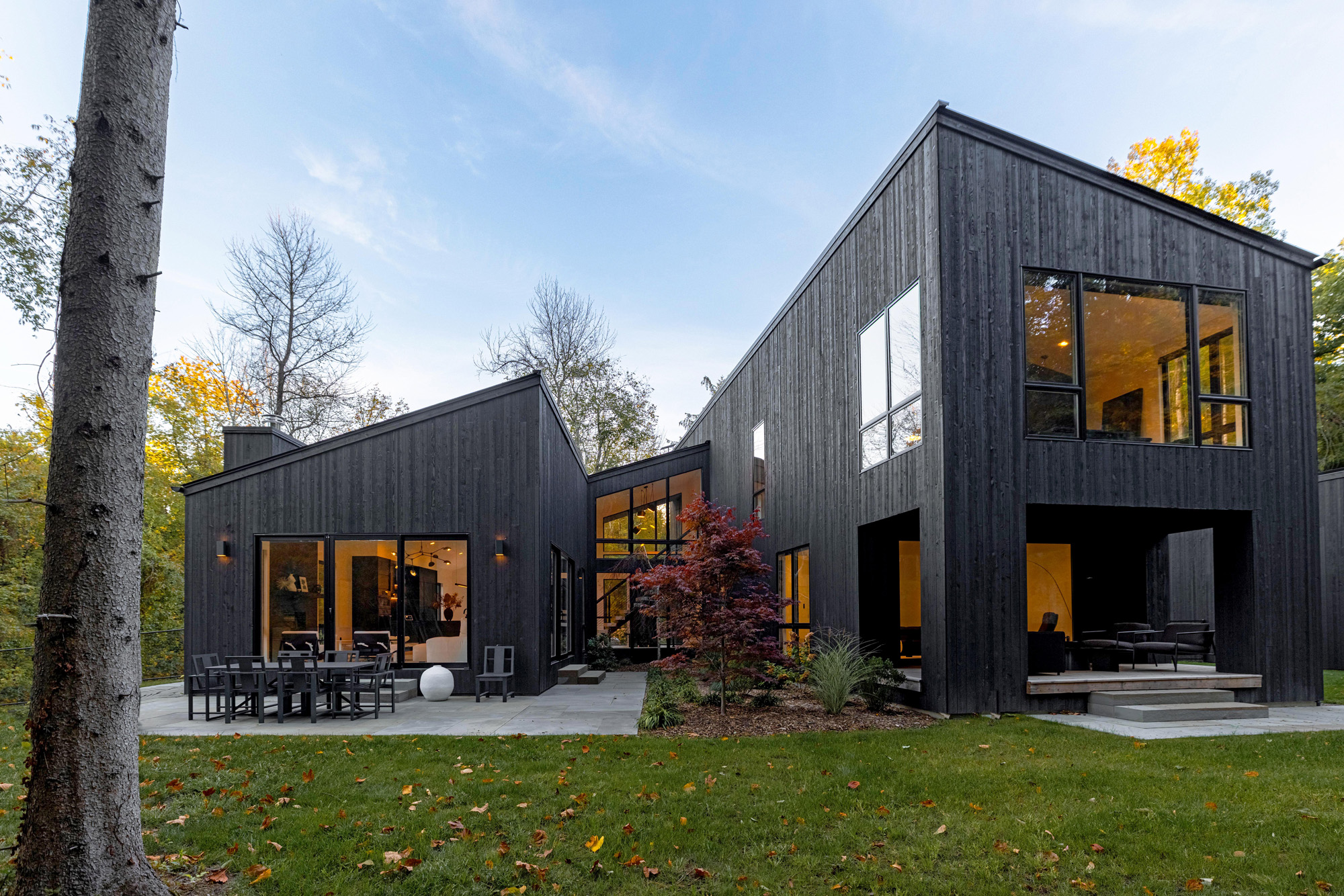
At the rear of the house, the two cedar-clad volumes open onto a courtyard-like outdoor space that reinforces Upstate Modernist’s emphasis on sightlines, flow, and connection to the surrounding landscape.
Underlying all of it is a strong emphasis on sustainability and performance. Upstate Modernist homes exceed New York State energy guidelines and have shifted entirely to all-electric systems, relying on heat pumps and geothermal technology in place of fossil fuels. Spray foam insulation, insulated foundations, energy recovery ventilation systems and tightly sealed envelopes help support that transition.
“We moved to all-electric houses as standard several years ago,” Maxwell says.
Still, for all the technical considerations, Spruce succeeds because it never feels overdetermined. The house is sophisticated without becoming austere, carefully composed without losing its sense of livability. Its modernism is not about confrontation or spectacle. It’s about calibration—between house and site, restraint and comfort, architecture and the lives unfolding inside it.
And in the Hudson Valley, where the relationship between landscape and home increasingly defines the region’s design culture, that calibration may be exactly what resonates.