
This Modernist Hudson Valley Home Takes Cues from its Skytop Location
By Mary Angeles Armstrong | Winter 2024/2025 | Features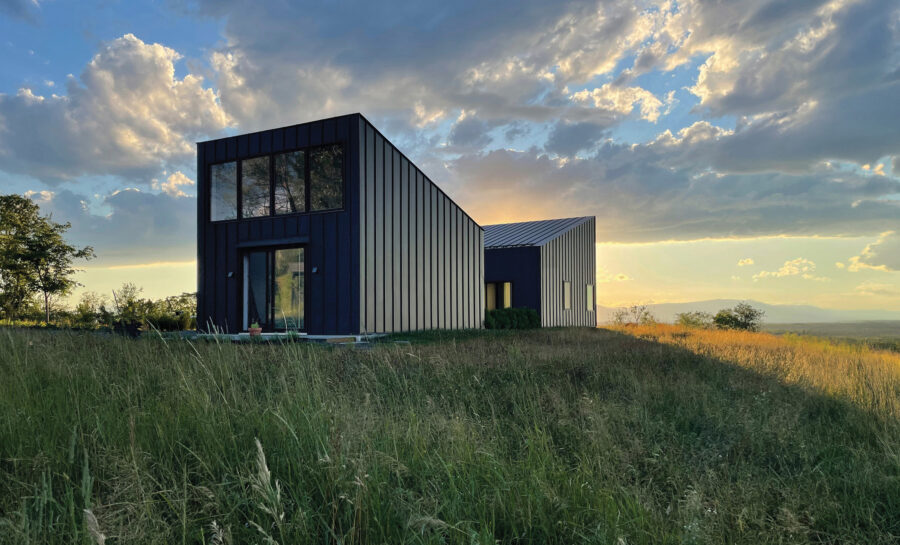
Paul Gates’s first visits to the Mid-Hudson Valley had him looking skyward. “My father used to bring us up here [from Westchester] to visit the Rhinebeck Aerodrome for the airshows,” he explains. “Even then I was taken by the beauty of the area.” It’s probable that, on one of those visits, as one of the airshow’s historic, open-cockpit biplanes looped across the sky, the plane passed right over Turkey Hill, where Gates, an architect, would one day build his modernist take on a simplified nature retreat. The home and studio, two shed-like structures clad in black metal and tucked against the hilltop tree line, merge contemporary design with the natural rhythm of sunlight, open skies, and surrounding fields.
The design’s simplicity is deceiving. Sited carefully on the hilltop, the 2,200-square-foot main house and separate 500-square-foot studio were calculated precisely to maximize efficiency and erase the boundary between the interior and setting. The buildings and their layout draw on a lifetime of design influences gleaned from Gates’s time working on both coasts and abroad. “The house is unabashedly modern,” says Gates. “It’s a composition of prismatic forms set in juxtaposition to the landscape and arranged in a clear, simple plan.”
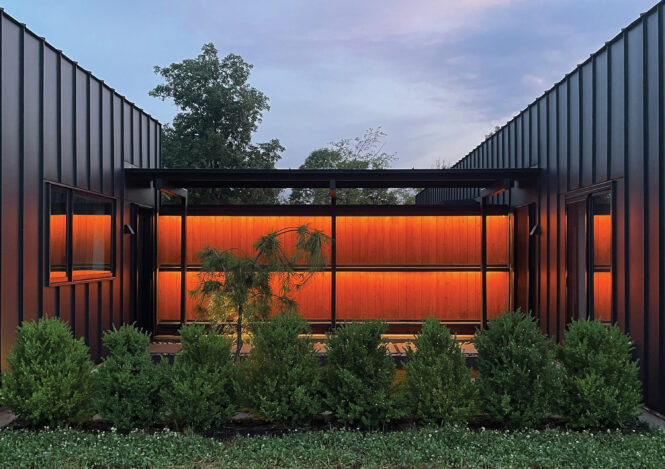
Left: A Japanese-style moss garden and breezeway separates the living space from Gates’ studio. “The idea of separating the house and the studio—live and work—by the small moss garden was inspired by the Eames house,” says gates. “It provides a psychological distance between the two activities.”
The angled roofs, calculated for maximum solar harvesting and to capture the expansive northern views, mimic the hawks constantly swooping over the surrounding fields. “The structure is designed like an airplane wing,” explains Gates. “We had to add 25 bolts holding the house into the earth so it doesn’t fly away.”
Sky Scraping
Gates began studying architecture in Southern California, where he first encountered the region’s iconic Case Study Houses, a series of modernist homes that blurred indoor and outdoor living and maximized grand views. It was one of his earliest inspirations. “I studied with one of the Case Study architects, Pierre Koenig, who was a huge influence on me,” he says. “I learned that architecture needs to be harmonious with its place in every sense of the word; socially, environmentally, and technically.”
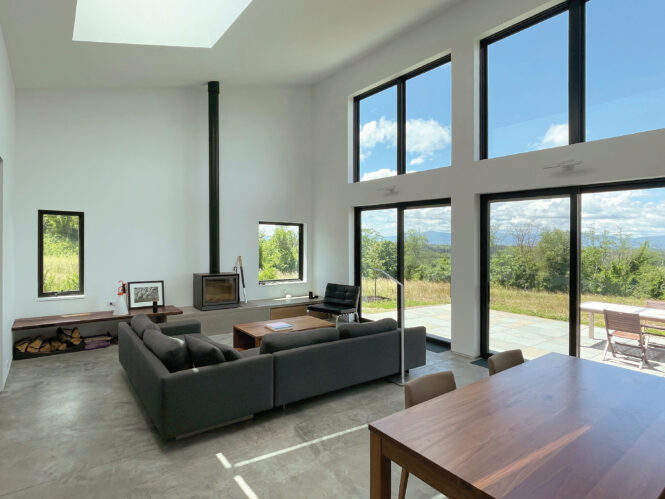
Right: The north-facing living room is oriented toward the valley-wide views; Gates added a south facing skylight for winter light. “This house exploits its relationship to the landscape, but it’s compact and efficient,” says Gates. Along the room’s western wall a live-edge walnut plank sourced from Ghent is “akin to a tokonoma,” says Gates, referencing a recessed space in Japanese-style reception room for displaying art objects.
After completing his master’s degree at Princeton, Gates began his career designing skyscrapers for Kohn Pedersen Fox Associates. The job took him to Tokyo, where he spent time in the nearby mountains and developed a deep appreciation for traditional Japanese architectural design. “The whole Japanese notion of architecture, of artifice and nature, intrigued me,” he explains. “They are always integrating nature into everything they do. Not necessarily stylistically, but conceptually.” Gates eventually started his own firm in New York City, Gates Merkulov Architects, designing a range of commercial, mixed use, and residential projects.
North by West by East
As his business grew, Gates regularly began returning north, where he rediscovered his love for the region during hiking trips through both the Catskills and Berkshires. He began sporadically looking for properties where he could design his own retreat, combining the architectural concepts he’d learned in his career into one residential project.
In 2018, he decided to take his dream seriously. “I thought, ‘If I’m going to do this, I’ve got to do it,’” he says. “I really put my nose to the grindstone and searched for the right place.” Initially, with the intent of finding a buildable five-to-10 acre parcel, Gates looked at more than 30 properties with no luck. “I wasn’t looking for a huge view,” he explains. “But I did want a sense of space.”
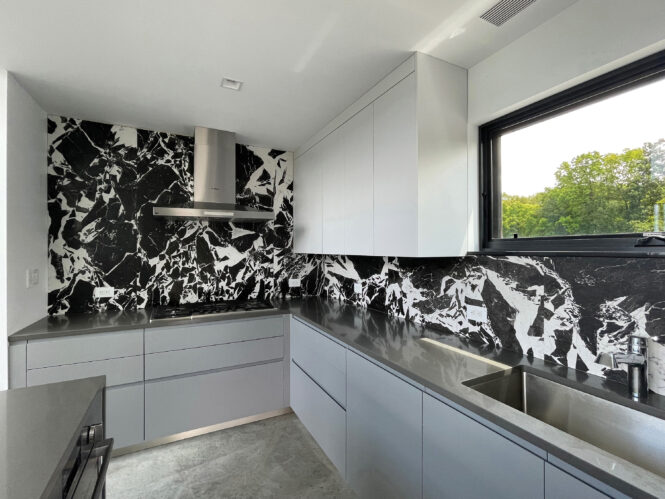
Gates added the black-and-white porcelain backsplash to the kitchen to contrast the kitchen from the open living room area. “I love to cook, so the kitchen was an important design element for me,” says Gates. The streamlined space has ample room for Gates to roll up his sleeves. “I’ve been able to make Thanksgiving dinner for bunches of friends here.“
The 60-acre plot covering most of Turkey Hill was much larger than he’d imagined taking on. A dairy farm through the 1930s, the secluded property was most recently used as a hunting club, and briefly as a gravel mine. Most remnants of its former incarnations were long erased—except for a 19th-century stone gate at the property’s entrance. “The gate is actually the stone abutments of the Rhinebeck to Connecticut Railroad built in 1870,” says Gates. “They removed the railroad and bridge in the 1930s but left the stone walls, which form a monumental entrance to the property that feels very private.”
Inside the gate, the property is comprised of three large fields separated by topography and tree lines that lend privacy to each. Gates loved the otherworldly feel of the hill, as well as the Roeliff Jansen Kill, which formed a natural border along the bottom edge of the site. But it was the vista that really pulled him in. “The view is spectacular,” he says. “It spans the entire Catskill range and north up the Hudson Valley.” After a year of negotiating, Gates closed on the property a week before the Covid lockdown. Then he began the work of designing a property for the site. “That was a real adventure,” he explains.
Watching Shadows on the Wall
The home’s form draws from Gates’s early experiences with the Case Study Houses, but conceptually reimagined for a northern climate. “It’s not California,” says Gates. “But there’s a similar openness to the air and light.” To achieve the same open flow, Gates turned away from the hot, dry climate of the West Coast, and looked northward—specifically to Nordic design principles that revel in nature by establishing a sense of place and sustainability through design. “I designed the house with clean lines and minimal ornamentation, reflecting the Scandinavian aesthetic of letting the landscape speak for itself,” he explains. “We also relied on natural materials like wood and bluestone to create a warm, inviting atmosphere that complements the natural beauty of our region.”
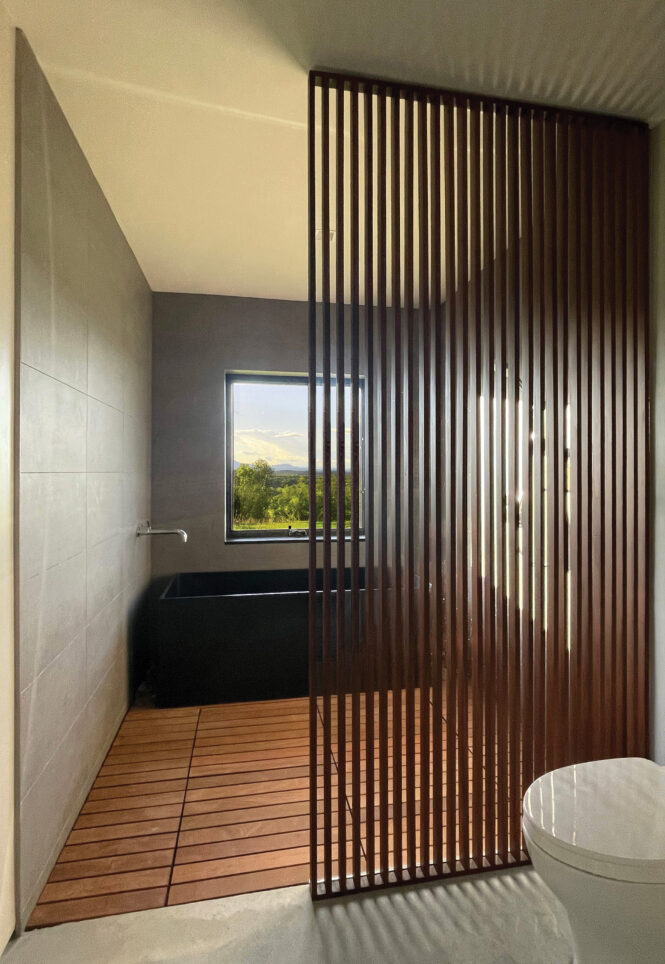
Inspired by his early years working in Japan, Gates designed the guest bathroom to be a spa-like environment. “The guest bathroom breaks with the neutrality of the home’s overall palette,” says gates. “The large soaking tub is set in a wood-and-volcanic tile-clad room overlooking the distant landscape.”
Sustainability was also a prevailing requirement when designing the house. “Sustainability was an important consideration, both for practical maintenance purposes and for environmental reasons,” says Gates. “I wanted to enjoy living in the house, not working on its upkeep.” Gates incorporated high-efficiency radiant heat and poured concrete floors throughout the structure. The high-density wall and ceiling insulation exceeds New York State standards by 50 percent. “The investment in quality materials was essential to achieve the design goals,” he says. “Their cost of the additional insulation is outweighed by the energy savings in the long run.” Gates also incorporated triple-glazed windows and glass sliders throughout both structures. In the living room, a large, south-facing skylight captures natural light in the winter and has a roller shade for low-tech cooling in summer.
Two double-height volumes anchor the opposing ends of the main house, both facing the northern view. “The double-height rooms act as light boxes, tracking the movement of the sun over the course of the day,” says Gates. At the western end of the house, the open living room and kitchen have panoramic sunset views. “The finishes lean industrial, but they are not raw,” he says. “White walls and concrete floors provide a neutral background to the furnishings and art.”
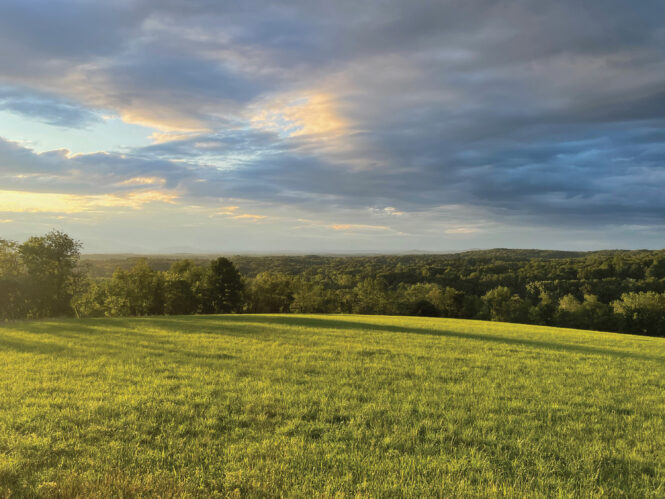
The view from Gates’ house.
The open chef’s kitchen features a dramatic black-and-white patterned porcelain tile backsplash to add visual interest to the open-concept living room. A large rectangular island separates the living room and kitchen and adds an extra worktop. “I love to cook, so the kitchen was an important design element for me,” says Gates. “It’s both its own discrete working area and a part of the social space of the main living area.” Outside, a barbeque and herb garden form an outdoor room.
At the eastern end of the home, the primary bedroom also incorporates large sliders and plenty of natural light. The bedroom annex, also finished in neutral tones, includes a walk-through closet and primary bathroom. “Simplicity and calm rule the interior design,” says Gates. “By highlighting simple forms and details, and a connection to the daily rhythm of nature, the bedroom has a contemplative and inspiring atmosphere.”
Corner of the Sky
The space between the two main volumes is divided into two stories. The second-floor guest room and first floor library share the home’s north-facing view. Gates drew from his time in Japan to create the spa-like guest bathroom, which references Japanese hot springs, known as onsens. “When I was in Japan I’d often stay an extra weekend without telling anyone my plans,” he says. “In my extra time I’d go up to the mountains to visit different onsens. Often I was the only Westerner there.” To capture the feeling of the traditional Japanese bath houses, Gates added an oversized soaking tub and surrounded it with locally sourced stones, volcanic tile, and wood accents. “It’s a kind of secret realm with a spectacular view,” he says.
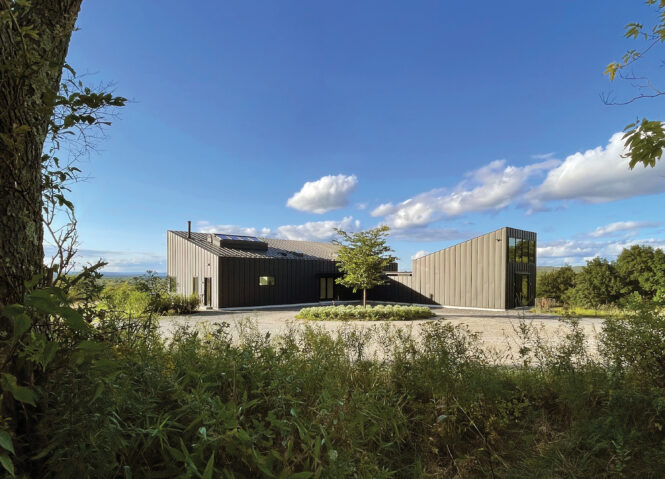
The exterior entry of Gates newsletter.
Gates divided the home and southern-oriented work studio behind it. Between the two buildings, a Japanese-inspired moss garden acts as a natural hallway transitioning between live and work areas. Gates composed the studio with the same sustainable and understated elements as the main house—with one distinction. “I purposely oriented the workspace away from the view,” he says. “So I could actually get some work done.” But Gates couldn’t entirely escape the hilltop’s predominant feature. The studio’s northern window looks across the moss garden, through the bedroom’s south- and north-oriented windows, to capture a glimpse of the sky.