
Plate Expectations: International Museum of Dinnerware Design Opens in Kingston
By Joan Vos MacDonald | Winter 2024/2025 | Features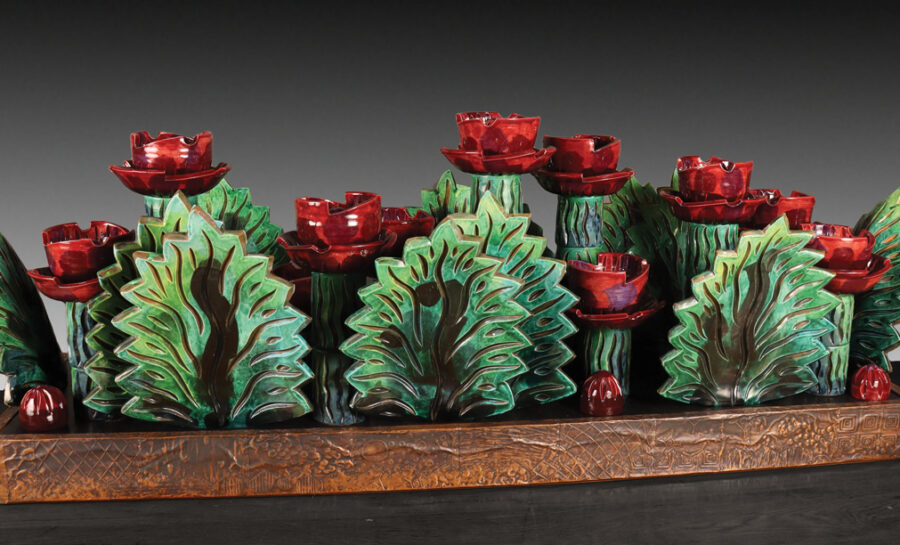
What constitutes dinnerware? Do you have to be able to eat with it or off it? Or could it simply feed your imagination? The International Museum of Dinnerware Design, which opened in Kingston this fall showcases both perspectives, featuring pedigreed dinnerware and some inventive dining-inspired art.
Although the museum was founded in 2012, the new location in Midtown serves as its first long-term exhibition space. Before deciding on the former Barcone’s Music store, the founders presented a series of lectures and pop-up exhibits at locations such as SOFA Chicago and Ann Arbor’s Museum on Main Street showcasing more than 9,000 pieces of dinnerware and art.
The museum’s inaugural exhibit is titled “Holy Grails.” The title refers to a cup that, according to medieval legend, was used at the Last Supper and thereafter became the object of knightly quests. It’s apt because founding director and curator Margaret Carney has been on a lifelong hunt to collect distinctive dinnerware and art that reflects the dining experience.
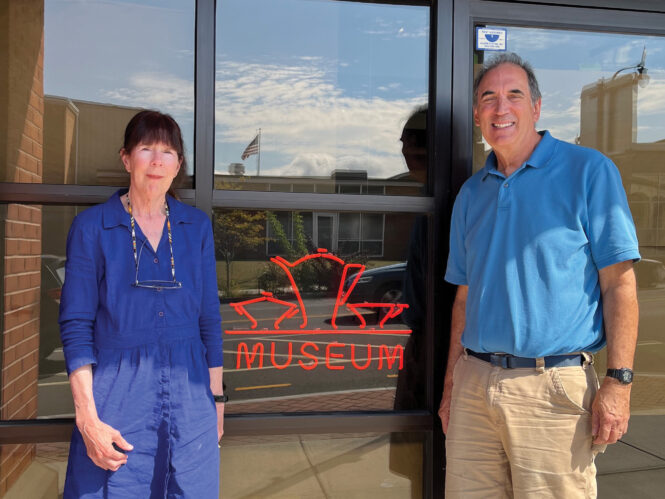
Margaret Carney, International Museum of Dinnerware Design director and curator and her husband, Bill Walker.
The exhibit features pleasingly symmetrical dinnerware by industrial designer Russel Wright, pieces by Eva Zeisel, the first female designer to have a show mounted at MOMA, and black-and-white diner dishes designed by pop artist Roy Lichtenstein. The exhibit also serves up whimsical, less practical selections. It would be difficult to actually dine on the sculptural wire dinnerware created by Portuguese artist David Olivera, although it does cast appetizingly feathery shadow patterns. And it would be impossible to eat with the impressive knife, fork, and spoon sculpture by Bill Parry. Nestled somewhere between art and everyday dinnerware are the tea cups that fit neatly into the crevices of a porcelain teapot. Designed by Peter and Peg Saenger, this boldly configured tea set was featured on “Star Trek: The Next Generation.”
“We’re not just grandma’s little old dishes with flowers on them,” says Carney. “We have those, but we don’t need any more of those. I want things that will inspire people and show different materials and show how artists think about things. We have the best designers ever, many of whom were Mid-Century or Art Deco people, in our collection.”
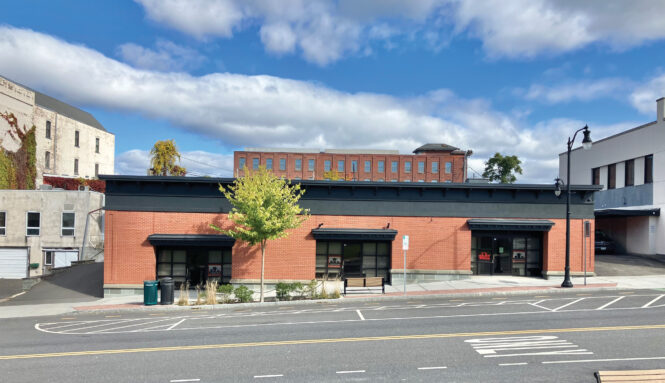
The International Museum of Dinnerware Design’s siting in Kingston is part of an artistic renaissance in the city’s Midtown neighorbood that includes the expansion of the Center for Photography and the opening of the Center for Holographic Arts.
The museum’s collection is a mix of functional and fanciful.
“Referencing dining, we have kitsch, we have art, we have the whole realm,” says Carney, who has a PhD in Asian art history. “And we have more ceramics than we have other things, because that’s what people think of. However, we also have a lot of, and I do mean a lot of, glass, paper, plastic, disposable dishes and metal fiber.”
The most striking piece in the current exhibit is Rose Garden, a sculpture by Eddie Dominguez that also happens to be a full dinner set. Diners can lift out the plates that look like large vertical leaves and claim the small bowls that look like roses.
‘This artist’s work is beautiful and that’s why I love it,” says Carney. “People could walk around it because if it was on a buffet, you’d be picking up your plate and you’d be getting your cup and your bowl. You’d be taking your set. The artist labeled everything. After 25 years the numbers are still on the bottom of the pieces and on the leather insert. So you know how to stack it. There’s a diagram with it, so you won’t get the order wrong. It’s how to celebrate dining and the garden as an installation.”
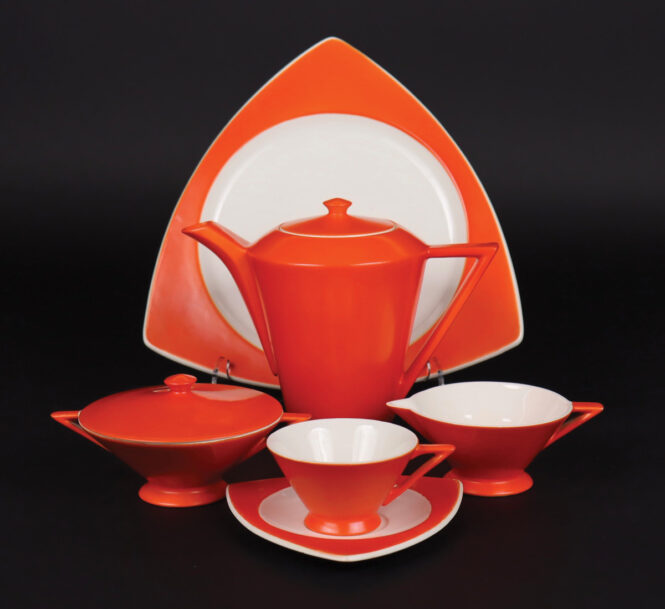
Mandarin Tricorne dinnerware by Don Schreckengost and other designers at Salem China Co., circa 1930s, from “Dining Grails” the inaugural exhibition at the International Museum of Dinnerware Design in Kingston.
The exhibit also includes a persimmon-edged Art Deco dining set designed by Don Schreckengost, as well as painted porcelain replicas of takeout boxes by contemporary artist Beth Lo. For a helping of nostalgia there’s a vintage lunchbox from the Aladdin Company, with an exterior decorated to look like a loaf of sliced bread.
Other museums feature dinnerware, says Carney, but it’s often a small, dedicated space, and she’s convinced that dinnerware deserves more. Carney hopes to raise funds for an even larger permanent space with an on-staff chef. “We’re the only museum in the world devoted to dining, to celebrating dining,” says Carney. “And the reason I founded the museum is not only my obsession with food, but it’s the idea that it brings diverse people together. They’re sharing a meal, they’re sharing a conversation, or they’ve just shared an experience.”
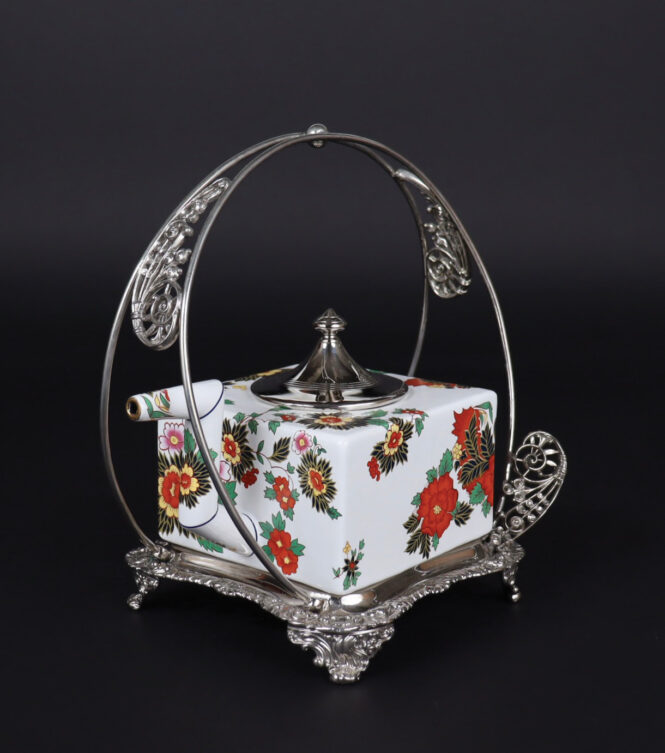
Leopold Foulem Imari Teapot conceptual teapot in the “Dining Grails” inaugural exhibition at IMoDD
The right setting can provide historical and cultural context so the museum offers a room full of dining vignettes. Plastic peas seem to congeal on a TV dinner tray in front of an early TV set. There’s a swinging ‘60s vignette complete with a shag rug, Peter Max dinnerware, a Dylan album, and a Peter Max poster of Dylan. There’s a setting in a diner that might have served Chinese food in long-ago San Francisco. A well-appointed picnic blanket sprawls across another section of the floor.
Carney, who previously founded a ceramics museum at the New York State College of Ceramics at Alfred University, was living in Ann Arbor, Michigan, when she and husband, Bill Walker, began considering where to locate the museum. They considered Minneapolis, Saint Paul, and Palm Springs before deciding on Kingston because of its thriving art scene. Their current space is sunny and central.
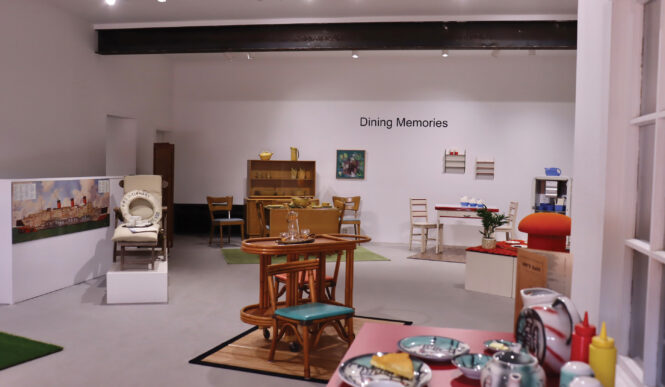
“We’re in Midtown, we’re in a prominent place, and we’re close to the Center for Photography and there’s the Center for Holographic Arts on this corner,” says Carney. “We know that we’re in exactly the right place.”
Upcoming exhibits will feature dining-related themes that invite contemporary artists to display their works. Past exhibits had playful themes such as “Entomophagous Dining,” that is eating insects, or the more palatable design themes of “Cake,” “Breakfast,” or “Butter,” none of which featured actual food. Carney says she has not yet run out of fun exhibit ideas. “We did one that was called the ‘Art of High Chair Fine Dining,’” says Carney. “We displayed the artist’s work on old vintage high chairs.”
A planned series of Zoom lectures have already started with the first talk delivered by sculptor Eddie Dominguez. Carney hopes the museum will promote new perspectives on what dining is and can be. “Even if you’re dining off of disposable dinnerware, it’s a chance to be together with other people, to have an experience, to have a moment.”