
How a Stone Ridge Cottage Transformed from a Hunting Cabin to a Home
Interior Desginer Samantha Feuer reimagines Stone Ridge Cottage for the modern day while maintaining its storied history
By Brian K. Mahoney | Ethan Herrington | Summer 2026 | Features | House Feature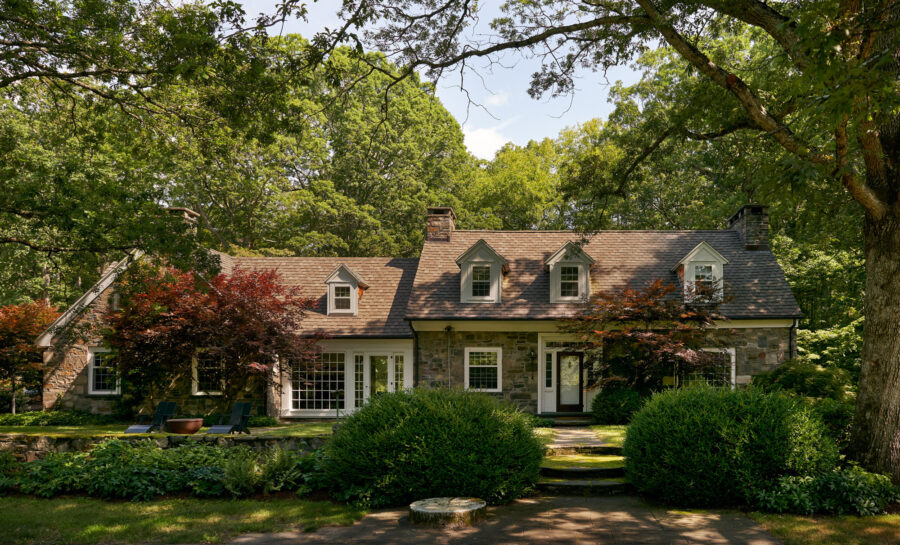
On 125 wooded acres in Stone Ridge, a 1944 stone cottage sits with the kind of authority that comes from having outlasted its original purpose. Built as a hunting cabin by a returning WWII General Sherman V. Hasbrouck, the house was conceived as a place of retreat—masculine, self-contained, and tuned to the rhythms of a different era. The bones remain: thick stone walls, wood-paneled interiors, a seriousness that can’t quite be designed in.
When a Manhattan-based artist couple—longtime friends of interior designer Samantha Feuer—purchased the property as a weekend retreat for their growing family, they weren’t looking to reinvent it. They wanted to inhabit its history without being bound by it: a place where children could run outside all day, where friends could gather for long weekends, and where the house could hold both its past life and their own.
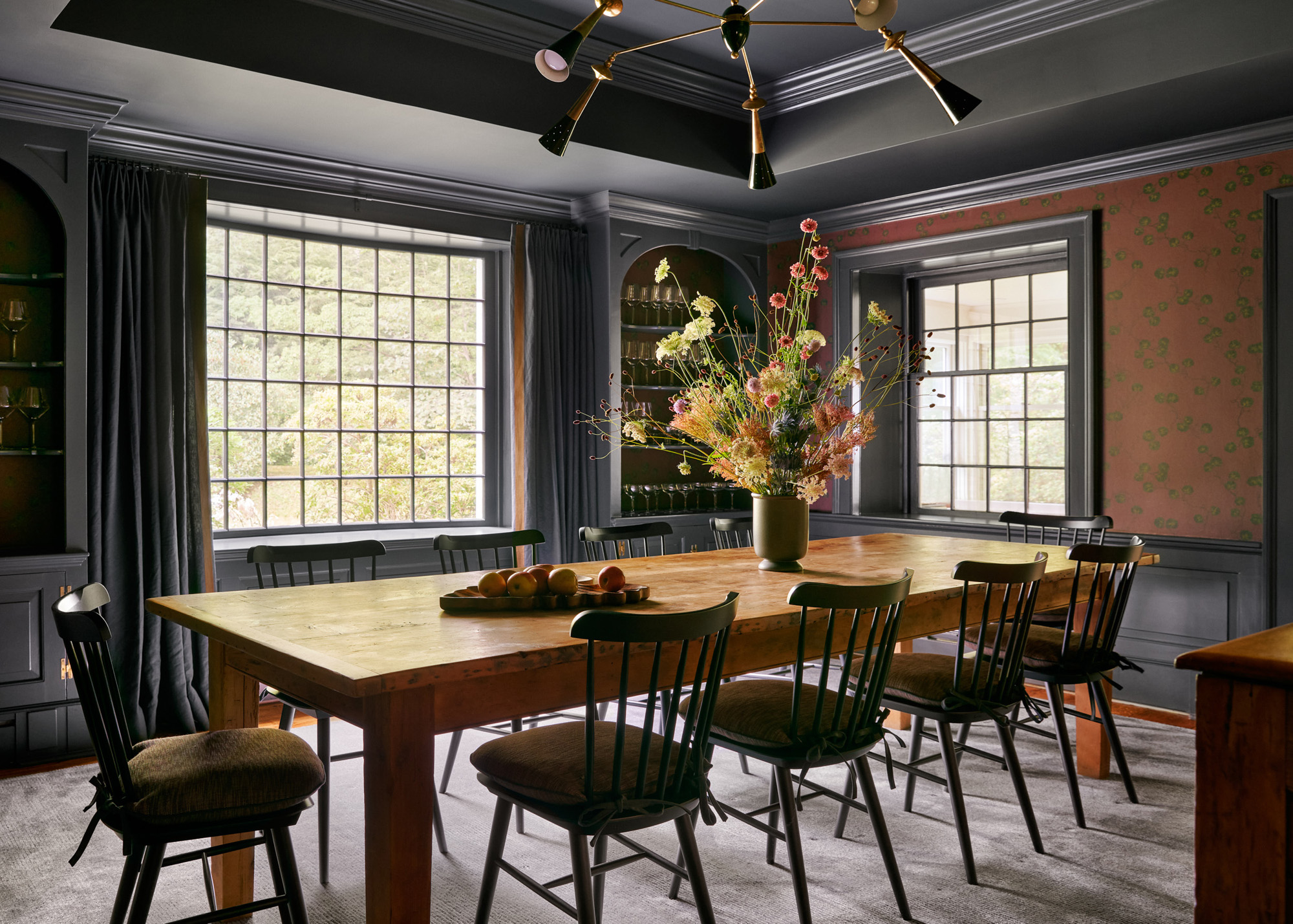
Original built-ins and dark trim anchor the dining room, where designer Samantha Feuer introduced Zak + Fox wallpaper and understated contemporary touches to gently pull the 1944 cottage forward in time.
Feuer, principal at Tennessee-based Norris Studio, came to the project with a personal connection to the clients and an intuitive understanding of how they live. “The client kind of became a dear friend almost a decade ago,” she says. “We’ve done a lot of work together, so there was already a level of trust.” That familiarity shaped the brief as much as the architecture did: create what the team described as an “enchanted cottage in the woods,” but keep the home’s original DNA intact.
The Discipline of Restraint
Feuer’s approach begins with subtraction—or, more precisely, with refusal. In a design culture that tends toward intervention, her work here is defined by what she leaves alone. “We left as much of the original things that we could, like the original wood paneling, even in the kitchen,” says Feuer. “It’s important that you ask, ‘Do we actually need to redo it?’”
That ambiguity is the point. In the kitchen, cabinetry is pared back, hardware kept small, and lighting chosen to recede rather than declare itself. Fixtures are selected to match the original decor and not become focal points—elements that support rather than compete with the architecture.
Restraint, here, is not minimalism. It’s calibration. The house already carries weight; the designer’s job is to distribute it evenly.
Even moments of intervention—like the dining room’s Zak + Fox wallpaper—are less about contrast than modulation. The built-ins remain original, but the room gains a liveliness that pulls it forward in time. The effect is cumulative: a house that feels neither frozen nor freshly stamped, but continuous.
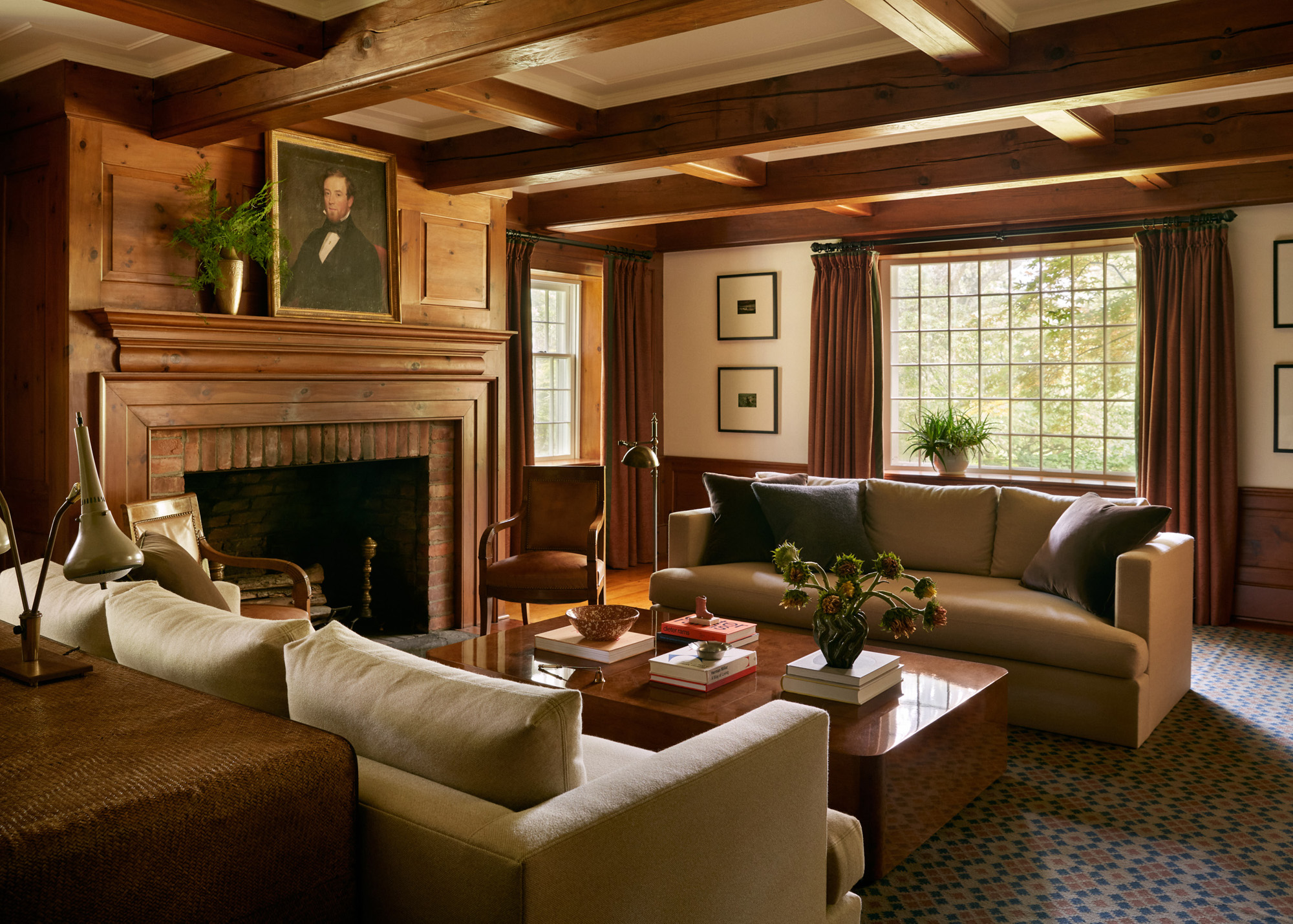
Originally built in 1944 as a hunting cabin for General Sherman V. Hasbrouck, this Stone Ridge cottage was reimagined by Feuer as an “enchanted cottage in the woods” for an artist family.
Against Pastiche
The risk in a project like this is obvious: Lean too hard into the hunting-cabin narrative and you end up with a stage set—antlers, reclaimed wood, a catalog version of rusticity. Feuer avoids that trap by taking cues from the clients rather than the cliche. “They love a nod at history,” she says. “She’s a vintage collector. She loves tartans and plaids and wools, so we really leaned into that.”
But the line is carefully drawn. “What we didn’t do was bring in a fake antler chandelier,” she says. “That just wasn’t the right nod toward the house.”
Instead, the historical reference is embedded in material language: wool upholstery in houndstooth and plaid, vintage furniture with visible age, textures that register as both durable and familiar. In the living room, low-slung sofas upholstered in wool invite use rather than admiration. The room reads as settled—not styled.
A House Built Around Habit
If the aesthetic is rooted in history, the planning is rooted in behavior. One of the project’s most telling moves is also its most pragmatic: the conversion of a poorly placed bathroom into a coffee bar and pantry.
“It was a kind of terrible little shower bathroom right next to the garage,” Feuer says. “There wasn’t enough food storage in the original design. As our clients are big coffee drinkers, we gutted it and made it as cute as we could.”
The move is less about design than about use. By carving out dedicated zones for appliances and storage, Feuer keeps the main kitchen surfaces clear—an invisible intervention that shapes how the house functions day to day.
That sensitivity to habit runs throughout the project. “If we just imposed our design on every decision, nothing would be authentic anymore,” she says. “The best designs come from staying true to the client and what their needs actually are—and then making that the most beautiful version of itself.”
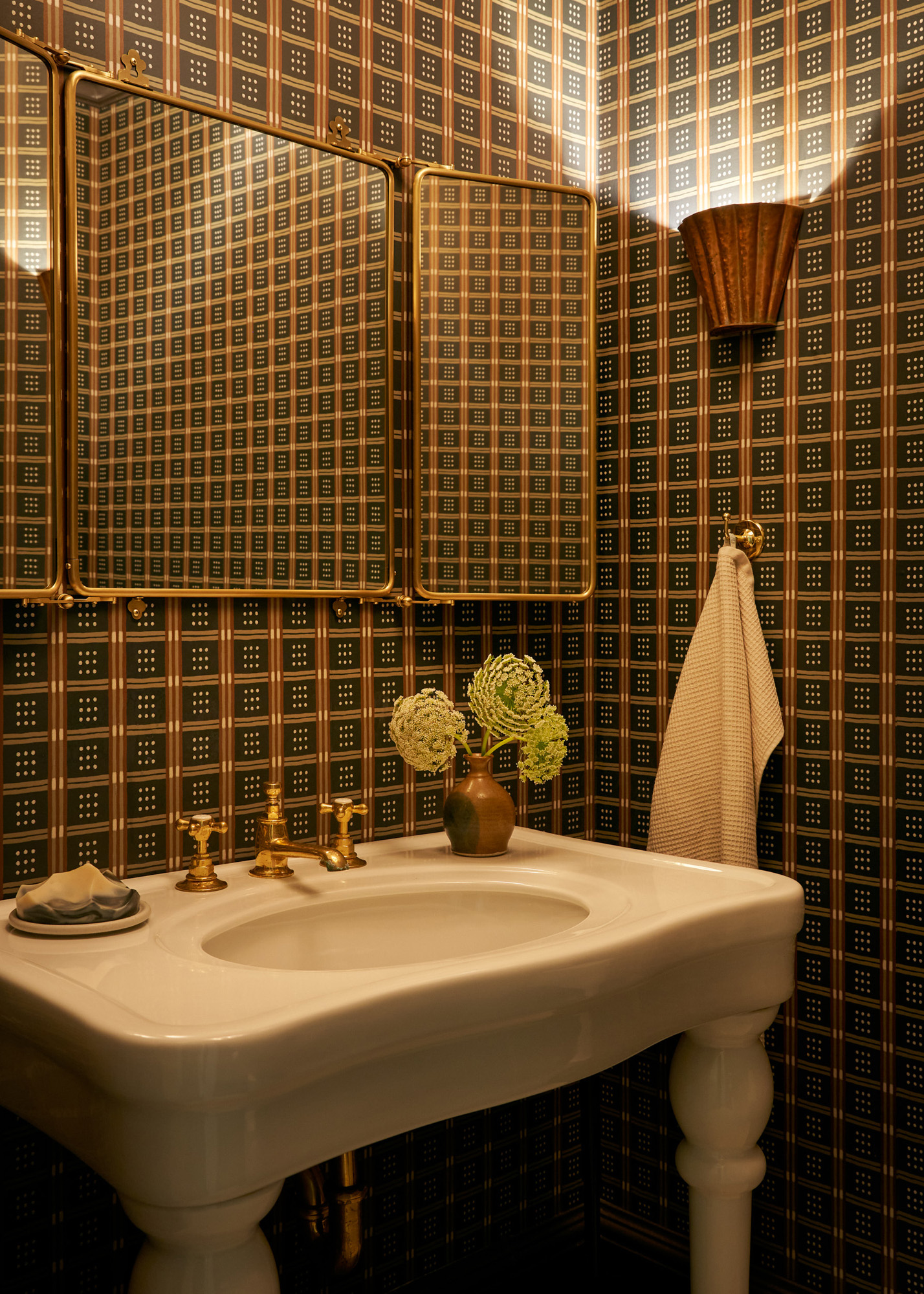
In the powder room, vintage-inspired fixtures and richly patterned wallcoverings extend the cottage’s layered dialogue between historical character and contemporary comfort.
The Art of the Collected Interior
The house is filled with objects, but it doesn’t feel crowded. That’s partly a function of balance—modern upholstery offsetting vintage pieces—but also of a disciplined approach to storytelling. “You can’t have a house full of antiques or a house just full of family pieces,” Feuer says. “It doesn’t feel very dimensional.”
Instead, she constructs a collected interior: contemporary sofas paired with inherited chairs, newly made elements set against artifacts of the house’s past. General Hasbrouck’s belongings—his flag, a star from his jeep—are integrated alongside the clients’ own artwork and family heirlooms, creating a layered narrative that belongs to no single era.
The sourcing strategy reflects that ethos. Feuer relies on a network of trusted vintage vendors but supplements it with opportunistic finds—flea markets, online listings, pieces that may need repair but carry the right kind of history. “You collect for your clients,” she says. “That’s how you create spaces that have a lot of dimension and a lot of life to them.”
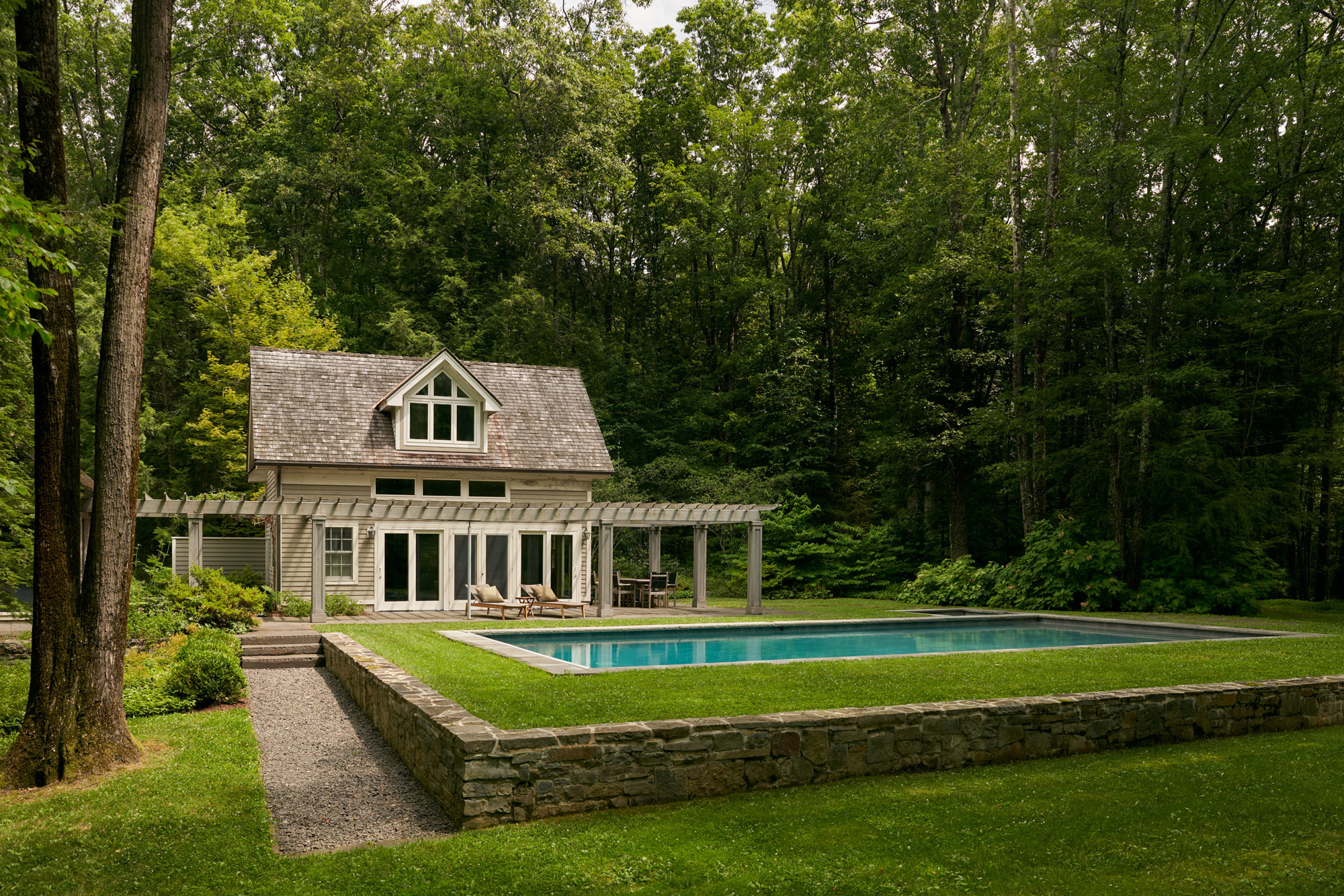
Set on 125 wooded acres in Stone Ridge, the restored cottage balances historical character with relaxed, lived-in comfort.
Nothing Precious
For all its references and craftsmanship, the house resists preciousness. This is not a place to admire from a distance. “We want every room to feel inviting and casual,” Feuer says. “Not that it looks casual—but that it feels casual. I want people to walk in and feel like they should sit on that sofa.”
The materials do that work. Wool, in particular, becomes a kind of emotional infrastructure—soft, durable, forgiving. The tartans and plaids carry historical resonance, but they also signal use. Nothing asks to be protected. “Nothing is precious,” she says. “It’s meant to be lived in.”
Collaboration as Method
The dynamic between designer and client—friends for nearly a decade—shapes the project at every level. The client’s sensibility, especially her interest in menswear fabrics and vintage collecting, becomes a driving force rather than a constraint. “She was the one who wanted to home in on the hunting lodge,” Feuer says. “She pushed us in a really great way.”
That push-and-pull produces moments of synthesis: vintage chairs reupholstered in tartan, inherited pieces reframed as focal points. The house feels authored, but not singularly so.
The Feeling of Rightness
Ask Feuer to name a favorite space and she hedges—then offers two. The kitchen, where the family naturally gathers, and the formal living room, where the house seems to exhale. “It’s a lounging type room,” she says. “Every time I sit down, you immediately pull your legs under you, you lean back.”
That physical response—the instinct to settle in—may be the best measure of the project’s success. Not the materials, not the references, but the way the body reads the space.
In the end, the achievement of the Stone Ridge house is subtle. It doesn’t announce itself as a renovation. It doesn’t insist on its newness. It feels, instead, as though it has always been this way: a place shaped by use, memory, and a careful attention to what matters.