
How a 1970s A-Frame Near Hunter Mountain Was Reimagined for Modern Family Life
A hated hearth sparks a soft-modern renovation of a 1970s A-frame near Hunter Mountain, as designer Jamie Smith rethinks a ski cabin from the inside out—doubling its footprint while preserving its original form.
By Brian K. Mahoney | Spring 2026 | Features | House Feature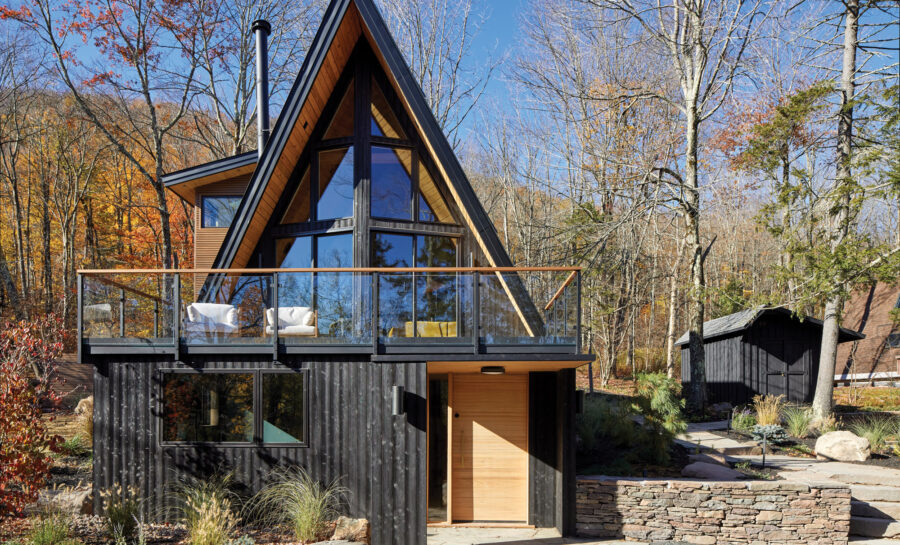
Every gut renovation has an origin story. Sometimes it’s structural rot, sometimes it’s a growing family, sometimes it’s the slow, existential realization that a house no longer fits the life unfolding inside it.
For Jamie Smith, it was an ugly fireplace.
Not charmingly ugly. Not “we’ll fix it someday” ugly. This one was actively, aggressively wrong: a squat, rectangular woodburning unit wrapped in a faux brick-pattern wallpaper. Worse, its placement dictated the entire social geometry of the house. The couch faced the fire but had its back to the kitchen. Which meant that whenever Smith cooked—which is often—she was staring at the backs of people’s heads.
“I really, really hated that,” she says, laughing now, though the irritation clearly lingers. “As somebody who cooks a lot, all I was doing was looking at people from behind.”
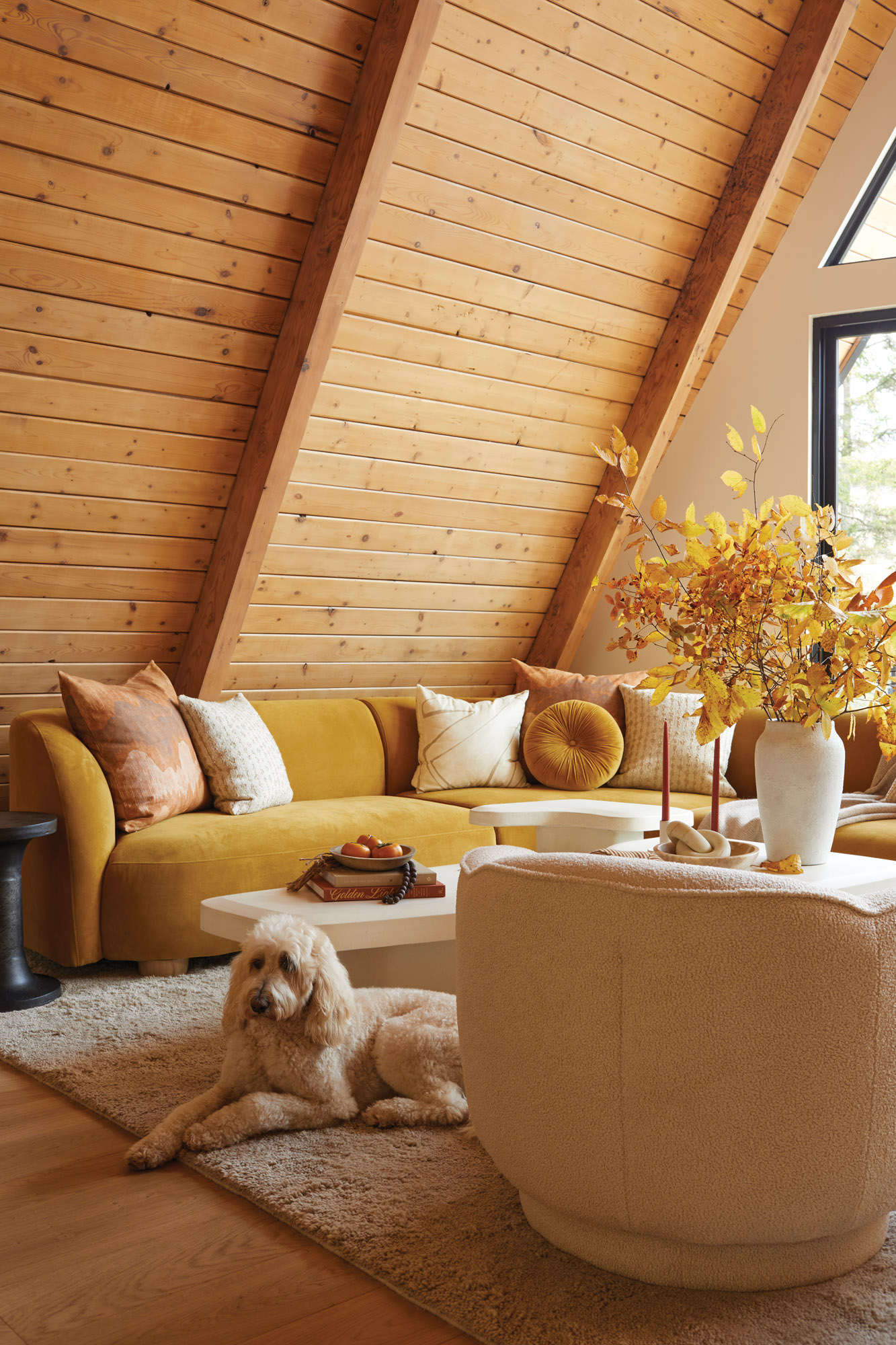
The living room, preserved within the original A-frame, keeps its 1970s pine ceiling and geometry intact while new furnishings—anchored by a curved sofa and modular coffee tables—restore the social flow once disrupted by a badly placed fireplace. Photo: David Engelhardt
There was no saving it. No clever redesign. And so, like so many domestic turning points that begin with a shrug and end with a extensive construction, the logic escalated quickly. “You know how people say, ‘The fridge broke, so we redid the kitchen’?” she says. “This was like: the fireplace was shitty, so we had to redo the whole house.”
And just like that, a classic 1970s A-frame at the base of Hunter Mountain—beloved, cramped, and fundamentally misaligned with how the family actually lived—was headed for a full-scale reinvention.
Kit House, Reimagined
The house is tucked into a neighborhood where A-frames repeat like a riff from a 1970s pattern book, Smith’s house looks—at first glance—comfortingly familiar. The steeply pitched roof, the triangular silhouette, the pine-lined interior: it reads unmistakably as a Catskills ski cabin, the kind you half expect to find immortalized in a faded Polaroid or a long-forgotten rental brochure.
That sense of recognition is deliberate. Smith, the principal designer and founder of Smith Home Studios, could have torn the house down and rebuilt new. A contractor even suggested it. But that would have erased the very thing she loved most: the cathedral A-frame living room, with its original pine paneling and geometry that no amount of modern “character” can convincingly replicate.
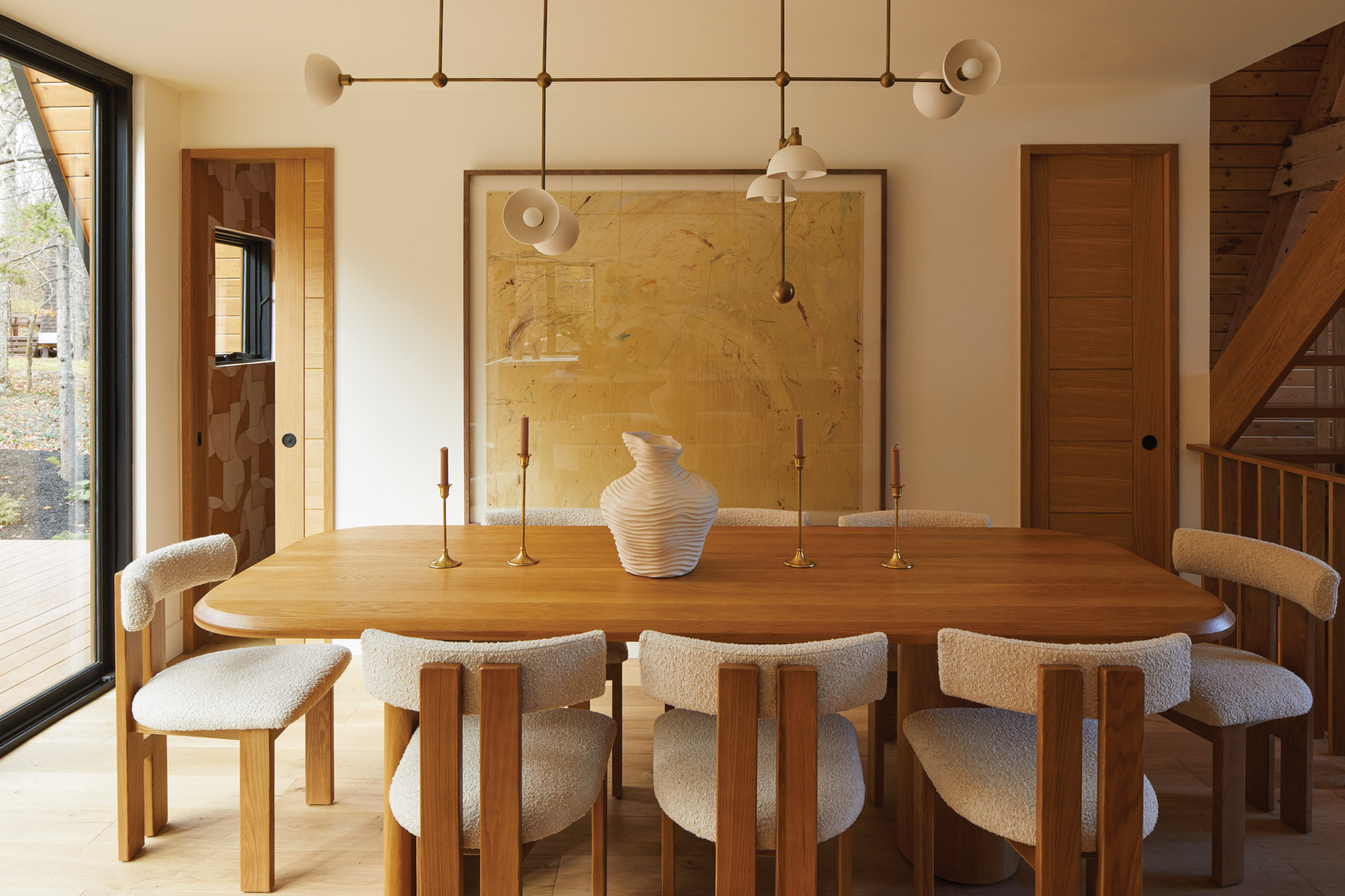
In the dining area, a modernist Apparatus chandelier stretches low and linear above the table, anchoring the room as a functional piece of sculpture and reinforcing Smith’s belief that everyday moments—like sitting down to eat—deserve a sense of occasion. Photo: David Engelhardt
Instead, Smith doubled the house’s footprint—expanding it from roughly 1,100 to 2,200 square feet—while leaving its front-facing identity largely intact. From the road, it still reads as an A-frame. The sleight of hand happens behind the scenes, and behind the house.
“It was really important to honor the original structure,” Smith says. “That room—the living room within the original A—has a coziness you just can’t recreate in a new build.”
The house is one of dozens—maybe hundreds—of similar A-frames in the neighborhood, likely erected from a kit in the 1970s. Smith learned from a neighbor that the original owner even hand-dug the basement, an act of determination that ultimately gave the house its walkout lower level. That DIY grit felt worth preserving, even as the house was fundamentally reimagined for contemporary life.
Designing for Herself, Finally
Smith and her husband bought the house in 2018 after renting it the year before for ski season. For a couple years, it served as a seasonal retreat—tight but beloved. Then came 2020, when the family spent 88 straight days there during lockdown. “It was… small,” she says diplomatically.
By then, Smith had been running her design studio for several years, crafting homes for clients who wanted spaces that were both beautiful and deeply functional. Eventually, she made a pitch at home: give her full creative control, and she’d turn the A-frame into a kind of manifesto for Smith Home Studios.
Her husband said yes. Smart man.
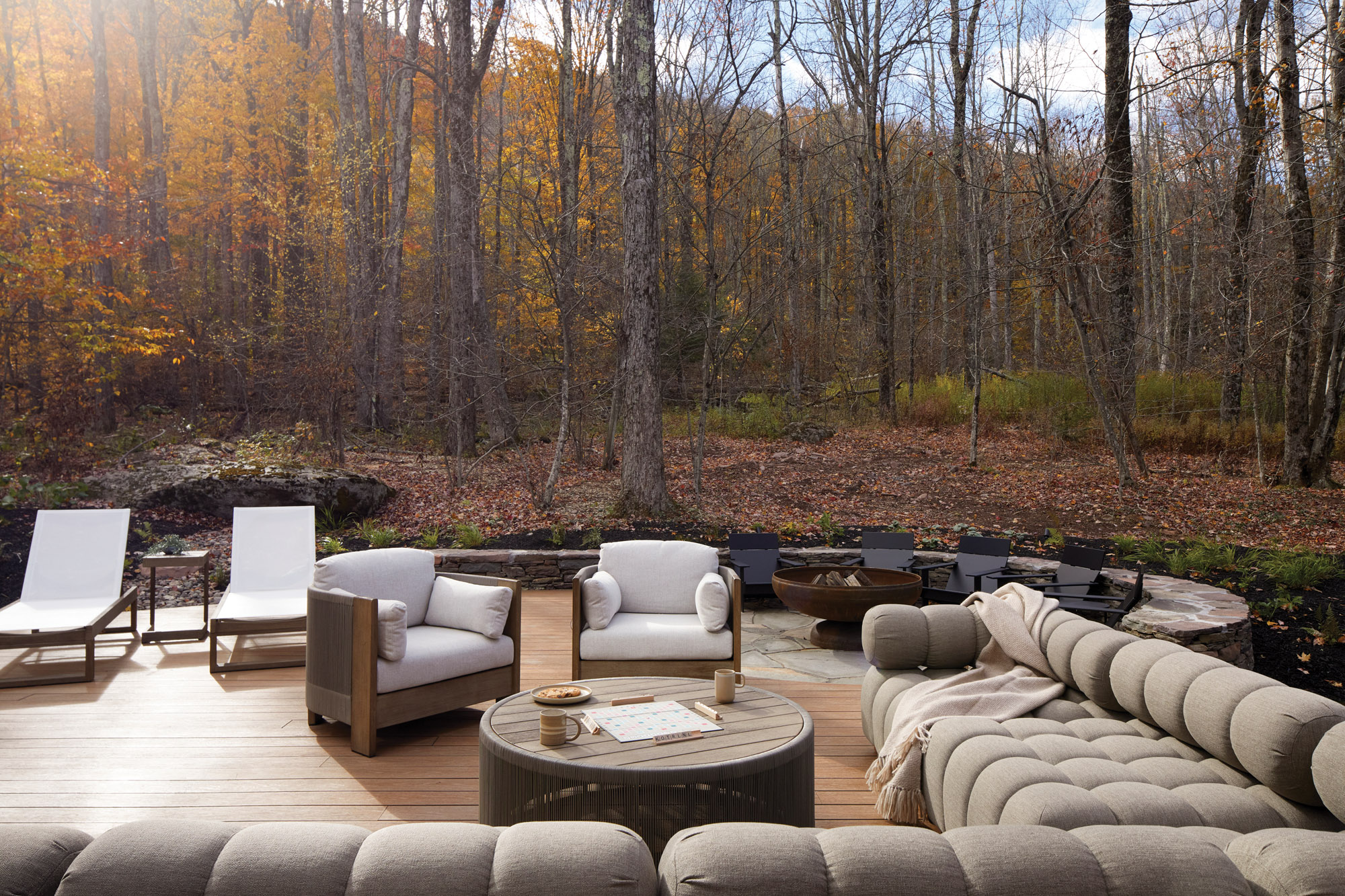
The rear deck extends the house into the landscape, with curved seating zones, a sunken fire pit, and space to gather after ski days. Photo: David Engelhardt
Designing for herself proved more indulgent than pragmatic—but also more exacting. Every inch had to earn its keep. “If a space doesn’t function correctly for your family, then the design isn’t beautiful,” she says. “You can have the most gorgeous room in the world, but if you can’t put your coffee down, it fails.”
That philosophy—what Smith calls “soft modern”—runs throughout the house: a modern foundation softened by natural materials, organic forms, and a muted palette drawn from the surrounding woods.
Honoring the “A”
The living room remains firmly within the original A-frame, its pine paneling carefully stripped of its glossy, yellowed shellac and refinished to feel closer to raw wood. Smith tested countless stains before landing on a matte Bona product that subtly neutralizes the yellow tones without obscuring the grain. The result feels both authentic and updated—pine that looks like pine, just calmer.
Anchoring the room is the replacement fireplace, a bulbous Malm, that quintessential 1970s hearth, still handmade in California. Smith relocated it from its original position to a new corner that reorients the room and restores conversational logic.
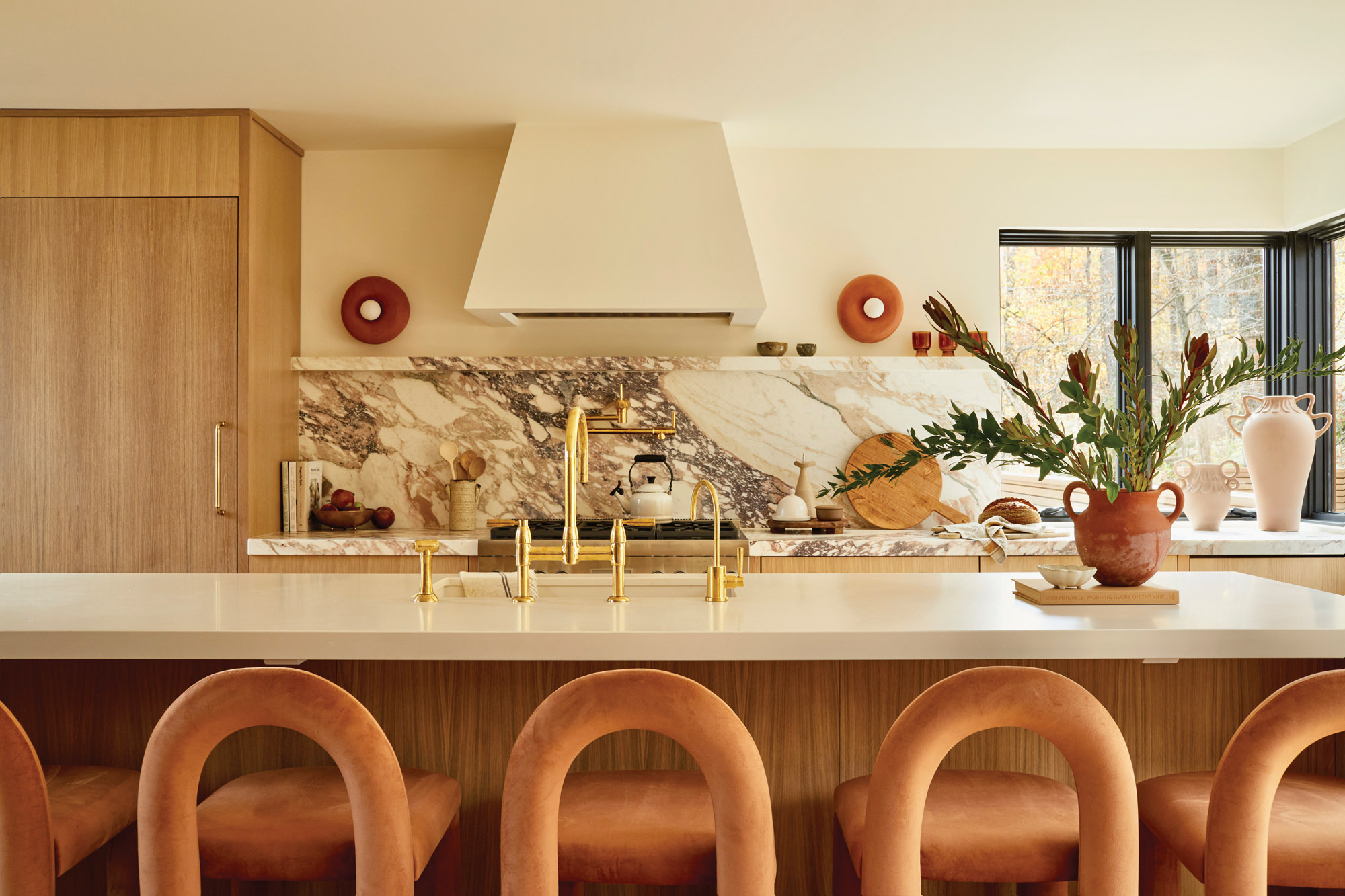
The reworked kitchen—made possible by bumping the house out the back—pairs warm oak cabinetry, marble surfaces, and brass fixtures, creating a space designed for feeding a crowd and anchoring the social life that once revolved around a badly placed fireplace. Photo: David Engelhardt
The seating arrangement curves gently around a three-piece concrete coffee table from Lulu and Georgia—three separate pieces that nest together like a puzzle. The table is heavy, tactile, and clever. Each seat on the U-shaped sofa has somewhere to land a mug or prop up a foot. Function masquerading as sculpture.
A Kitchen Blowout
The kitchen was once the house’s biggest liability: cramped and inhospitable to actual cooking. The renovation pushed the house 12 feet out the back—a complex structural maneuver that preserved the A-frame’s integrity while unlocking new square footage across three levels.
Now, the kitchen flows directly into the dining area, creating a single zone built for feeding crowds. It’s not massive, but it’s efficient—and, crucially, it has a focal point. Above the dining table hangs a sculptural chandelier from Apparatus, the Brooklyn-based lighting studio known for fixtures that double as art objects. Its slender brass arms and softly flared ceramic shades reading like a modernist line drawing.
It’s one of the most expensive pieces in the house, and Smith doesn’t hedge about its importance. “It anchors the space,” she says. “It makes it feel like a moment.” Behind it hangs a subtle painting by Texas-based artist Taylor Guinn, chosen not to compete with the chandelier but to converse with it. Together, they create a visual pause—something to look at while chopping vegetables or pouring wine.
Grown-up Design for Kids
Downstairs, the walkout basement houses one of the home’s most joyful spaces: a bunk room designed to accommodate the steady stream of kids who pass through the house during ski season. Smith’s children, now 12 and 14, are competitive skiers, and the family’s social life revolves around Hunter Mountain.
The bunk beds—custom-built by New Paltz woodworker Christian Galesi—are arched and sculptural, intentionally beautiful enough to read as installation rather than utilitarian furniture. Smith wanted the room to work for movie nights and sleepovers alike, without screaming “kids’ room” when adults are using it. “It almost looks like art,” she says. “That was intentional.”
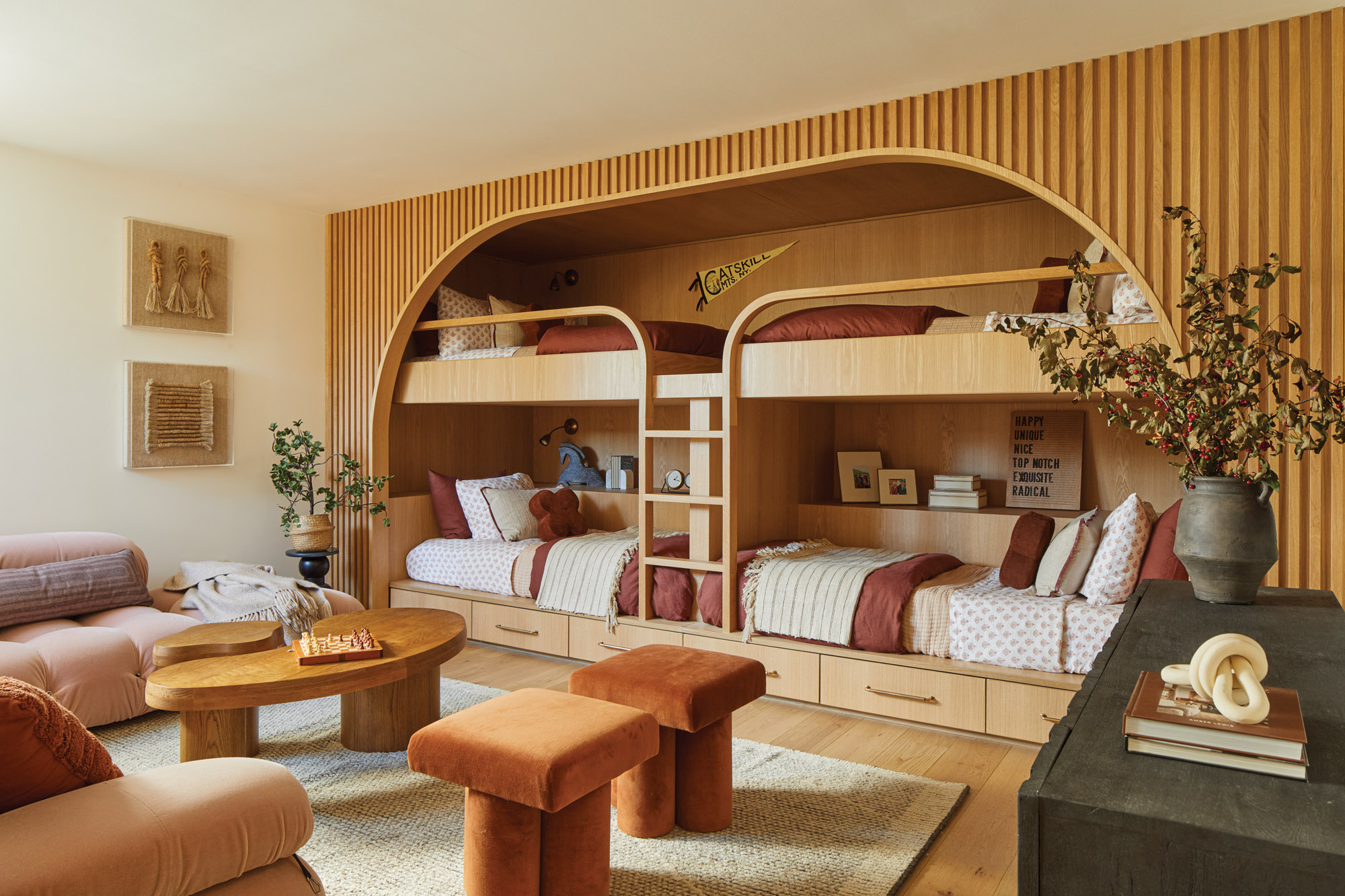
The basement bunk room, pairs custom arched bunks with built-in storage—turning a kid-heavy space into something that reads as architecture, not afterthought. Photo: David Engelhardt
A Quiet Reward
At the top of the house, the primary bedroom occupies what was once a painfully tight sleeping loft. Now it’s a serene retreat with generous windows overlooking the woods. Smith skipped curtains entirely, letting the landscape serve as both view and privacy. “We wake up and just watch the animals,” she says. “Turkeys, deer—it’s like a nature [TV] station.”
The adjoining bathroom is a wet room, with pitched tile floors and a linear drain that allows the shower and tub to coexist without enclosure. Heated floors—installed throughout the house—eliminate the need for traditional HVAC, supplemented instead by mini-splits and a meticulously insulated envelope that make the living spaces efficient and comfortable.
An Outdoor Living Room
The back deck extends the house’s social life outdoors, with curved forms that echo each other across seating areas, a sunken fire pit, and a cedar hot tub set flush with the deck. The curves were Smith’s husband’s idea—a design intervention from a non-designer that she happily embraced.
At night, the hot tub becomes the house’s unofficial star attraction. “The water’s soft, it smells amazing, and you’re just sitting under the stars,” she says. “It’s kind of perfect.”
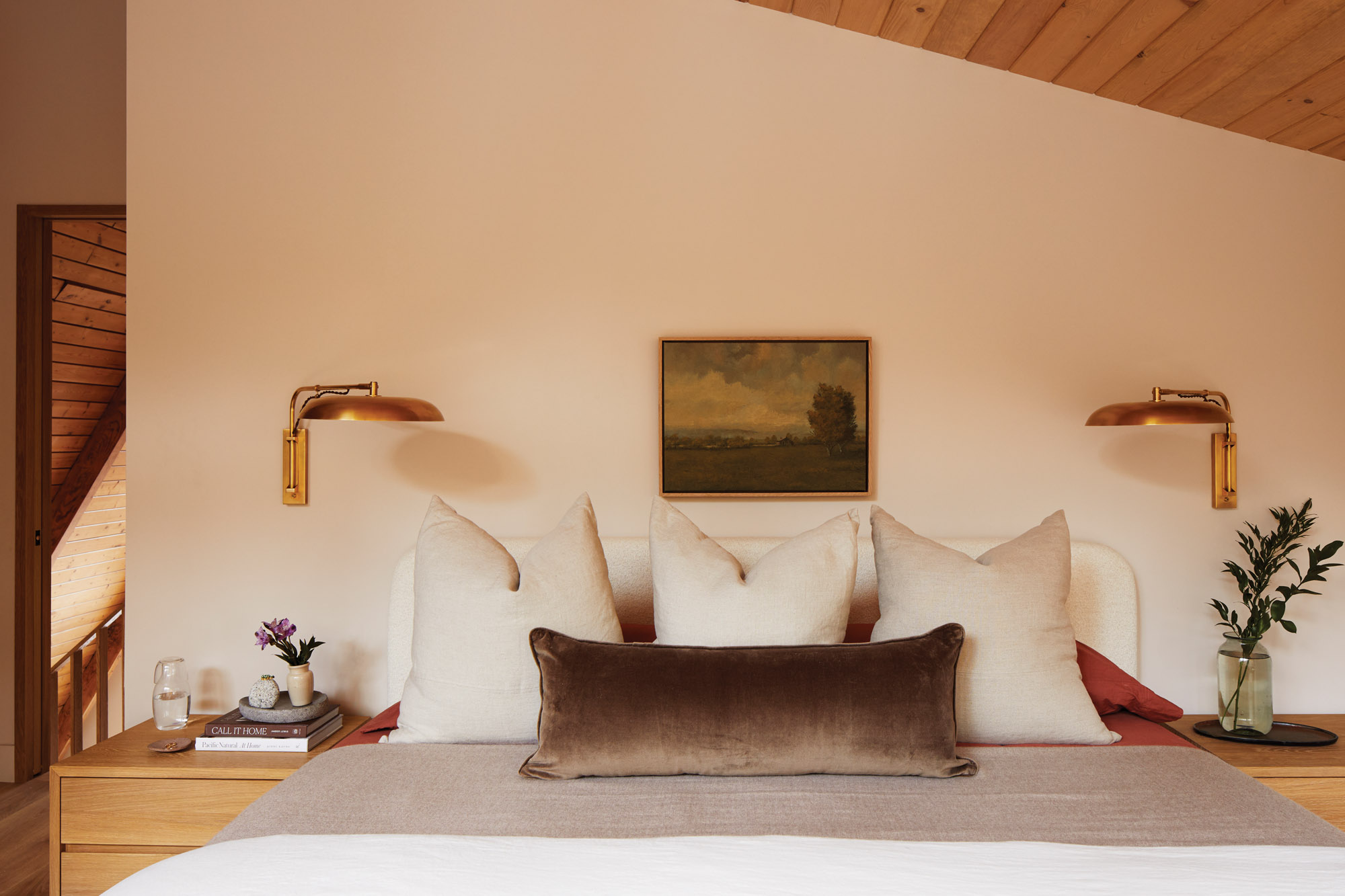
Upstairs, the primary bedroom replaces a former head-bumping loft with a calm, generous retreat—warm wood, layered textiles, and brass reading lights framing a space designed for slowing down after full days on the mountain. Photo: David Engelhardt
A House That Knows What It Is
The renovation took 18 months, beginning in 2023, and involved a trusted team: general contractor Jeremy Constable, electrician Gabe Agosto, staircase fabricator Troy Grant. Smith waited for the right people, knowing that precision and communication mattered as much as aesthetics.
In the end, the house never strays far from its origin story. The Malm fireplace—handmade, unapologetically ’70s, and finally positioned where it makes sense—now anchors the living room without dictating it. People gather around it, but they also face each other. The kitchen and living space speak across the room. No one is stuck staring at the backs of heads.
It’s a small thing, in a way. A fireplace is just a fireplace. But it’s also a reminder of how design shapes behavior—who talks to whom, where bodies turn, how time is spent. Fix that one thing, and suddenly everything else is up for reconsideration. Or, as Smith discovered, sometimes an ugly fireplace isn’t just an eyesore. It’s an invitation.