
Frederick Tang Architecture Redesigns a Farmhouse for Window-Watching Weather
By Mary Angeles Armstrong | Photos by Gieves Anderson | Winter 2024/2025 | Features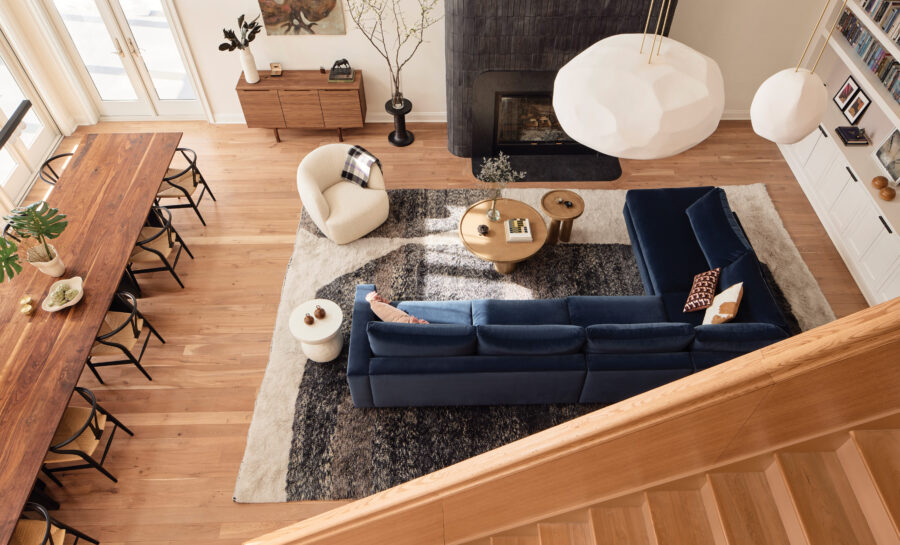
There’s an Icelandic word—gluggaveour—that captures a certain Hudson Valley winter aesthetic, when the stark, moody weather is beautiful to look at, but best enjoyed from indoors, ideally near a roaring fire with a cup of tea in hand. It was exactly this juxtaposition of cozy and captivating that architect Frederick Tang hoped to capture when remodeling a 4,500-square-foot farmhouse on 16 acres in Pine Plains.
His clients, bio-ethics professor Lauren Flicker and podcast producer Julian Yap, were seeking a retreat that functioned on parallel levels. With two young children and a dog, the couple needed comfortable, intimate spaces for family weekends ensconced at home. But they also need space: A few spare rooms and an oversized dining area to host extended family—sometimes lots of them—for holiday celebrations and sit-down dinners. “Growing up, my parents had a cabin in Greene County,” explains Flicker. “We wanted a place where family could gather but we also envisioned our daughters growing up here together.”
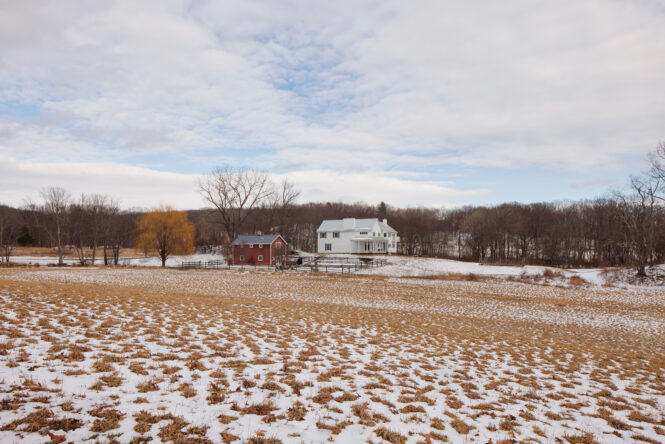
The Y2K-era Pine Plains home was designed to echo the region’s agrarian roots but featured a faux Colonial interior and dark walls. Sitting on 16 acres of open fields and adjacent to forever wild land, the home also features unobstructed views of nearby Stissing Mountain. “We weren’t drawn to the home’s interior, but when we visited the house and saw the view, we thought ‘This is it, this is the one,’” says Flicker.
Tang had renovated a relative’s Germantown home and they loved the results. “Fred’s work on our cousin’s house was exactly our aesthetic with beautiful, clean lines,” says Flicker. “We’d also spent some time with him socially and hit it off.” Tang married the couple’s vision with his own expertise, creating a home steeped in the vast setting but so comfortable it’s tempting to hibernate inside all winter.
A Farmhouse on the Edge
In 2020, after Flicker and Yap found themselves making regular weekend visits to the Hudson area, the couple decided to “semi-seriously, semi-fun” look for a permanent abode. That’s when they enlisted Tang, who has a home in nearby Tivoli, to not only help them create their ideal retreat but to find it. Tang introduced them to broker Kate Wood of Worth Preserving and walked them through both the region and the realities of upstate architecture. “I encouraged them to find something to remodel rather than a new construction,” says Tang. “New builds are costly and would take up to two years to complete. I thought we could finish something a lot sooner.”
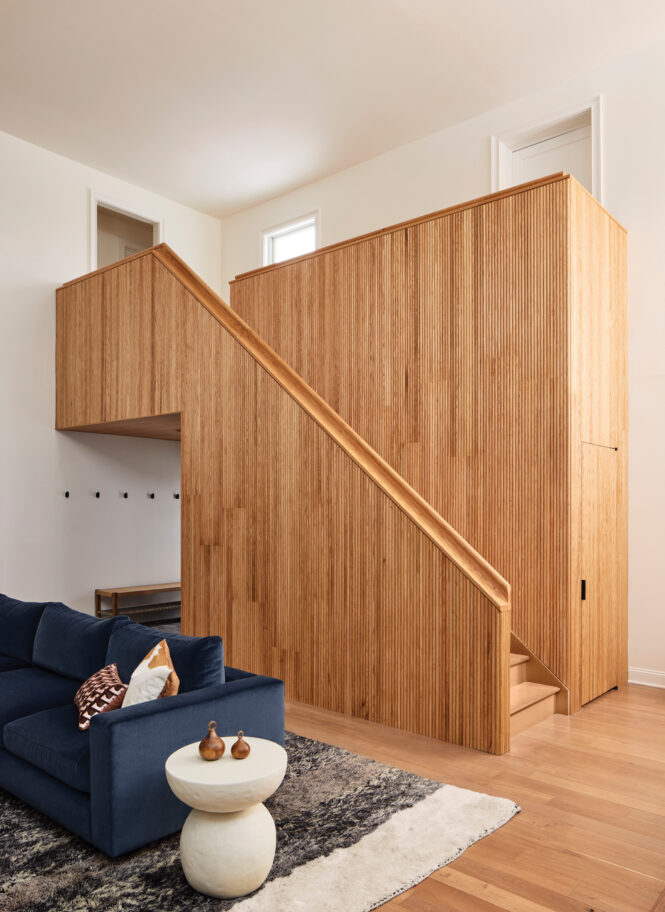
Tang also removed a boxy, Craftsman-style staircase, and then replaced it with a single-run staircase made from red oak tambour. “We wanted it to feel like a sculpture sitting apart from the space,” says Tang of the staircase design. Underneath, a separate dark terracotta-tiled mudroom features a hidden coat closet and entryway.
The couple focused their search on Dutchess and Columbia counties. They found their contemporary farmhouse unexpectedly after initially dismissing it. “I didn’t really get a good vibe off the house from the online listing,” says Flicker. “But our realtor encouraged a visit.” So they journeyed to the edge of their search radius and found an agrarian scene with a modern twist. Surrounded by fields and built to look like a traditional farmhouse, the property was protected visually by an agricultural easement and adjacent to forever wild land. A classic red barn (which is actually a pool house) completed the bucolic motif.
With six combined bedroom-bonus rooms and four baths, the farmhouse was large enough to accommodate the couple’s needs, however it was the rural landscape and the unobstructed views of Mount Stissing that sold them. “When we saw the view, we said ‘This is it, this is the one,’” explains Flicker. They bought it and Tang began transforming the home into a comfortable outpost with contemporary flair.
Y2 Cave
Tang had his work cut out for him. Built in 2004, the Y2K-era interiors were cluttered and overbearing. “The house was initially a modular house,” says Tang pointing to the L-shaped first floor with an oversized, double-height living room. “The living room wasn’t typical for a farmhouse,” he says. “It was dramatic but also cavernous, so we needed to find balance.” With dark blue-painted walls, an imposing fireplace, and a modular craftsman staircase dominating the space, the home’s main room was all jagged angles. “The staircase was really strange because it turned back on itself and ate into the space of the room,” says Tang. “It was too chunky and boxy for the room.”
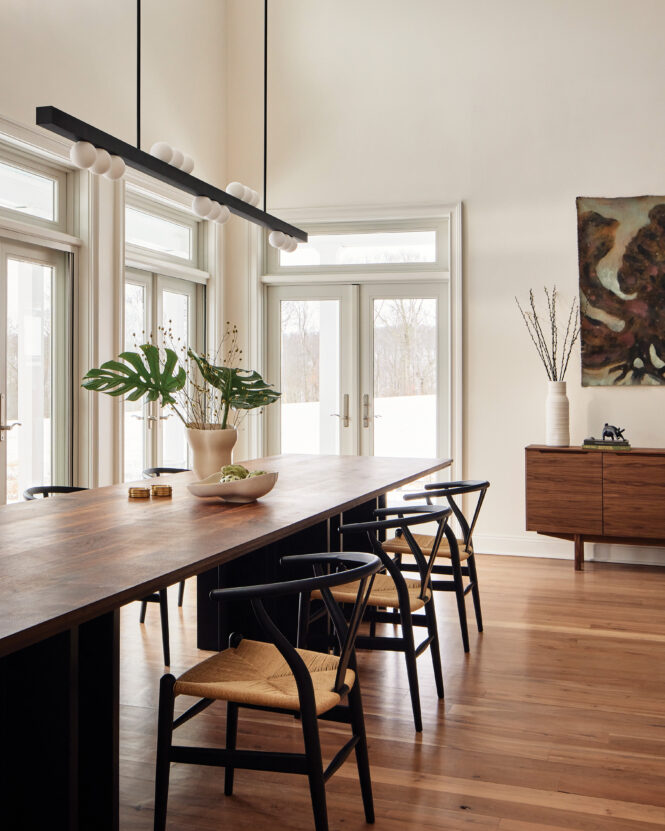
Flicker and Yap hoped to find a home where they could comfortably host relatives coming from near and far. When they found the right space, Tang helped custom design a 10-seat dining table out of walnut with ebony hardwood trim for the perfect living room corner. The wishbone chairs are matched with a Cointrin light fixture.
The double-height fireplace was also completely out of place. “It was like a Colonial fireplace on steroids,” Tang says. “The mantel was as tall as a human being, fussy, and totally out of scale.” The cloying color scheme, faux Colonial and craftsman details, and an awkward TV nook all detracted from the spacious vistas. The ambiance was the opposite of cozy. “Really what was magical about this house was the land,” says Tang. “It’s a really beautiful setting. We felt the space needed to be reoriented to maximize the connection with the landscape. “
Sculptural Stand-off
To soften and simplify the design, Tang began by addressing the home’s most visually and spatially dominant elements—the fireplace and staircase. He removed the craftsman stairwell entirely, and then pushed the staircase opening into a corner of the room. He then reconceived the passage as a less obstructive, single-run design. “This opened the living room and created more usable space,” says Tang, who then rebuilt the new staircase as object d’art. “We wanted it to feel like a sculpture sitting apart in that space,” says Tang. “So we utilized white oak tabor to create a beautiful textural effect that contrasts the rest of the living room.”
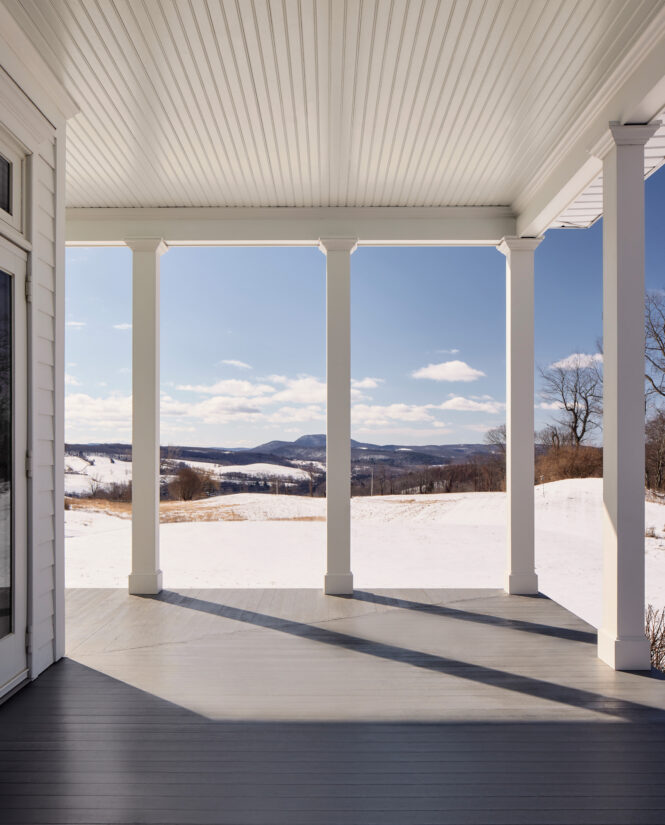
The property’s open 16 acres are partially leased to nearby farmers, but the couple regularly hike around the land with their young children on their backs. “The landscape was really the most important part of the property for us,” says Flicker. “We wanted to maximize the home to feature the land.”
Inspired by Eliel Saarinen’s staircases at the Cranbrook Academy of Art in Michigan, Tang custom designed sculpted handrails and carved rounded feet. The staircase landing cleverly conceals the entrance foyer—Tang added a hidden coat closet on the underside of the stairwell that flows seamlessly into the design. “The new staircase clarifies the space and simplifies it,” he says.
The fireplace remodel helped redefine the room, and whole house, aesthetic. “The original fireplace had too many decorative elements that didn’t work well with the scale of the room.” Tang lost the Colonial mantel entirely. “We wanted something that felt modern but still textured and earthy,” says Tang. “The material choice was key.” Tang utilized black terracotta brick from Cle Tile for the floor to ceiling length of the fireplace, and then curved the edges to soften the shape. “It has a very rich, matte texture that feels natural and warm but sophisticated,” says Tang. “The fireplace provides another sculptural element that helps ground the space, and draws your eyes to the flame.”
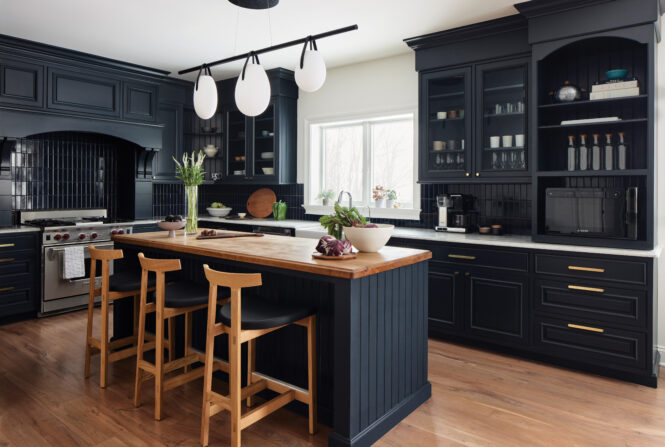
The kitchen didn’t require extensive renovation, but Tang did update it to echo the colors and textures in the living room. He refinished the cabinets in a dark jewel tone to match the fireplace and added a navy blue
In-house interior designer Barbara Reyes further softened the room’s design by adding a dark velvet Reid Chase sectional and plush swivel chairs in contrasting ivory tones. Domed pendant lights add a warm glow to the intimate space. Tang converted the adjacent TV nook into more streamlined built-in shelving along one wall. Along the other, a custom 16-person dining table looks through rows of French doors, allowing dinner guests to bask in the vista.
Wide, Open Spaces
Elements of the living room’s redesign echo throughout the house. “The kitchen didn’t need a full renovation,” says Tang. “But we worked to make it feel more modern and cohesive within the design.” After replacing the hardware and appliances, Tang repainted the yellow buttercream cabinets in an almost-navy shade, recalling the fireplace tiles. The relocated staircase had freed up space in the kitchen so Tang added a banquette in the reclaimed corner. “We love having coffee in the morning with our dog,” says Flicker. “The banquette has become a special spot with the same wood finish that ties in with the rest of the home.”
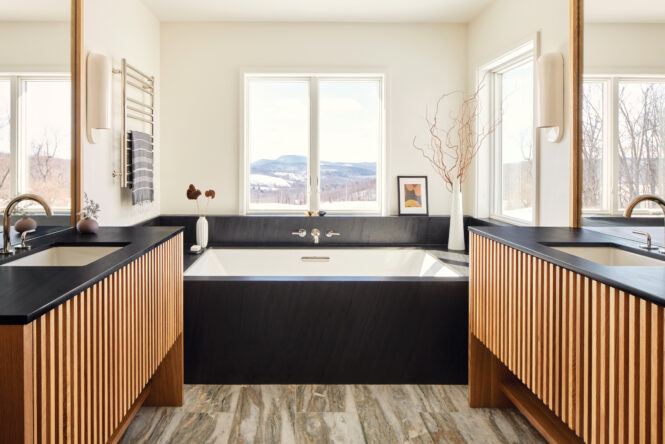
Tang opened and reoriented the primary bathroom to maximize the calming view. He continued the oak slats and millwork from the home’s staircase into the matching vanities. The giant tub fit perfectly under the window—Tang finished the bath in Milky Way tile by Fireclay.
The home’s three-and-a half-bathrooms also needed a complete transformation. “In both the guest and primary bathrooms, the original layouts didn’t make sense,” says Tang. “There was a lot of wasted space. We had to take both rooms down to the studs and reorient the layout.” In the guest bathroom, Tang chose cabinets finished in white oak similar to the staircase trim and matched it with gray and purple stone. “We wanted to keep the material palette simple but luxurious,” says Tang. “We focused on texture and contrast. The stone adds depth and the white oak adds warmth. “
Tang also gutted the home’s primary bathroom and then redesigned the space to invite the outdoors in. After removing shelving, he added matching streamlined vanities along opposite walls, both custom crafted from white oak. To further open the room, Tang raised the ceilings, removed window shutters, and reoriented everything towards the view of the Berkshires. Tang sourced an oversized bathtub and placed it window side, then finished the surrounding deck in Vermont slate. The bathroom’s redesign has created a retreat within a retreat. “It feels so spacious,” says Flicker. “It’s so cozy, and such a happy place to be.”
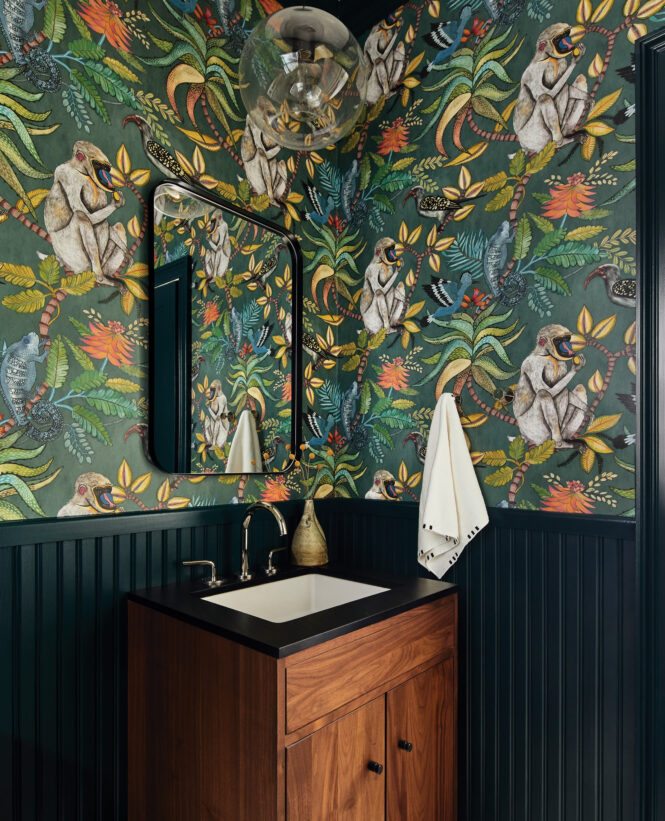
The first-floor powder room features wallpaper by Cole & Son and Pacific Sea Teal wainscoting and trim. The vanity is walnut and Nero Marquina tile.