
The Attic Advantage: How Sealing and Insulation Cut Energy Bills
Sealing and insulating your attic is one of the fastest, most cost-effective ways to reduce heat loss, improve comfort, and lower energy bills—especially in Hudson Valley homes.
By Jeff Eckes | Spring 2026 | Features
There is a simple, relatively inexpensive, and very effective way to cut heating and cooling costs—and it starts in the attic. The catch? You’re not storing anything up there anymore.
Attics aren’t meant for storage in the first place. Laying down flooring caps insulation at laughably low levels and creates prime conditions for moisture problems caused by condensation. The fix is straightforward: move the boxes elsewhere, rip up the floor, and replace it with generous amounts of money-saving insulation.
With a proper energy assessment and a few insulating guidelines to follow, this is a “Homeowner 102”-type of project; maybe not the first one you tackle as a new homeowner, but nothing that is outside a basic skill level, so let’s begin at the beginning; assessment.
Assessment
Energy assessing the entire house, roof, attic, windows and doors, should be a high priority for any homeowner. Generally, we lose 25 percent of our energy through our roofs, 35 percent through our walls and 15 percent through our floors, so insulating your attic space is a great place to see measurable savings and increased comfort. I strongly suggest a professional home energy assessment and avoid “audits,” as they tend to be less detailed and contain less usable information for the homeowner. An energy assessment will always include an assessment of your attic sealing and insulation, a good company will also let you know of any animal or pest infestations and will include a few infrared (IR) photos, if the season is cold or hot enough to generate some contrasting temperatures. In fact, I’d recommend that new homeowners purchase one of the new IR cameras for smart phones. They start as low as $199 (and that’s for a good one!) and come in handy for everything from finding air leaks in windows and doors, to finding water leaks behind walls (they show up very dark in color, because water is usually colder than the air or materials around it) and bad switches and outlets (they often begin getting hotter than usual as they fail).
Clean Up
So now you have your energy assessment and your IR camera, you’ve determined that you need additional insulation in your attic, so what now? Dirty air leakage passing through the old insulation will cause a soot like dirty color in the insulation, occasional pests like squirrels, chipmunks, mice, and bats can leave droppings, which will need to be removed. Generally, unless your attic insulation is young and pristine, you’ll want to remove it. Caution: rodent droppings have the potential to carry diseases like hantavirus and arenaviruses, so personal protective equipment like respirators, latex gloves, safety glasses and full Tyvek jumpsuits with hood are a necessary investment, more on this in a moment.
Now comes the messy and annoying bit, the cleanup! One of the things that costs more than you might think is removing the old insulation from your attic, it’s labor intensive, so a great place to save money over a professional doing this part, even if you have them insulate the space, and yes, you need to remove it in most cases. All of it. And then you need to vacuum up the last bits too.
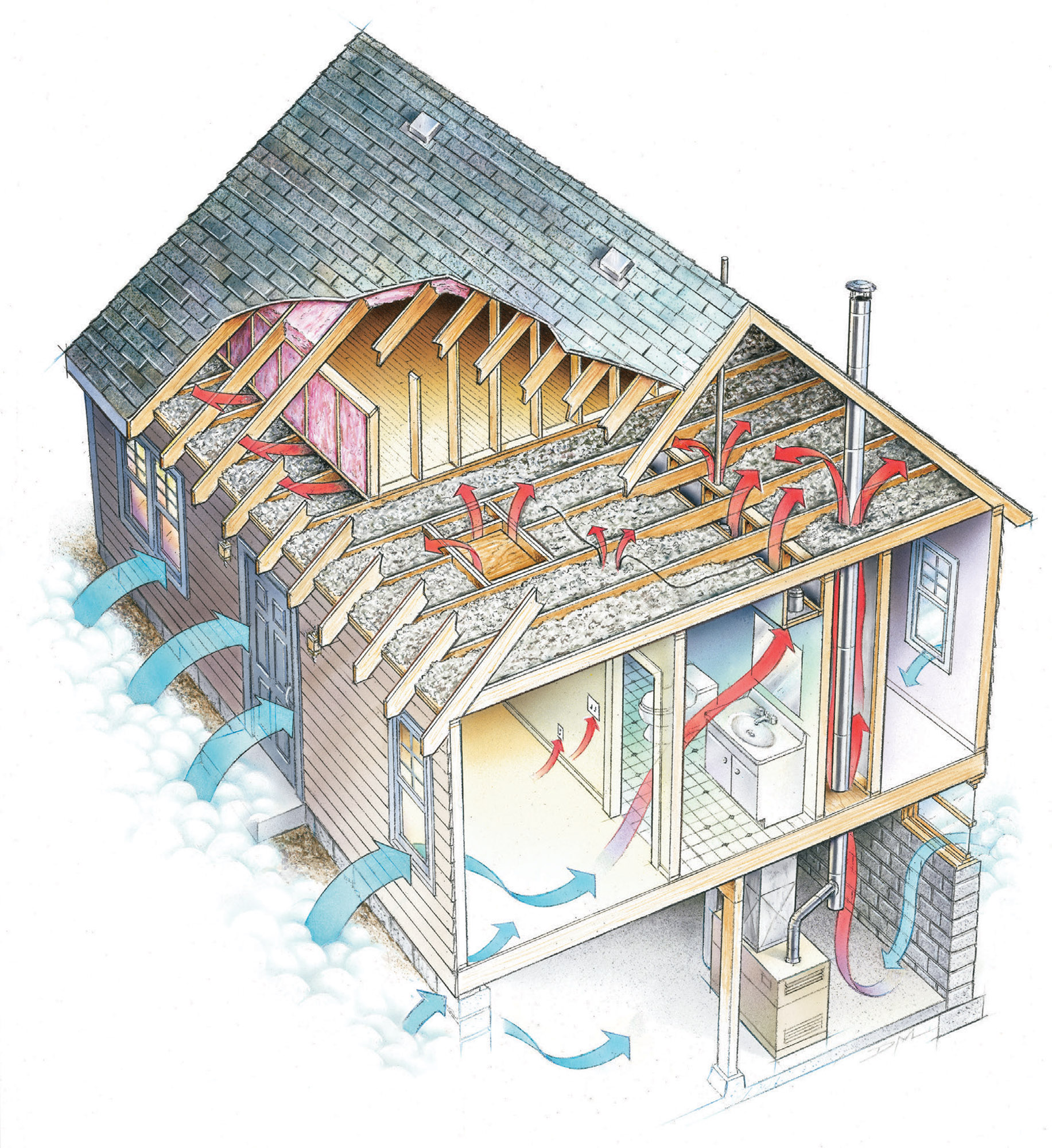
This diagram illustrates how air moves through an under-sealed attic: warm indoor air rises and escapes through gaps around wiring, plumbing, and framing, while cold outside air is drawn in from below to replace it. Proper air sealing blocks that upward convection, and continuous insulation slows conductive heat loss, keeping conditioned air where it belongs and reducing the stack effect that drives drafts and energy waste.
Credit: Energystar.gov
Protect Yourself
Personal protective equipment is important, so don’t skimp. A good half-face 3M respirator with a P100 cartridge filter provides at least 99.97 percent filtration efficiency against solids and liquid aerosols, as well as oil-based particles, and won’t come close to breaking the budget. Get one for everyone who’s helping. We use a full facepiece masks because we often reinsulate with either fiberglass or cellulose blown in insulation, and having the closed face/eye protection isn’t a luxury when the insulation flies. Any full body with hood cleaning suit will work. Tyvek makes them, but so do dozens of companies selling on Amazon and elsewhere, shop around to save money. A box of six-millimeter latex gloves round out this stunning ensemble. Oh, one more safety tip from someone that’s done this hundreds of times: cut a few boards that are at least 48-inches long and as wide as you can fit through your attic hatch, and use these to walk and situate yourself to work, you’ll thank me later.
Once you’ve removed the old insulation, it’s time to install the new insulation, right? Not quite yet, it is time to seal the drywall ceiling though. Sealing is as important or more important than insulating is. Most of the losses in old homes is from convection (air movement) not conduction (heat moving through a substance like wood and insulation) so proper sealing pays real benefits. Sealing encompasses two things: one is sealing the obvious holes created by wires and plumbing that penetrate into the space. This can be achieved with any good fire block expandable foam. The second is sealing against water vapor with a vapor retarder that is installed on the warm side of the insulation. In an existing space, that means it’s the first thing you install.
In the Hudson Valley building codes generally do require a vapor barrier for cross-ventilated attics (one that is vented through the soffits and out the ridge or gable vents, which is what most homes in the region are) beyond a kraft paper facing on insulation, but this is a terrible air barrier. The most scientifically sound and the easiest, though somewhat more expensive method, is with a liquid applied membrane that can be rolled, brushed, or sprayed onto the upper surface of the ceiling drywall (the attic side). Some of these products, like Visconn by Pro Clima, are “smart” membranes and adjust to seasonal vapor pressures at a molecular level, making them nearly foolproof vapor retarders as well as air-sealing membranes. Other vapor retarders are plastic sheet, kraft facing on batt insulation and certain other smart membranes like Intello, also by Pro Clima.
Once the sealing is complete, you’re ready to insulate, so batt or blown in? (Batt insulation, or blanket insulation, consists of pre-cut, flexible panels of material like fiberglass mineral wool, or cotton, designed to fit snugly between wall studs and ceiling joists.) Maybe both.
Using batt insulation in the bays between the ceiling joists can save you some money. If you haven’t used a liquid applied membrane for vapor retardation, a kraft paper-faced insulation would be a requirement. If you have, you can still use an unfaced batt in their place. An unfaced R30 roll batt insulation would work here, fill the entire bay, and could also be used for the cross rolled layer that is installed above and on top of the layer that is fitted between the joists. New York State requires R60 ceiling insulation in vented attics. Two layers of R30 batt insulation is all that’s required, or you can opt for blown-in fiberglass or cellulose insulation. To achieve an R60 insulation value you will need to install a few inches more than required to accommodate the settling, which is normal. For cellulose that is generally 18 inches, which settles to about 16 inches. A wealth of information is often available through manufacturer websites, and cellulose fiber is no exception.
In the end, sealing and insulating your attic spaces can save you thousands of dollars over the ownership of your home and make it more comfortable and valuable at resale, which makes doing this as soon as possible a no-brainer in my book.
The EPA has a pamphlet on its Energy Star website (Energystar.gov) that details this process: “A Do-It-Yourself Guide to Sealing and Insulating with Energy Star.”