
Art Fort: A Small, Site-Driven House for Art and Living in the Hudson Valley
Art Fort is a 1,400-square-foot house and studio by Studio MM Architect in Kerhonkson, designed for an artist whose work is shaped by architecture. The project demonstrates how modest scale, natural light, and restraint can feel expansive.
By Brian K. Mahoney | Brad Feinknopf/OTTO | Spring 2026 | Features | House Feature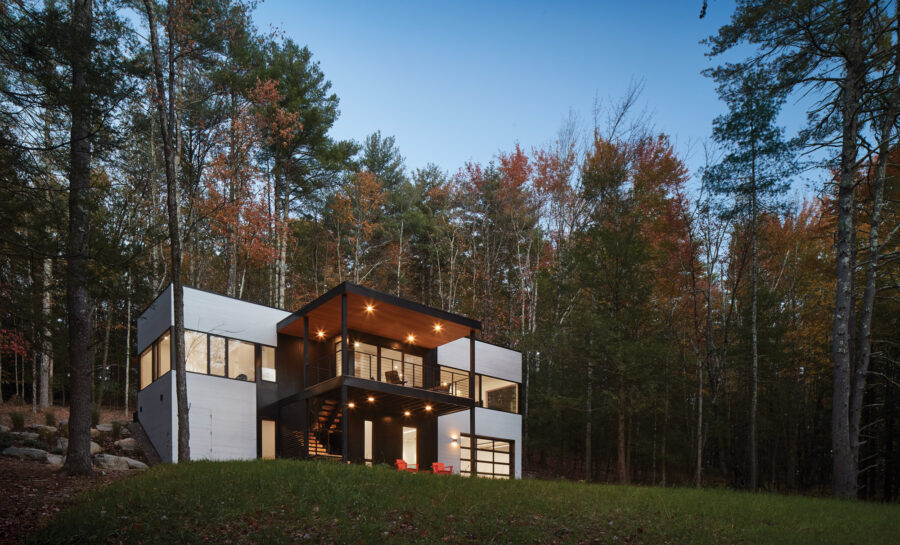
In the Hudson Valley, where architectural ambition is often measured in square footage, Art Fort makes its case more modestly. The 1,525-square-foot house and studio, designed by Marica McKeel of Studio MM Architect and completed in 2024 in Kerhonkson, doesn’t announce itself as an object so much as it settles into place—embedded in a wooded slope, calibrated to light, and tuned to the rhythms of a working artist’s daily life.
Its name offers the first clue. “The house is absolutely her home and her studio—working studio and potential gallery space,” McKeel says of the client, a painter whose work is informed by a background in architecture. “So very much Art Fort. And I think the fort part came because I knew it was going to be a very efficient space.”
Efficiency, here, is not shorthand for austerity. Instead, Art Fort demonstrates one of McKeel’s core beliefs: that careful planning, restraint, and site-driven design can make a small building feel expansive—and deeply personal—without excess.
Designed Before the Land Was Bought
Unlike many residential projects, Art Fort’s story begins before the client even owned the land. McKeel was involved early, walking the sloped site with her client and assessing whether it could support the kind of home-and-studio hybrid she envisioned.
“We did collaborate with her on finding the site and making sure it was going to work,” McKeel says. “So there were conversations happening even before she bought the land.”
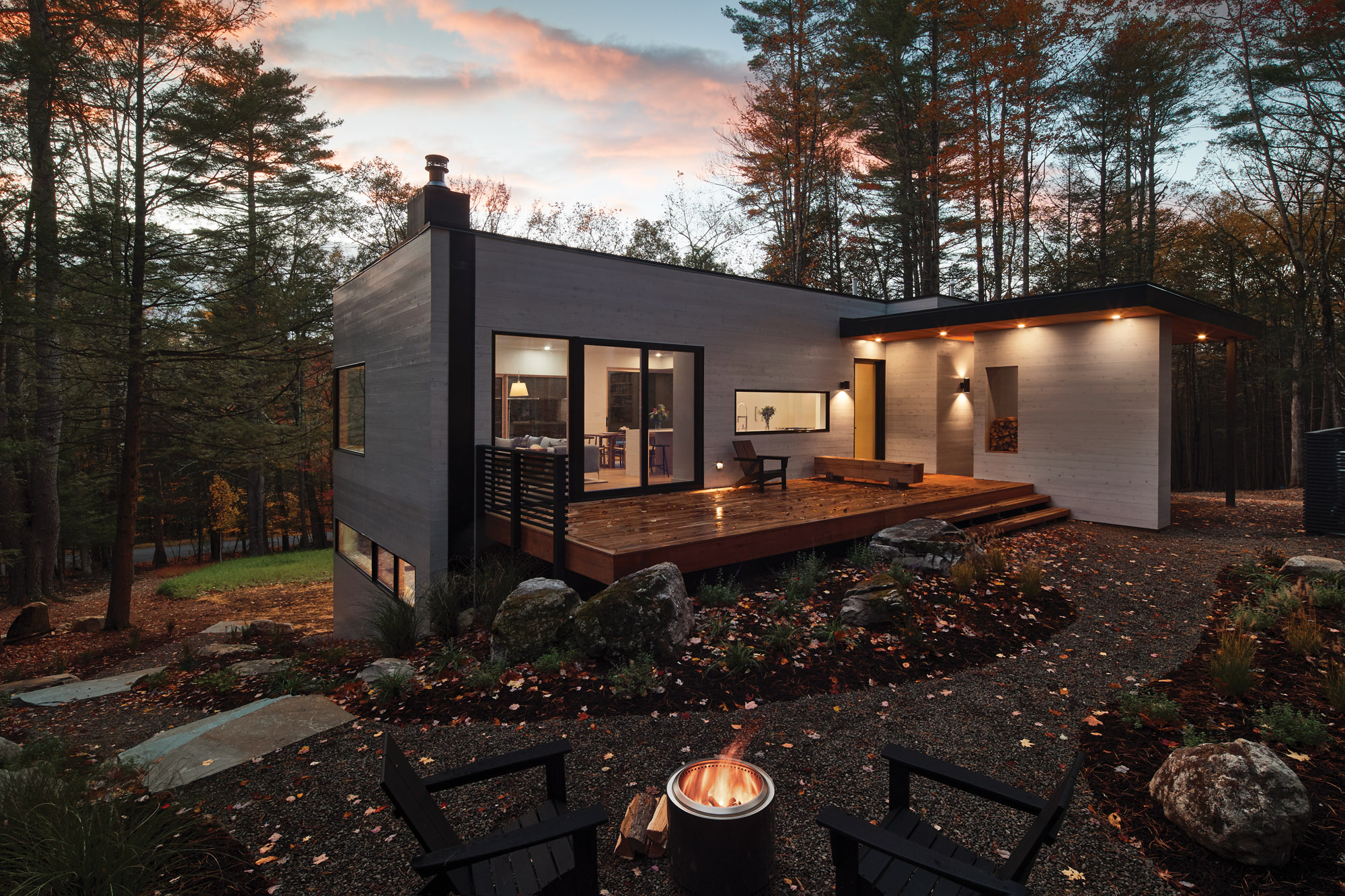
The main living spaces sit lightly atop the slope, where sliding glass doors and a continuous deck dissolve the boundary between house and landscape.
That early involvement paid off. The hillside didn’t become a constraint to be overcome; it became the project’s organizing principle. The house is embedded into the slope, with the studio occupying the lower level on the downhill side and the living spaces above. This sectional strategy allows both levels to function like first floors—one accessed from the drive, the other from grade below.
“She just drives right up to the living level and goes into her home,” McKeel explains. “And then if you go a little bit downhill, either for deliveries or for foot entry into the studio, that’s on the lower level.”
The result is a clear but gentle separation between living and working—something the client didn’t explicitly request, but which emerged naturally from the site and program.
Small, but Not Tight
At 1,525 square feet, Art Fort sits at the smaller end of Studio MM’s residential work, but McKeel relished the challenge. “Honestly, it’s almost more fun,” she says. “To figure out how to get everything our client really wants into this extremely efficient space—and make it work in every way—is even more of a challenge and therefore more fun.”
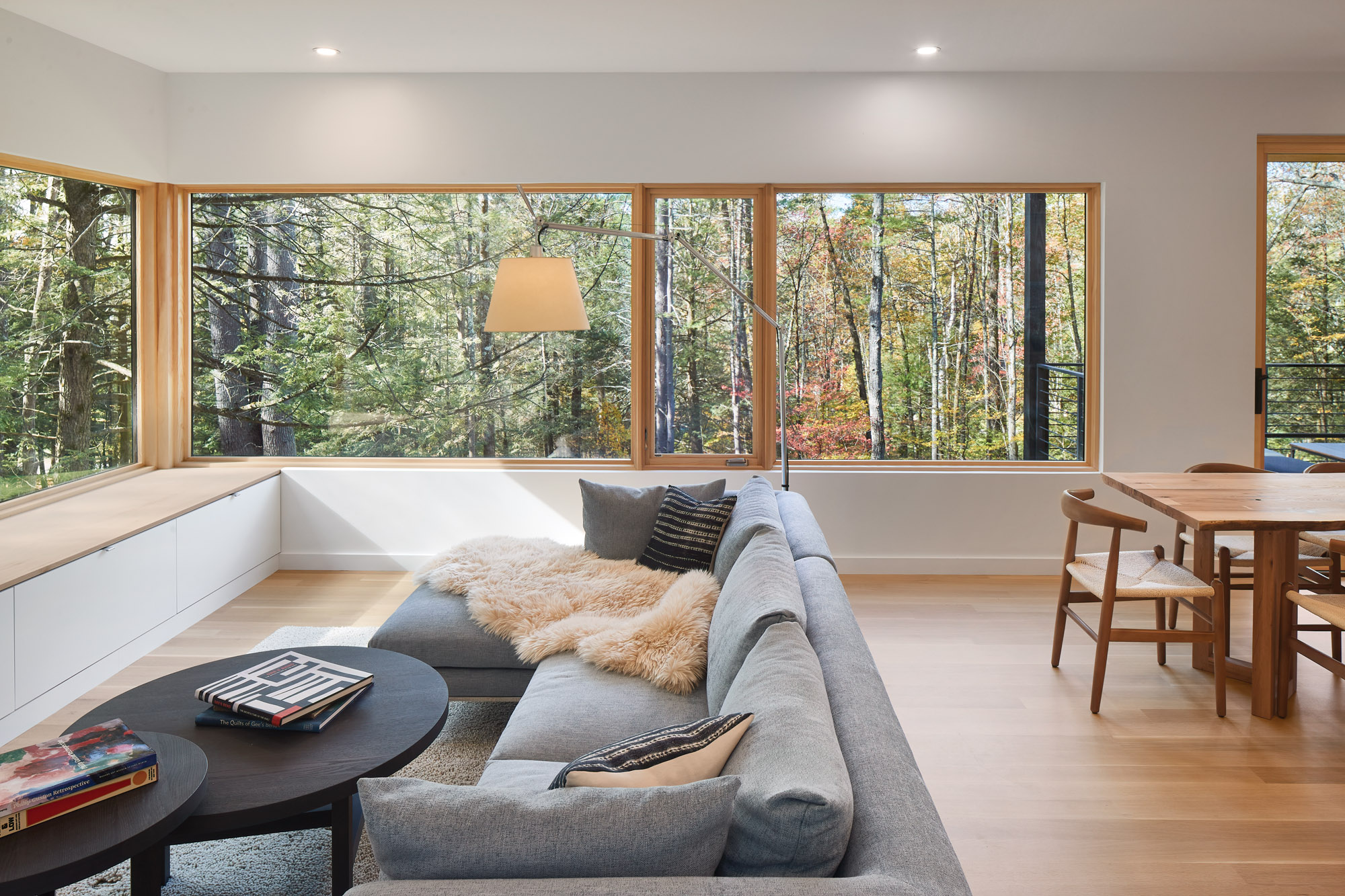
The living room’s restrained materials—white walls, pale wood floors, and maple trim—create a neutral backdrop for books, art, and daily life.
The primary move that makes the house feel larger than it is? Windows—and what they reveal. “We’re all about indoor-outdoor and really continuous space,” McKeel says. “Not only large windows that make a space feel bigger, but also the decks. There’s a deck on the back and a deck on the front, so as you walk in, you’re not only seeing the outdoors—you’re reading that as part of the living room.”
Glass sliders open the main living space onto outdoor decks, visually doubling the footprint and creating what McKeel calls an “overflow of space.” From inside, the line between interior and exterior dissolves, replaced by a sense of continuity with the surrounding woods.
A Living Level in the Trees
Upstairs, the house unfolds as a single open living space—kitchen, dining, and lounge arranged as one continuous room, wrapped in windows. White walls and maple cabinetry establish a restrained palette, while warm wood floors and built-ins provide tactile richness.
Restraint, for McKeel, is never about cold minimalism. “We design with a minimal aesthetic, but warmth is always on our minds,” she says. “What you touch, what you walk on, how that feels on your feet—that matters.”
The living room is McKeel’s favorite space in the house, and it’s easy to see why. On one side, the room opens onto a deck that steps out toward the fire pit and forest floor. On the other, the windows look out into the tree canopy, creating an almost treehouse-like sensation.
“You feel elevated on one side and grounded on the other,” she says. “It’s a really unique experience.”
Bookshelves are built directly into the architecture, filled with the client’s books—objects McKeel considers essential to making the house feel lived-in rather than staged. “That’s her life,” she says. “We want to be the vessel where the homeowner can add her own flair and make it her home.”
Designing for an Artist—Who Was Also an Architect
The client’s background in architecture shaped the collaboration in subtle but important ways. “She understood how we work and how we think,” McKeel says. “And she really trusted us.”
That trust allowed the design process to move fluidly. The client could visualize ideas quickly and engage deeply, without needing to control the architectural decisions herself. “She leaned on us for that,” McKeel says. “But she definitely has a strong aesthetic—a clean-line aesthetic—and that aligned with our work.”
Nowhere is that collaboration more evident than in the studio.
The Studio: Messy, Controlled, and Precise
Located on the lower level, the studio is designed as a flexible, hardworking space—concrete floors underfoot, white walls, and a large glass garage door that opens fully to the landscape. Clerestory windows along the north side provide consistent, diffuse light, while artist lighting allows for precise control. “For an artist, too much light isn’t always good,” McKeel notes. “Here, she can control it.”
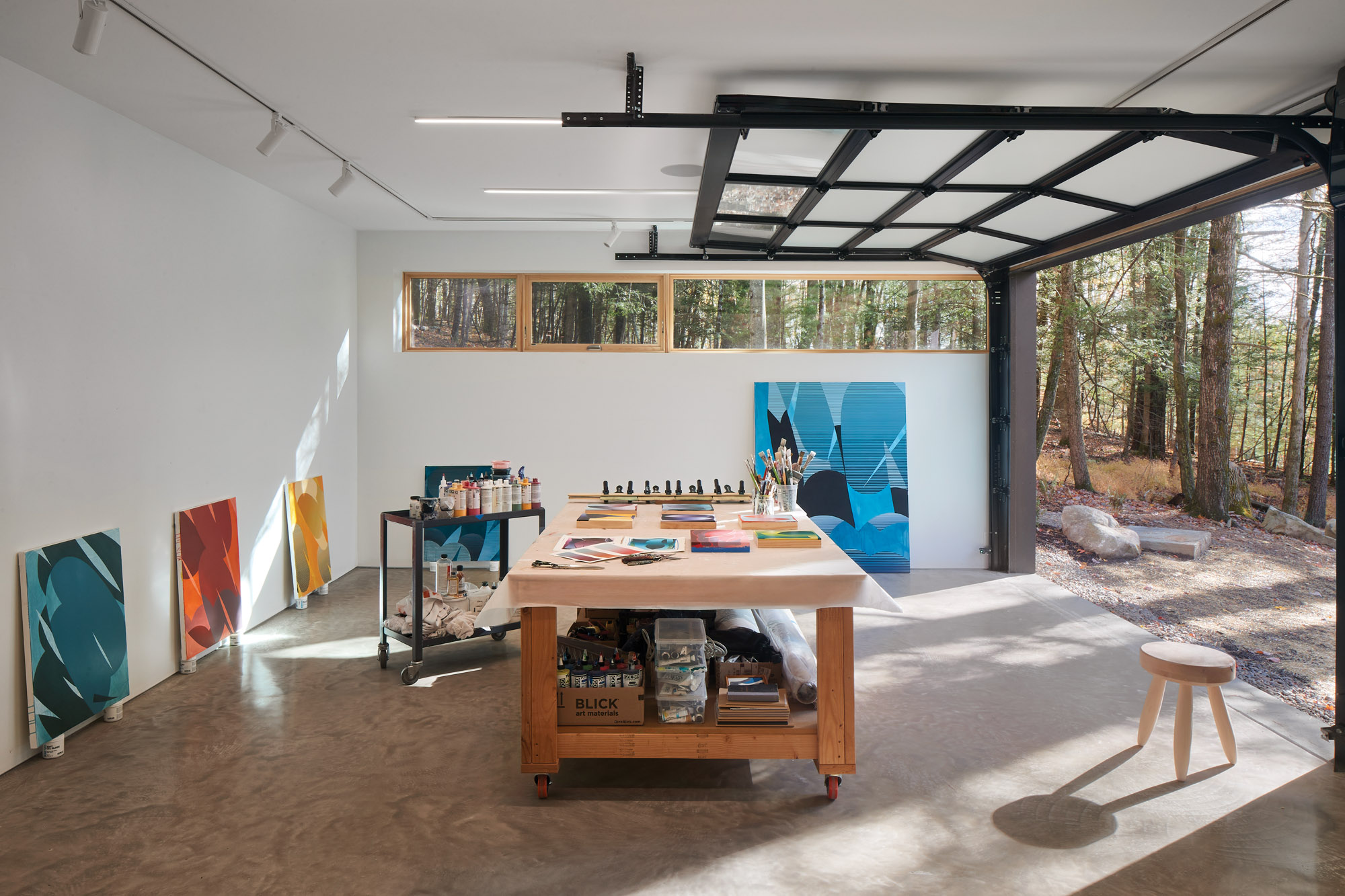
The lower-level studio is conceived as a flexible workspace, with concrete floors, controlled light, and direct access to the landscape.
The studio embraces what McKeel describes as “organized messiness.” A massive central worktable anchors the room, surrounded by bins of supplies. Brushes are cleaned at an oversized sink and hung meticulously on the wall—ordered, but ready for use.
The most distinctive feature is the custom rotating wall in the aerosol spray room. Designed to accommodate large-scale works, the wall allows the artist to move pieces into the spray booth without setting them down—critical when working with wet paint.
“She can hold the artwork, go into the booth, spray it, and never take her hands off the piece,” McKeel says. When closed, the wall seals the booth and directs fumes to an exhaust fan; when not in use, it doubles as a gallery surface.
“It’s both production and presentation,” McKeel says. “That integration was really important.”
One Stair, Outside
In the interest of efficiency, the house contains just one staircase—and it’s outside. “We initially had the stair on the interior,” McKeel says. “But we wanted to make the most efficient floor plan possible. So the stair got pulled to the exterior.”
The move eliminated the need for interior circulation space while reinforcing the separation between home and studio. The exterior stair, with custom wood treads and screening, becomes both functional and sculptural—a vertical moment in an otherwise horizontal composition.
Built from the Site Itself
Several pieces of furniture in Art Fort were milled from trees cleared during site preparation, including the dining table, headboard, side tables, and an exterior bench. “That was really important to her,” McKeel says. “She wanted to bring the land into the house in a real way.”
While using site-sourced wood for flooring often proves cost-prohibitive, furniture offered a more feasible—and meaningful—application. The pieces carry the memory of the land forward, grounding the house materially as well as conceptually.
Architecture as a Backdrop, Not a Statement
Asked how she defines success on a project like Art Fort, McKeel doesn’t hesitate. “That it suits my client 100 percent,” she says. “It feels like home. It’s exactly what they wanted.”
Art Fort doesn’t perform for the street or announce itself as a trophy house. From the road, it sits gently among the trees, its mass broken by horizontal lines—the carport roof and deck overhangs—that soften the box and visually anchor it to the slope. “It’s not about, ‘Look at this house,’” McKeel says. “It’s about her living, her art, and her happiness in her home.”
For Upstate House readers accustomed to seeing architecture framed as spectacle, Art Fort offers a counterpoint: a modest, deeply intentional building that prioritizes daily life, creative work, and connection to place. It’s a house designed less to impress visitors than to support its occupant.