
Architect Drew Lang Combines Victorian Elegance with Ancient Landscapes in this Germantown Home
The house's dual nature offers the best of both worlds, connecting with human elegance and natural beauty
By Mary Angeles Armstrong | Jonathan Hokklo | Summer 2026 | Features | House Feature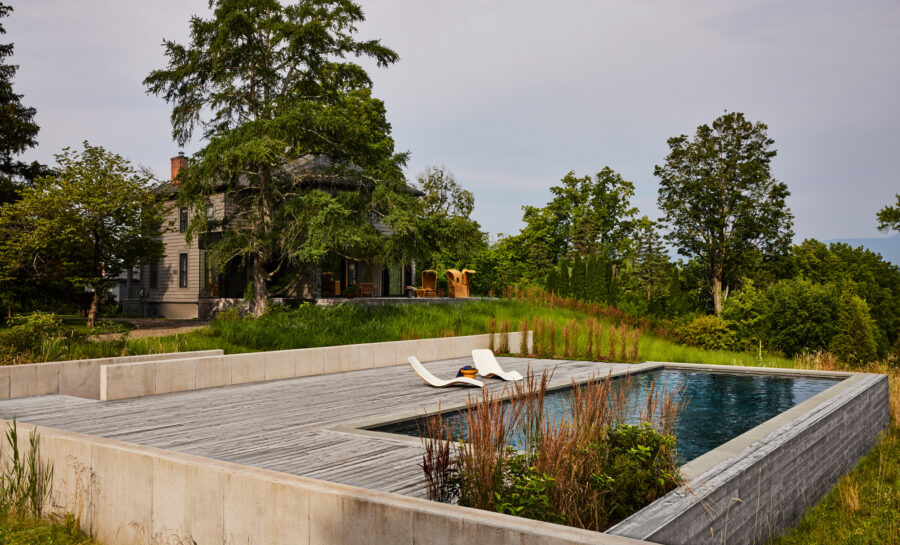
The split stairway at the side entrance of Sarah Barnett and Chris Brown’s Germantown home presents anyone arriving with a stark choice. Take the stairs to the left, and you find your way straight back into 1863, when the Italianate Victorian sat at the center of the hamlet’s bustling Main Street, surrounded by similarly grand homes built on wealth gleaned from the whaling industry 10 miles to the north in Hudson.
Take the stairs to the right, however, and you are thrust, immediately, back to a place much more ancient and wild—where the home’s back deck floats like a life raft above a sea of native grass and wildflowers, shaded on one side by an unruly tamarack pine, and the only thing to look at—besides the encroaching wild woods—is the Kaaterskill High Peak in sharp relief across the Hudson.
That dichotomy between the meticulously restored street-facing Victorian front and the ancient landscape behind is bridged by a thoughtful, contemporary redesign of the home’s rear section by architect Drew Lang of Lang Architecture. First approached by Barnett and Brown in 2020, Lang was immediately intrigued by the project’s dual nature. “I’m from New Orleans originally and have always had an affinity for historic architecture,” says Lang. “I’ve always had this interest and inclination towards marrying the historic and the new.”
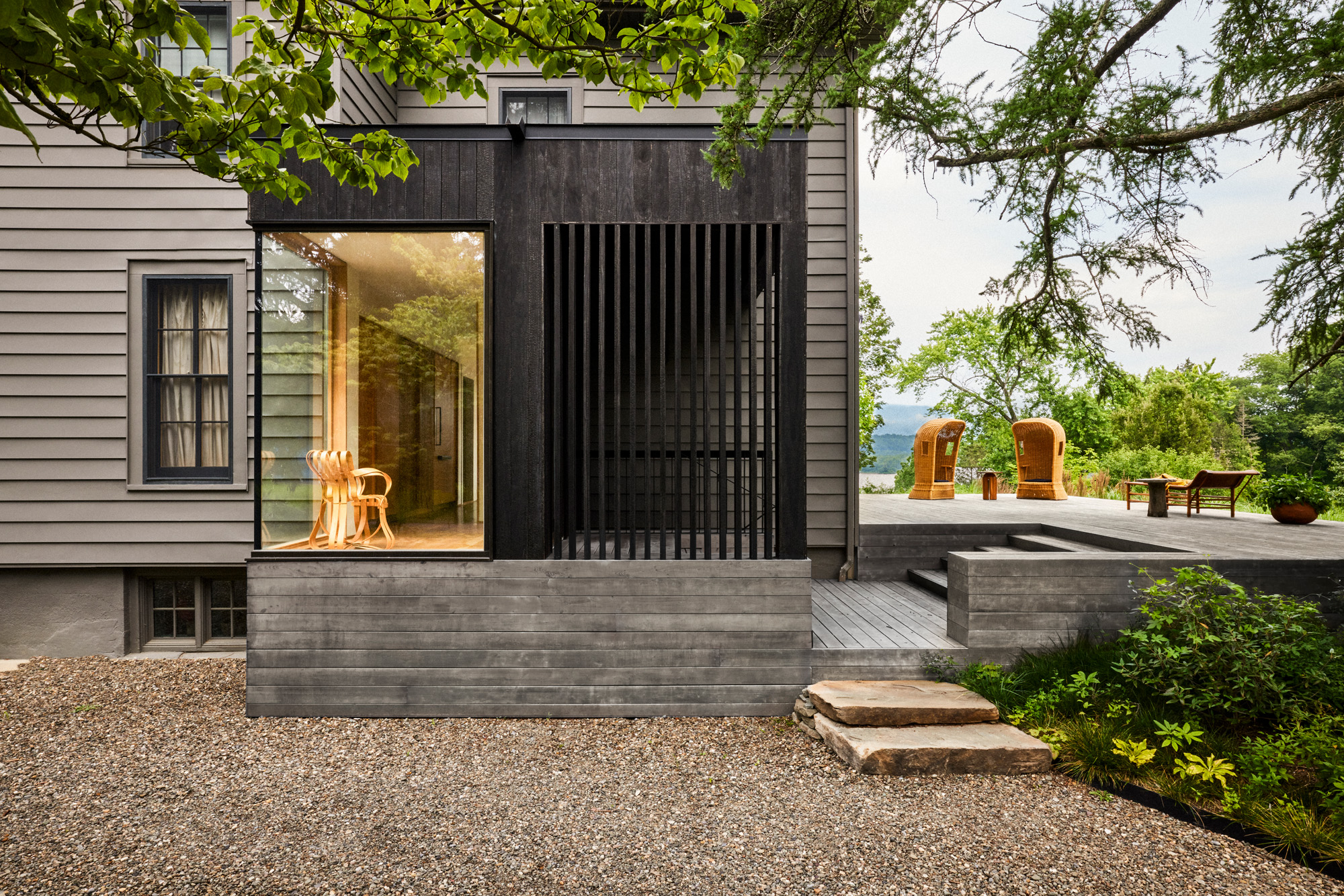
Wrapped in charred sho sugi ban siding, the new mudroom and entry addition bridges the home’s restored Victorian front with its minimalist rear expansion.
The epitome of 19th-century curb appeal, the Victorian exterior, which includes a deep veranda with bracketed cornices and curvy balustrades, was designed to catch the eyes of passers-by. It was the grandeur projecting, street-facing front parlor, with its extended Italianate sash windows and crafted molding, that first captivated Brown and Barnett in 2012. “When we first saw the house, the setting sun lit up the room in orange light, all wobbly thanks to the old glass windows,” remembers Barnett, a media executive. “That was kind of it. The scale of the rooms, the crazy intricate plasterwork, and the flow around the central staircase were all gravy.”
But the redesign of the Victorian’s backside was guided by a decidedly inverse logic. “I grew up in the English countryside, dying to leave and get to the big city,” explains Barnett. “Living upstate surrounded by birds, trees, and creeks brought me back to the rhythm of my childhood—a default setting I didn’t know was there.”
Lang intuitively understood the couple’s desire to reconnect with the landscape. “Their idea was to create a connection between the indoor spaces and the outdoors,” says Lang. “They wanted to build off the back of the house, but they also wanted openness and a visual connection to the exterior.” Every part of the section’s reimaging—from the removal of myriad obstructions to the hyper-minimalist interior design—was conceived towards one end—gazing outward. “Back here, the decoration,” Lang says, “is what you see through the glass.”
Follies of the Industrial Age
When Barnett and Brown first approached Lang, they actually had other ideas for the three-acre property. “Our original plan was to, yes, update the kitchen and add an upstairs bathroom,” says Barnett. “But our main focus was the restoration of a large, falling-down barn.” Alongside converting the barn to a pool house, the couple also hoped to restore a smaller, adjacent outbuilding into something equally functional.
The other outbuilding—a small folly—defied any real architectural logic. “It was odd, randomly placed, very small, and had no particular purpose,” says Lang. “We imagined it was a writer’s studio or maybe a place where people were sent when they were punished, but we couldn’t figure out what to do with it.”
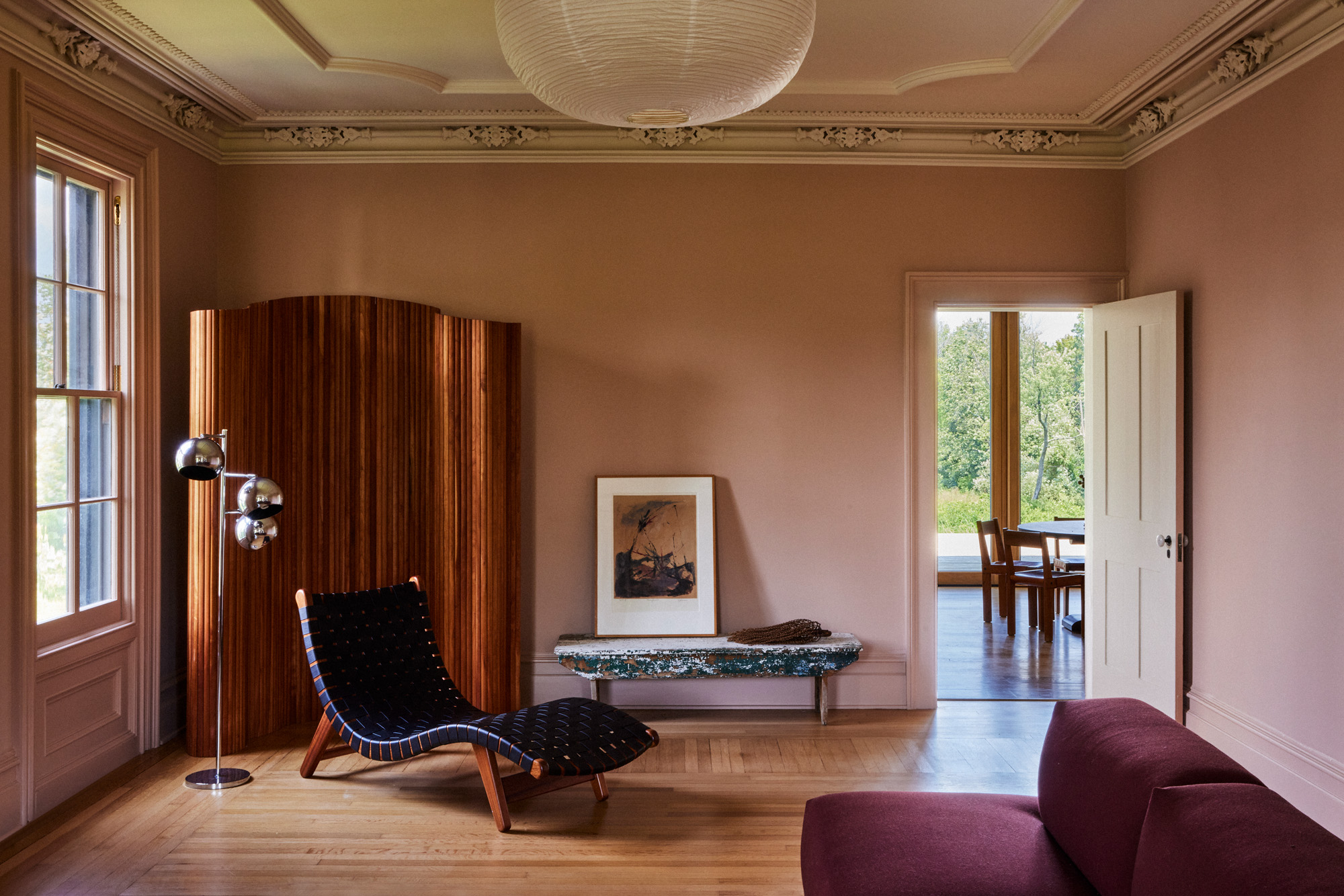
Original plasterwork, hardwood floors, and tall Italianate windows anchor the restored front parlor of the 1863 Victorian.
The condition of both outbuildings made the restoration too difficult and, ultimately, both structures had to be scrapped. Their subtraction, however, opened up new possibilities for the property’s redesign—ones much more aligned with the couple’s goals. “Drew and his team listened carefully to what we wanted and then proposed something quite different and much better,” says Barnett. “They steered us away from the immense impracticality of the barn restoration toward an opening up of the land.” Lang’s idea took the spirit of how Barnett and Brown wanted to live on the property, “then imagined something more radical and harmonious,” says Barnett.
Wild Maximization
With the derelict structures gone, Barnett and Brown could finally see beyond to the greater landscape. That sense of expansiveness guided the redesign of the back section. “Our inclination was to make it very different than the historic house—very open, very classy, very modern, and very connected to the outdoors,” says Lang. “There was a clear dichotomy between the historic house and the rear portion, which was different and non-historic, and screaming out to be transformed.” They gutted the section’s small dining room and kitchen, then removed the entire back wall as well as a fireplace, which was further obstructing the view.
Next, Lang enclosed the space with floor-to-ceiling windows and sliders from Eco Windows that open directly onto the newly constructed back deck, further erasing the line between the interior and the landscape. In contrast to the Victorian’s traditional detailing, the reconceived kitchen and dining room became a case study in minimalist restraint. “Programmatically, there was a lot that needed to be packed in,” explains Lang. “Barnett and Brown wanted a distinct kitchen and dining room, as well as plenty of storage, a new entryway, and a mudroom.”
Lang carefully sited an interior wall dividing the kitchen from the dining area to extend the minimalist interior without detracting from the view’s openness; then clad the cabinetry and floors in white oak milled by the Hudson Company in Pine Plains. The home’s major appliances, including the oven, were further tucked away in an appliance garage. “Our interest was to pare back the material palette so that it wasn’t cacophonous,” says Lang. “Let the purity of the space be the purity of the space, and privilege the openness and the experience of the landscape. The materials are really intended to sit kind of quietly and be almost secondary.”
Meanwhile, Barnett and Brown worked with a Hudson-based landscape designer, Heather Grimes, to re-wild the surrounding three acres. “We planted maybe 50 trees on the property, including many willows,” says Barnett. “And we’re slowly coaxing the meadow back into its splendor.” Their revitalization of the property has drawn in wildlife, which they regularly view from their perch on the back deck. “Living with greater visibility of the land makes the house feel like more of a sanctuary. We have bald eagles nesting nearby on the river, and egrets, falcons, hawks, and the occasional bear and bobcat pass through,” says Barnett. “It’s wild in all ways.”
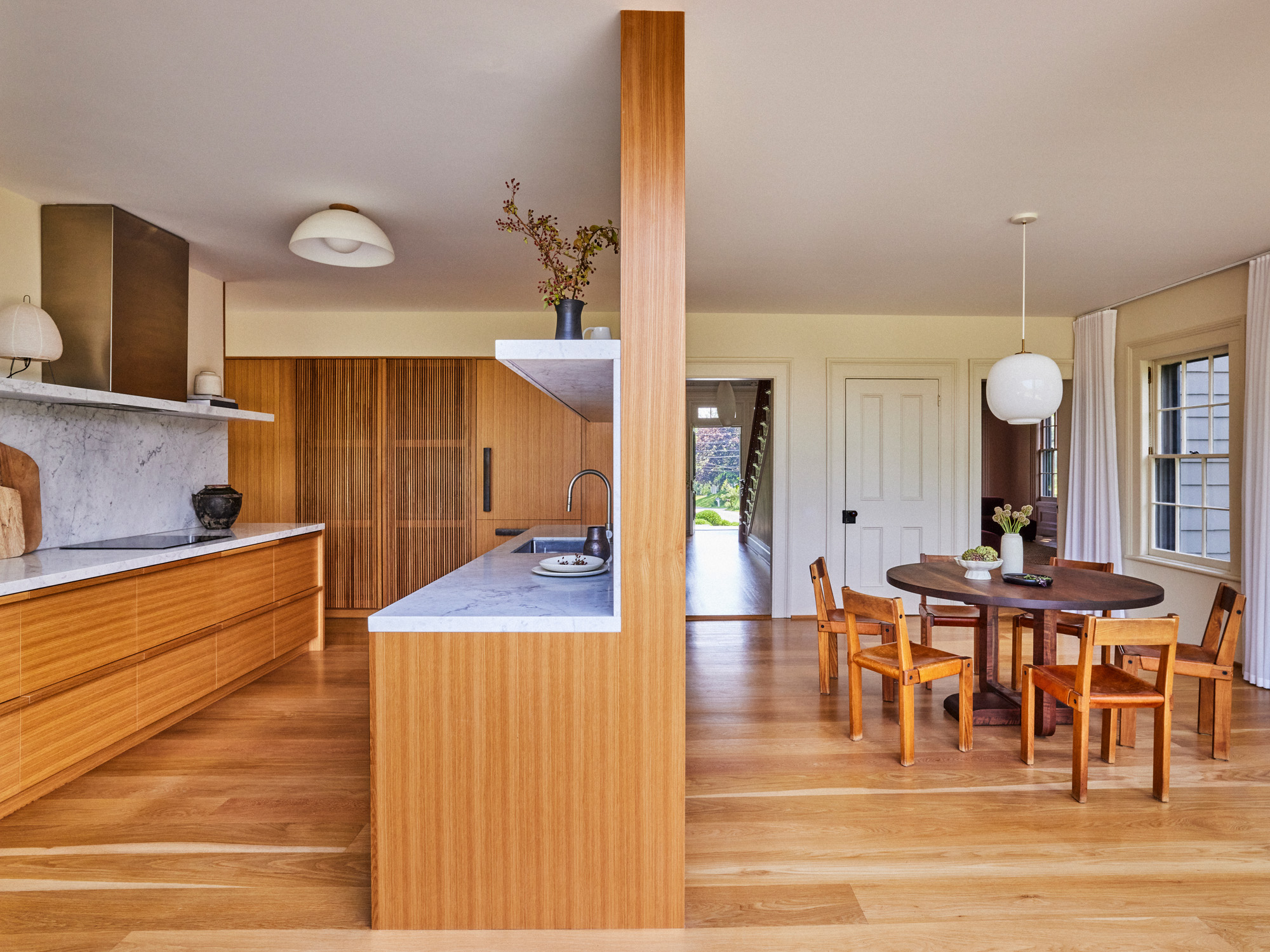
White oak cabinetry and restrained detailing allow the redesigned kitchen and dining area to recede behind expansive views of the
surrounding landscape.
Victorian Naturalist
Lang’s restoration team also tackled the street-facing front parlor, which features a decorative fireplace, the original plaster crown molding, cornices, ceiling medallions, and hardwood floors. To add sightlines and connect the historic front half of the home with the redesigned rear, Lang nudged open the central entry hallway. “The view extends the length of the building to the landscape beyond,” says Lang. “There is that threshold, where you’re crossing back and forth from one part to the next, but the floor level is the same floor level. However, the kitchen and dining room are spatially distinct, with a different ceiling height and no molding expression whatsoever.”
Upstairs, the home’s five bedrooms and three baths entailed additional minor restoration work. Lang and his team took the opportunity to add some modern touches without compromising the architecture’s integrity. “In the primary suite, which sits within the original footprint of the house, we kept the bedroom in its pure form,” he explains. “But we updated the closets and added a primary bathroom that is entirely modern and new.”
In Praise of Idleness
The recreation of the home’s secondary side-entry added a third vernacular to the home’s redesign—one that ties the home’s distinct 19th-century history to its 21st-century celebration of the land. “In order to accommodate the entrance, we needed to make more space,” says Lang. “In the process of creating more space, we pushed out from the house’s volume, creating an opportunity to develop a different visual language.”
Wrapped in sho sugi ban siding—a process that chars wood near black to naturally preserve it—the new entryway and mudroom transition the home’s distinct Victorian dark gray exterior to the simple back deck—still crisscrossed with the shade of the tamarack’s twisted branches.
Lang’s reconception of the home’s rear and back yard has only compounded Barnett’s captivation with the house. “I cannot stop looking north through those huge sliding glass doors—I waste hours of my life that way—There’s always a hawk flying by or a bank of clouds moving eastward or an approaching storm,” she says. “And dusk is still magical when the sun comes to dance in the front room.”