
Inside the Dickerman Residence, a Low-Slung Sullivan County Home by Richard Pedranti
Designed by architect Richard Pedranti, the Dickerman Residence in Sullivan County uses a simple shed form, natural materials, and high-performance strategies to create a home that settles easily into its wooded site.
By Brian K. Mahoney | Spring 2026 | Features | House Feature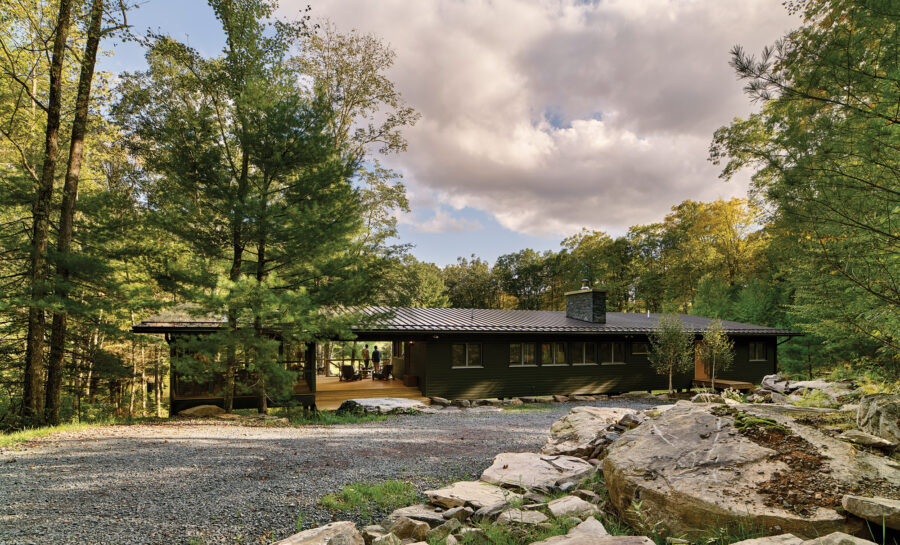
When architect Richard Pedranti talks about the Dickerman Residence, a modernist home built in Narrowsburg in 2015, he returns again and again to a deceptively simple idea: don’t mess it up. Pedranti is talking about the landscape, of course—a sloping, wooded site in Sullivan County, threaded with boulders, meadow, a seasonal stream, and a lake just downhill—but he might just as well be talking about the architecture itself.
The Dickerman house is a study in restraint: a long, low structure gathered beneath a single shed roof, quietly settled into the land. It’s the kind of building that looks inevitable once it’s there, which is another way of saying that a great deal of thinking went into making it feel effortless.
The clients, Colin and Peter, were living in Lower Manhattan when they first approached Pedranti. A writer and a designer, respectively, they were looking for a weekend escape—somewhere restorative, somewhere green. Like so many of those stories, the pandemic turned that weekend house into a full-time residence. But the original impulse never really changed: They wanted a place where nature did most of the talking, and the house knew when to keep quiet.
A Path, Not a Driveway
Before there was a house, there was the land—and getting to it was no small matter. The property, roughly five acres, required a new access road, threaded through mature trees, boulders, and slopes. Pedranti brought in landscape architect and retired forester Ed Brannon, who worked closely with the clients to walk the site repeatedly, identifying what should be avoided as much as what should be highlighted.
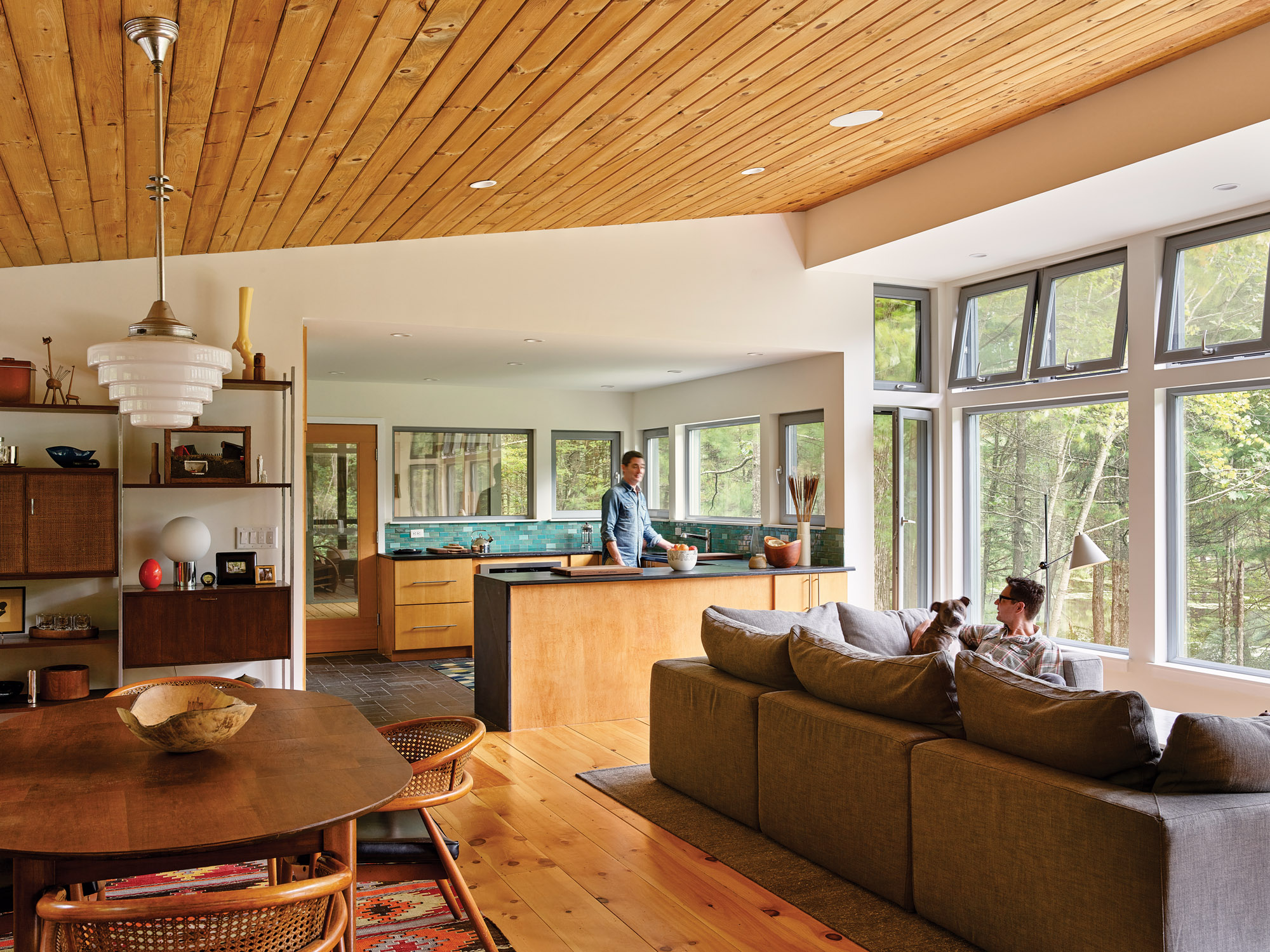
In the open living and kitchen area, a Douglas fir ceiling and grouped corner windows pull the surrounding forest deep into the interior, while the long, linear plan keeps public spaces fluid and social, with the most private rooms tucked further down the house. Photo: Jeffrey Totaro
The result is a winding driveway that respects the topography and preserves key features. That sinuous design doesn’t stop at the house, either. It continues past it, down a footpath through a wildflower meadow toward the lake, turning the building itself into a kind of pause along the way rather than a terminus.
That idea—architecture as something you move through, not just arrive at—became a central organizing principle of the project.
Everything Under One Roof
Early on, Pedranti and the clients landed on a strong, clarifying gesture: everything under one roof. One simple shed form would contain all the programmatic needs—living, working, hosting, retreating—without fragmenting the site into multiple structures.
The house is zoned linearly. Public spaces cluster near the entry, while private rooms are tucked at the far end, culminating in the primary bedroom. It’s a classic architectural move, but one that works particularly well here, allowing the house to feel both open and discreet at the same time.
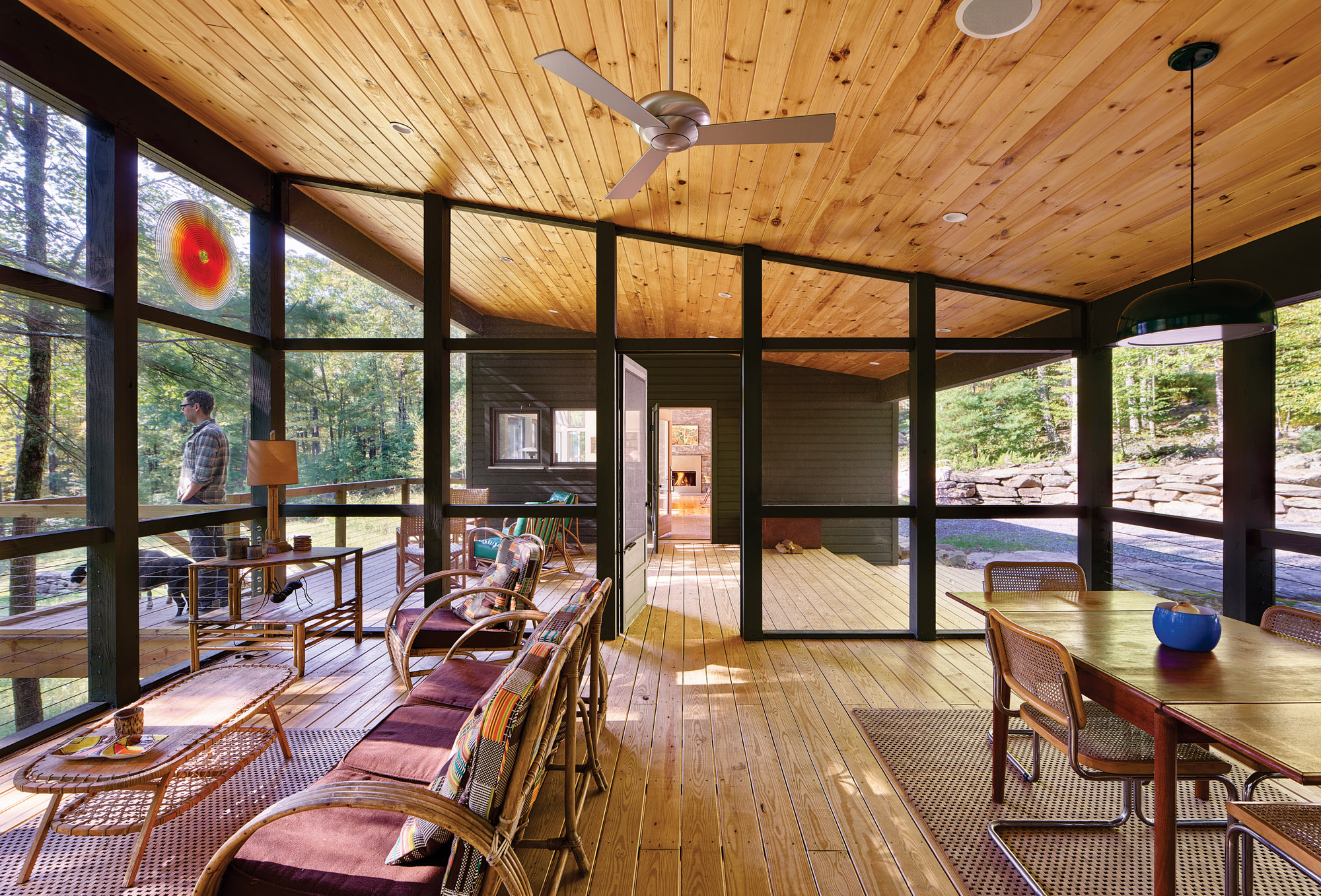
The screened porch—furnished like an interior living room and anchored by a midcentury enameled fireplace—acts as a true threshold space, where glass walls, wood ceilings, and a seasonal stream beneath the floor blur the line between indoors and out. Photo: Jeffrey Totaro
That entry is marked by a boulder—one of the site’s defining features—which the house literally overlaps. The builder, sympathetic to Pedranti’s light-touch approach, carefully framed the structure around it. The rock becomes a stoop, a threshold, a reminder that the house arrived after the landscape and intends to behave accordingly.
Inside, Looking Out
Step inside, and the house opens toward its most compelling asset: the lake. In the main living space, Pedranti subtly pushes the geometry outward, creating corner windows that wrap the view into the room. The effect is panoramic without being theatrical, immersive without demanding attention.
Materials throughout are drawn directly from the site’s visual vocabulary. Stone, Douglas fir, and wood surfaces dominate, complemented by an exterior clad in a muted green-gray that blends easily into the surrounding forest.
There are moments of personality, too. The kitchen backsplash features a custom-made, hand-crafted tile in a specific blue-green color that Colin brought to one of the earliest meetings as a physical swatch. It’s a small detail, but emblematic of the way this house balances discipline with personal expression.
The Room Everyone Loves
Ask Pedranti his favorite space in the house, and he doesn’t hesitate: the screened-in porch. It’s an outdoor room that behaves like an interior one, furnished accordingly and anchored by a midcentury California enameled fireplace the clients carried with them from the beginning of the project. Beneath the porch, a seasonal stream runs quietly, sometimes audible, sometimes not. In wetter months, the sound becomes part of the room’s atmosphere; in drier seasons, it’s a memory embedded in the place.
This space captures much of what the Dickerman house does best. It blurs boundaries without erasing them. It privileges comfort without closing itself off from weather or time. It feels casual, but nothing about it is accidental.
Performance Without Penance
Despite its relaxed demeanor, the Dickerman Residence is a high-performing building. With a HERS rating of 38 and a suite of Passive House-inspired strategies, it’s airtight, deeply insulated, and thoughtfully oriented for solar gain. Triple-pane, European-style windows; meticulous attention to air sealing; and a heat recovery ventilator all work together to create a house that’s efficient without feeling hermetically sealed.
Pedranti is pragmatic about certification. Passive House certification adds cost—$15,000 to $20,000—and not every client wants or needs it. What matters more, he argues, is spending the budget intelligently and building as well as possible within it. In this case, the clients were already environmentally minded, drawn to the region precisely because of its ecological richness. Sustainability was part of the brief from day one.
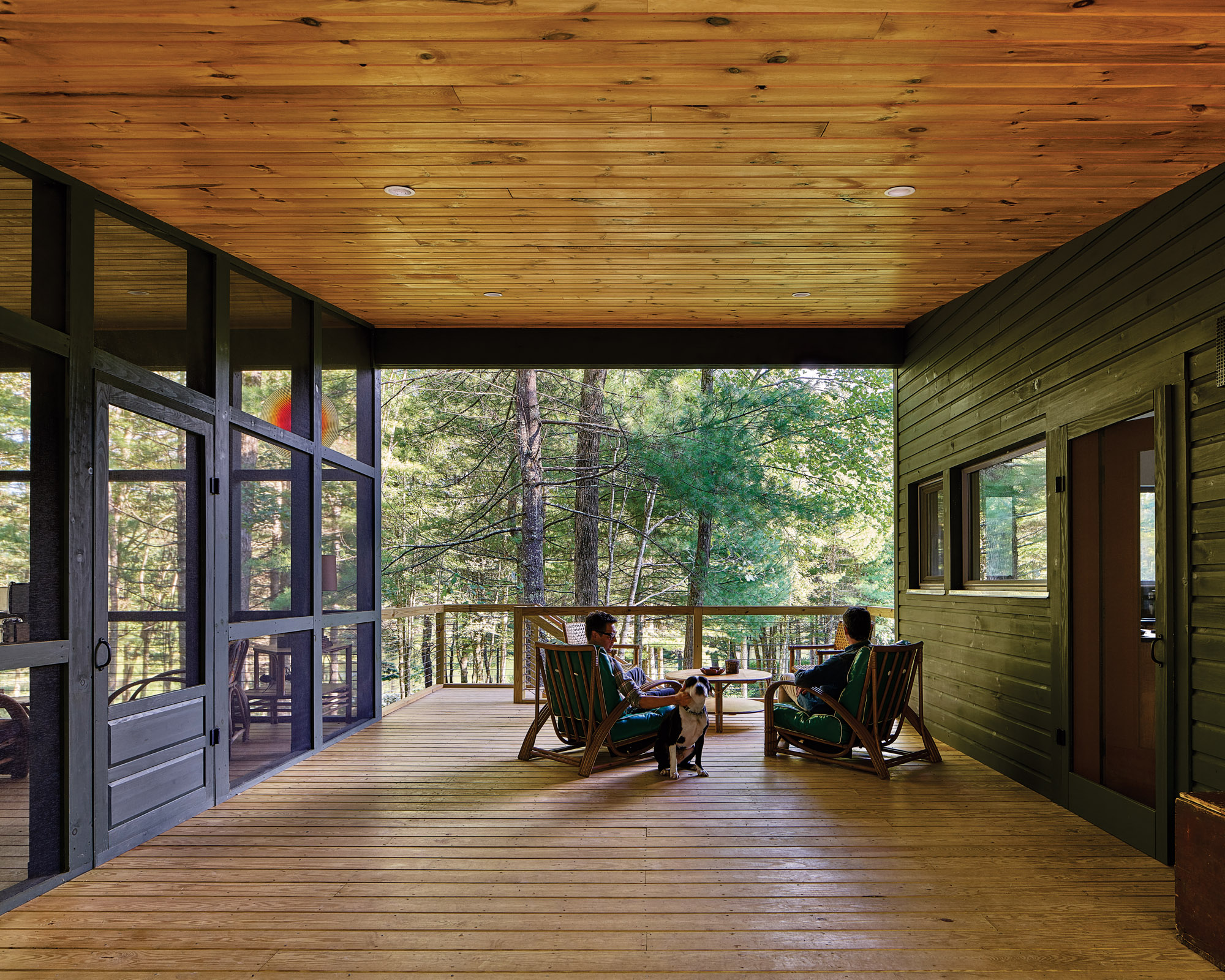
Looking out toward the lake, the screened porch becomes an everyday living space—part deck, part room—where the architecture frames the forest and encourages lingering, whether for conversation, reading, or simply watching the light shift through the trees. Photo by Jeffrey Totaro
Even the fireplace—a feature often viewed skeptically in high-performance circles—was rethought rather than eliminated. The unit here uses sealed combustion, with a glass door that can be raised for the experience of an open fire without sacrificing efficiency. It’s a reminder that comfort and conscience don’t have to be at odds.
Seasonal Thinking
It’s easy to imagine the Dickerman house in summer: doors open, meadow in bloom, lake shimmering below. But Pedranti is clear-eyed about country winters, too. The house is designed to be inhabited year-round, with spaces that feel protective rather than isolating when the landscape quiets down.
A cedar hot tub nestles beside another large boulder, forming an outdoor spa-like enclave that gets used even in the cold months. And a future pool house—sited uphill, with views over the main roofline toward the lake—will function as a glassy winter retreat as much as a summer cabana.
A Model Worth Repeating
Pedranti says he’s been asked repeatedly to “build one of those” since completing the Dickerman Residence. In fact, he already has—on another property in Livingston Manor. The house’s appeal lies in its clarity: an uncomplicated form, carefully placed, adaptable without being generic.
That simplicity, of course, is earned. It comes from understanding when to intervene and when to step back; from seeing architecture as something that participates in a landscape rather than competes with it.
In the end, the Dickerman Residence feels deeply of its place—not because it shouts regional references, but because it understands the region’s rhythms. The shed roof nods to agricultural forms. The materials age quietly. The house doesn’t try to improve the land so much as keep up with it.
Which, as it turns out, is no small architectural accomplishment.