
Dopamine Decor: The Feel-Good Home Trend
By Melissa Esposito | Winter 2024/2025 | Design Feature
Designer Jennifer Salvemini made a mood-boosting renovation on this c.1875 Sharon Springs kitchen for the HGTV show “Who’s Afraid of a Cheap Old House?” The redesign incorporated the original sink and built-in. Photo by Stephanie Munguia
For more than a decade, neutral modern-farmhouse decor has claimed the covers of design magazines and spread throughout the country. And while there’s no expiration to the idea that home should be a soothing sanctuary with a pleasing, catalog-worthy aesthetic, the scales are tilting in a vibrant direction, focused on uplifting decor that elicits joy. Sure, the two concepts can intersect, but the latter is an intentional form of emotive design; a growing trend that has recently been referred to as “dopamine decor.”
The trend is centered around how one’s home can be designed in a way that elicits a rush of dopamine—that naturally occurring hormone associated with pleasure and reward. This treatment can be as simple as displaying heirloom china in a hutch associated with positive family memories, or as luxurious as a whimsical reading room for bookworms. For some, that dopamine release can be sparked by colorful wallpaper in hues associated with a nostalgic place and time—rich beachy blues, woodsy autumnal tones, retro orange, and the like.
Mood-Boosting Rooms
“To me, it seems like the phrasing ‘dopamine decor’ is piggybacking on the trend of how psychology has permeated popular culture, with topics like ‘dopamine,’ ‘trauma responses,’ and ‘bio-optimization’ becoming mainstream,” says Jennifer Salvemini, owner of interior design service JLS Lifestyle Consulting in Shokan. “Also, maybe because we’re in a time when people are looking to return home to a space that isn’t just relaxing, but actually boosts your mood—because it’s hard out there, and a space that sparks happiness and joy is worth doing with more intention.”
For some, that means decking their home with vibrant, happy hues and bold patterns. “The modern-farmhouse look saturated the design world for a hot minute, and it seems like the interest in bold color is indicative of the pendulum swinging in the opposite direction,” Salvemini says. “With this trend, people aren’t just redoing cute little powder rooms, but larger spaces or entire homes.”
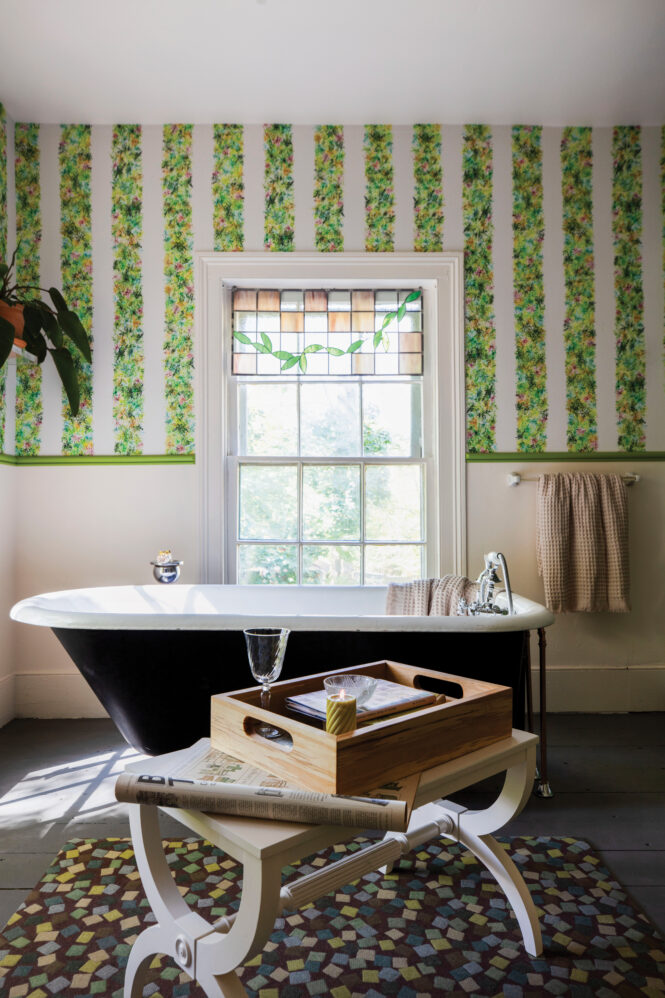
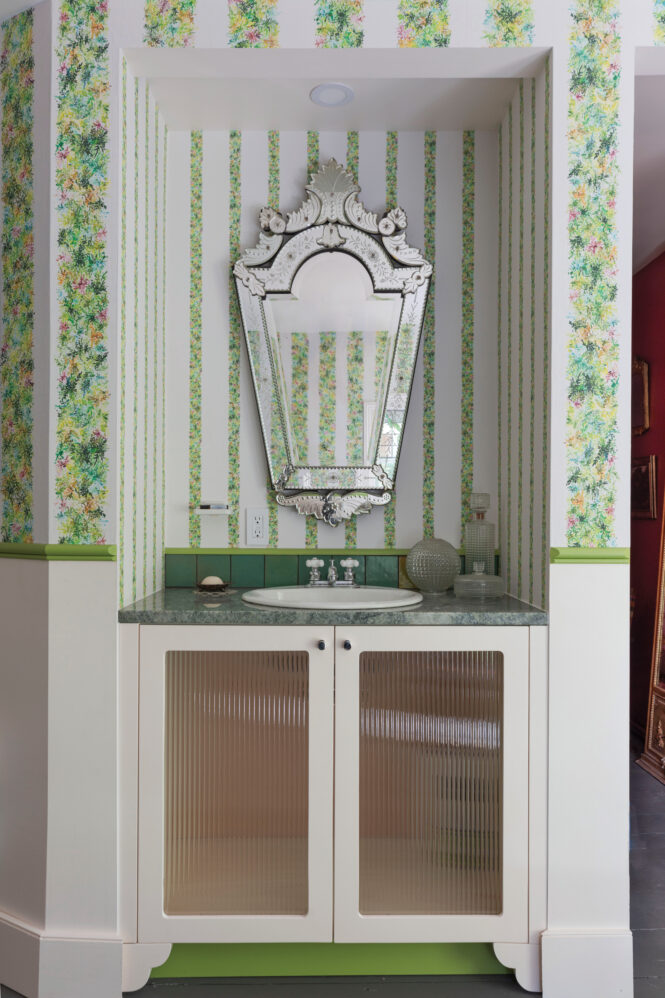
Jennifer Salvemini for Studio Hinterland’s bathroom design for the 2024 Kingston Design Showhouse in Stone Ridge.
Photo by Phil Mansfield
 She describes a client project for which a couple wanted their house to feel like a celebration, and decided on a running theme of sherbet colors. For example, lemon sorbet cabinetry was brought into the kitchen, with a backsplash of terrazzo tiles in pink, orange, and green, and orangey tones were used throughout the home. “It just felt so happy and joyful,” she says. “It’s really about personal taste, because you could get that dopamine hit from something that might not hit for someone else. And on the other hand, you might find colors that you’re really drawn to, but maybe because one feels soothing and another feels romantic. But if the intention is joy, what colors are eliciting joy? And can you go a few shades brighter to push your boundary?”
Nothing Is Off Limits
Designer Kate Cummings, owner of Freestyle Restyle in Kingston, offers the advice of treating color exploration in design the same way you would in fashion. “When clients have trouble expressing their likes, I tell them to go into their closet, find their favorite things, and take note of colors, patterns, and textures,” Cummings explains. “For example, if you like aubergine purple, perhaps that would bring joy to your dining room or den. I think that with the idea of dopamine decor, people are looking for joy, especially through color because that expresses their personality. There’s always a place for a soothing space, but this trend is more about happiness—nothing too serious, and almost no rules.”
That includes the “rule” that one should consider resale value before making any striking changes to home design. While it’s not quite maximalism—which refers more to the brink-of-overstimulation layering of colors, patterns, and textures for show-stopping wow-factor—this design trend encourages a hyper-personalization of sorts that many have shied away from in recent years, typically sticking to standard grays, creams, and whites for neutrality.
“I understand the whole resale conversation, but I try to talk clients into making it theirs—you should enjoy your home now! The resale-value look is very safe and achievable without bringing in a designer, and if you’re bringing in a pro, have them help you express who you are,” Cummings says. “There’s a way to incorporate whatever makes you happy, from entire color-saturated rooms to small touches like framed concert posters. Whatever. Go for it. Nothing is off limits.”
Pushing Past Preconceptions
“Some people are very scared of bold color,” agrees Ana Claudia, of Ana Claudia Designs in Rhinebeck. “Maybe this trend is a way to push people past their preconceived notions to see that it’s not scary, but kind of fun. And in the end, it’s all about how you feel when you walk through the door.”
Claudia suggests that the dopamine trend isn’t just about color, but also about the emotion behind fond memories and the thrill of new experiences. For instance, she notes a project for a couple who had a very family-friendly 1990s Colonial and a fondness for neutrals, but were open to creating a formal dining room that made a statement. “The idea was that although they likely wouldn’t entertain often, they would have this unique space for when they wanted to travel within their own home,” she explains. “We went with a wallpaper in green jewel tones, an oval marble table, and velvet chairs in different tones of rust, green, and dark gray. It’s still very classic, but fun, and leaned away from the more functional design that they’d been used to, making it feel like a very special room.”
Functional design can still be incorporated into dopamine decor, but Claudia suggests thinking about how to take one element and find what about it evokes those positive feelings. A pool table, for instance, might bring joy on game nights or other sporadic occasions. Or, perhaps it’s not the table itself, but that speakeasy vibe—and now you have an idea for your informal living room.
“I think dopamine decor can be about creating that conceptual space,” she says. “If going on holiday makes you happy, what can we do to bring that feeling back home? Start with a story, an experience, a memory—if you’re traveling and inspired by art, contact that artist. If you loved these pillows at a boutique in Miami, buy them from Miami. These pieces will be attached to a memory. That’s what dopamine decor is really about: connection to positive emotion so that your home helps you feel good.”